
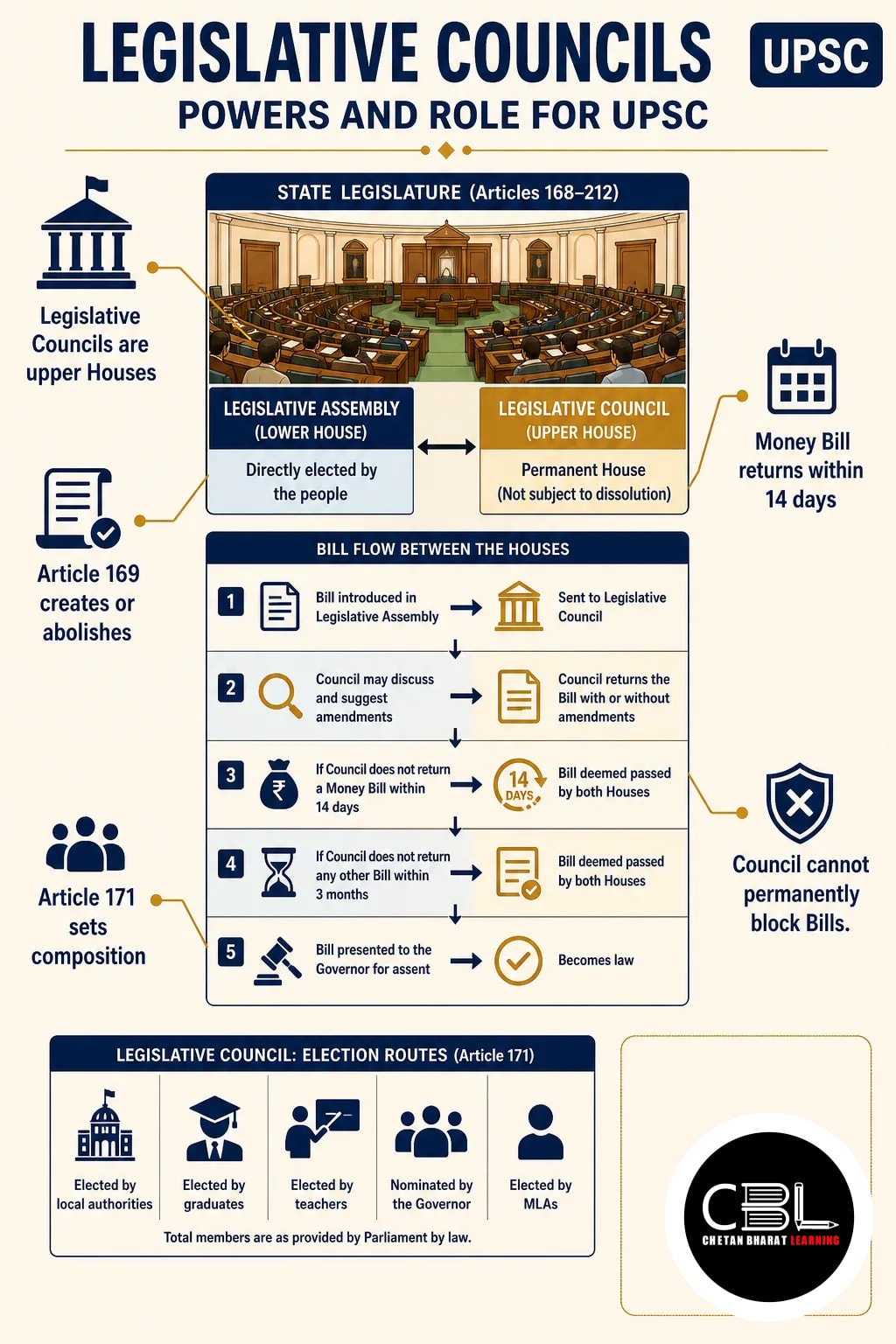

Legislative Councils returned to public attention after elections to 28 seats across four states. The results also renewed interest in how state upper Houses work. For related coverage, explore polity current affairs.
Quick answer: Legislative Councils are the upper Houses of bicameral state legislatures. Elections to 28 Council seats in Uttar Pradesh, Bihar, Maharashtra and Karnataka in late October 2026 drew attention to their role. Councils can review legislation, but the directly elected Assembly has the decisive role in lawmaking and government accountability.
What brought state Councils into the news?
Elections to 28 Council seats across Uttar Pradesh, Bihar, Maharashtra and Karnataka prompted discussion of their constitutional role. In Karnataka, the source records that Bharatiya Janata Party leaders celebrated four seat victories in Hubballi on 28 October.
Unlike Assembly elections, Council polls use distinct electorates for different categories of seats. For more context, see CBL’s explainers on paper ballots in Council elections and preference voting in the Bihar Council poll.
How are Legislative Councils created?
Parliament may create or abolish a Council by law after the concerned Assembly passes the required resolution under Article 169. The resolution needs a majority of the Assembly’s total membership and a two-thirds majority of members present and voting.
Therefore, neither Parliament acting alone under Article 169 nor an Assembly resolution alone completes the process. Such a law is not treated as a constitutional amendment for the purposes of Article 368, even though it may amend the Constitution as necessary.
In a bicameral state, the Governor and the two Houses form the legislature under Article 168. A Council is a continuing chamber: it is not dissolved, and approximately one-third of its members retire every second year.
How are Council members chosen?
Article 171 combines indirect elections from specified electorates with nominations by the Governor. The constitutional proportions below apply as nearly as possible.
| Share | Electorate or method |
|---|---|
| One-third | Elected by members of municipalities, district boards and other local authorities specified by Parliament. |
| One-twelfth | Elected by eligible graduates of at least three years’ standing. |
| One-twelfth | Elected by eligible teachers with at least three years’ experience in specified institutions at secondary level or above. |
| One-third | Elected by Assembly members from persons who are not Assembly members. |
| Remainder | Nominated by the Governor from persons with special knowledge or practical experience in specified fields. |
The specified nomination fields are literature, science, art, the cooperative movement and social service. Moreover, elected members use proportional representation through the single transferable vote, with voting by secret ballot.
A Council normally cannot exceed one-third of the Assembly’s strength or have fewer than 40 members. However, the minimum is subject to a different provision made by Parliament by law.
Which constitutional provisions govern their powers?
The Constitution gives the Assembly the final word over ordinary legislation and a stronger position on financial matters.
| Article | What it provides |
|---|---|
| Article 164 | The Council of Ministers is collectively responsible to the Legislative Assembly. |
| Article 169 | Parliament can create or abolish a Council after the prescribed Assembly resolution. |
| Article 171 | It sets the Council’s size limits and broad composition. |
| Article 196 | An ordinary Bill may originate in either House, subject to constitutional provisions. |
| Article 197 | It limits the Council’s power to delay an ordinary Bill passed by the Assembly. |
| Articles 198 and 199 | They set the Money Bill procedure and define a Money Bill. |
Ordinary Bills and Money Bills
For an Assembly-passed ordinary Bill, the Council can initially hold up passage for up to three months. If the Assembly passes it again and sends it back, the Council has a further month; thereafter, the Bill is deemed passed in the form passed by the Assembly, subject to the constitutional conditions.
A Money Bill can originate only in the Assembly. The Council may recommend changes, but it must return the Bill within 14 days; the Assembly may accept or reject its recommendations. If the Council does not return it in time, the Bill is deemed passed by both Houses.
Thus, the Council can scrutinise and recommend, but it cannot permanently block an Assembly-passed Bill through these procedures. There is no joint sitting of the state Houses to resolve such a disagreement.
What are the arguments for and against Councils?
The central debate is whether an additional reviewing chamber improves legislation enough to justify its costs and limited democratic mandate.
- Legislative review: A second chamber can identify drafting problems and examine consequences before a Bill proceeds.
- Continuity and expertise: Its continuing membership and nominated members can support institutional memory and specialised debate.
- Representation: Local authorities, graduates and teachers have distinct electoral channels; however, these electorates do not represent all adult voters equally.
- Cost and duplication: An additional chamber requires public resources and may repeat rather than deepen Assembly scrutiny.
- Political use: Critics argue that Council seats can become a route into office for party nominees rather than a means of independent review.
- Limited authority: The Assembly’s overriding role preserves democratic primacy, but it also limits the Council’s ability to insist on changes.
How can Councils add value?
Councils can justify their reviewing role through consistent scrutiny, transparent nominations and informed public debate.
For example, committees could examine Bills in detail and publish reasoned findings before debate. In addition, clearer public criteria for nominations could help connect the constitutional expertise requirement with legislative work.
Members can also assess whether proposed laws are practical for local bodies and affected communities. Finally, states should evaluate the quality of scrutiny alongside expenditure, rather than judge a Council only by the number of Bills discussed.
The Second Administrative Reforms Commission also considered reforms relating to Councils. However, the available source notes do not specify its recommendations; the measures above are analytical suggestions, not an attributed list of Commission proposals.
Source: The Hindu Explained, 3 November 2026
- MLC Paper Ballots: Why Are They Used? | UPSC (31 Oct 2026)
- Bihar Council Poll: Preference Voting for UPSC (29 Oct 2026)
Asked in UPSC: Previous Year Questions
- UPSC CSE Mains 2021 (GS Paper II): Explain the constitutional provisions for establishing Legislative Councils. Review their working and current status with suitable illustrations.
UPSC connects constitutional provisions with institutional performance; therefore, prepare both facts and evaluation.
Punjab PCS and Haryana HCS General Studies can test Article 169, Council composition and the Assembly’s relative powers. In addition, compare unicameral and bicameral state legislatures when preparing state governance.
Prelims Practice Corner
Mains Practice Questions
Frequently Asked Questions
Which Article provides for creating a Legislative Council?
Article 169 provides the procedure. Parliament must pass a law after the concerned Assembly adopts the prescribed resolution.
Can a Legislative Council reject a Money Bill permanently?
No, because it can only make recommendations and must return the Bill within 14 days. The Assembly may accept or reject those recommendations.
Are Legislative Councils dissolved like Assemblies?
No, because a Council is a continuing chamber. Approximately one-third of its members retire every second year.
Who nominates members to a state Legislative Council?
The Governor nominates the remaining members after the elected categories. They must have special knowledge or practical experience in fields specified by Article 171.
Related Current Affairs
Preparing for UPSC, PCS or HCS?
Talk to a mentor at Chetan Bharat Learning, Chandigarh. Free guidance on choosing the right exam and building a study plan.
Chat on WhatsAppCall 97793 53345UPSC / IAS / PCS coaching in Chandigarh · Trusted by aspirants across Punjab & Haryana

 Ananya RanaIAS · AIR 60
 Aditya SharmaIAS · AIR 70
 Ria Kaur SethiIPS · AIR 89
 Aman AloonIRS · AIR 295
 Sumer Singh VirkIRS · AIR 335
 Shivani PanchalIAS

Leave a Reply
You must be logged in to post a comment.