
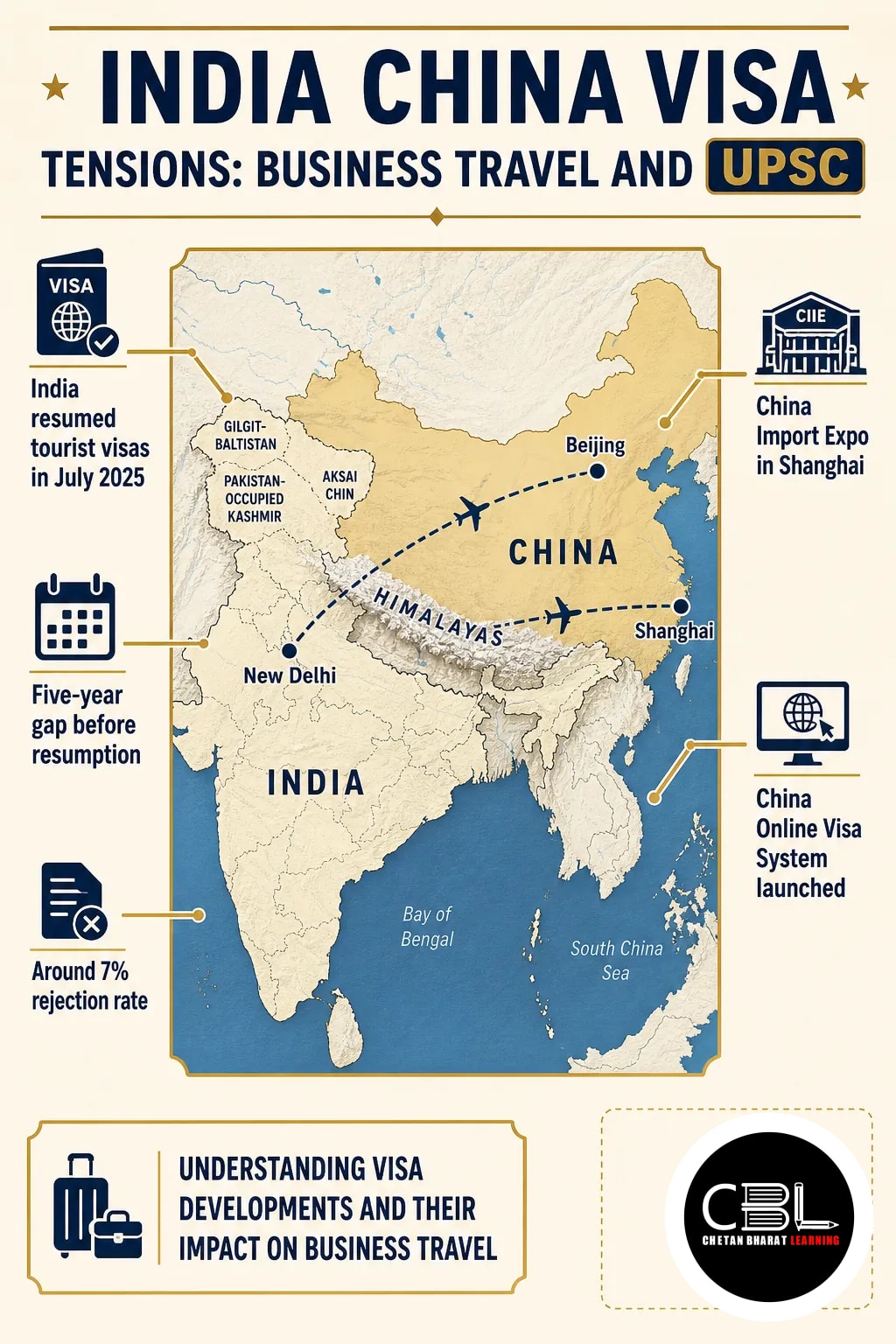

India China visa arrangements are under scrutiny after reports of reduced Chinese visa issuance to Indian nationals. China has said it is ready to work with India to facilitate business travel. The issue also connects mobility with the wider study of India’s international relations.
Quick answer: China has offered to work with India on India China visa arrangements for business personnel from both countries. The statement follows reports of reduced Chinese visa issuance to Indians. Meanwhile, Indian officials say India’s visa rejection rate for Chinese nationals has fallen to around 7% in recent months.
What happened to India China visa arrangements?
China expressed readiness to facilitate business visas with India amid reports of reduced issuance to Indian nationals. In a written response to the Press Trust of India, its Foreign Ministry said eligible foreigners receive visas under Chinese laws and regulations.
Reports also said fewer Indian businesspeople received visas for this month’s China Import Expo in Shanghai. The annual fair brings businesses together to showcase their offerings to Chinese consumers. However, the source does not give a number for the reported reduction.
China has stopped the China Visa Application Centre service provider from accepting applications. Its diplomatic missions have instead begun handling them directly. Meanwhile, the Chinese Embassy had introduced the China Online Visa Application System for Indian applicants in December 2025.
What are the key developments?
The recent visa issue follows steps by both countries to restore travel links after a prolonged strain in relations.
| Period or measure | Development |
|---|---|
| 2020 | The Galwan Valley clashes severely strained bilateral ties. |
| July 2025 | India resumed tourist visas for Chinese nationals after a five-year gap. |
| December 2025 | The Chinese Embassy launched an online visa application system for Indians. |
| Recent months | Indian officials put India’s rejection rate for Chinese nationals at around 7%. |
| Direct flights | The countries launched direct services between several cities, including Beijing and New Delhi. |
The 7% figure concerns Indian decisions on Chinese applicants; it is not China’s rejection rate for Indians. Moreover, the source provides no corresponding Chinese rejection rate.
Why does business mobility matter for India?
Predictable business travel can support commercial contacts while India and China manage wider diplomatic differences.
- Trade engagement: In-person visits enable firms to meet potential partners and participate in trade fairs. Visa uncertainty can therefore complicate travel planning.
- Connectivity: Direct flights and visa access address different parts of mobility. A flight connection alone does not ensure that a traveller can obtain a visa.
- Diplomatic signalling: Visa facilitation can demonstrate willingness to maintain contact. However, it does not by itself resolve border differences.
- People-to-people ties: Tourism and business travel create opportunities for direct interaction. Consequently, administrative access matters alongside high-level dialogue.
The wider security context remains important: see CBL’s coverage of India-China border talks. The two governments must consider mobility and border management as distinct but connected aspects of the relationship.
What are the main concerns?
The immediate concern is whether business applicants can access a predictable and transparent process.
- Incomplete information: Reports describe reduced Chinese issuance, but the source gives no overall count or rejection rate. Therefore, the scale cannot be quantified from these facts.
- Administrative transition: Direct handling by missions changes where applications are processed. However, the source does not specify its effect on processing times.
- Security and access: Both governments retain legitimate screening interests. At the same time, unclear procedures can make lawful business travel harder to plan.
- Uneven normalisation: The Galwan clashes show why broader trust matters. Consequently, progress on flights or visas should not be treated as proof that all bilateral concerns have been settled.
What should be the way forward?
India and China could combine clear application procedures with security screening and regular diplomatic communication.
- Publish clear guidance: Missions could explain application channels, eligibility documents and procedural changes. This would help applicants plan without assuming automatic approval.
- Improve communication: Both sides could discuss difficulties faced by business travellers through diplomatic channels. In addition, they could clarify how applicants should seek status updates.
- Monitor outcomes: Consistent information on applications and processing would help assess access. However, figures should distinguish tourist and business visas and identify the issuing country.
- Maintain parallel dialogue: Business mobility should proceed alongside engagement on security and border issues. Thus, cooperation in one area need not substitute for attention to another.
In September 2026, Prime Minister Narendra Modi and Chinese President Xi Jinping met in New Delhi on the sidelines of the BRICS summit. BRICS is the grouping named for Brazil, Russia, India, China and South Africa. For institutional context, read about the New Development Bank and BRICS finance.
Source: The Hindu, 24 November 2026
- New Development Bank: BRICS Finance and India (16 Sep 2026)
Punjab PCS and Haryana HCS may test this issue under international relations and India’s neighbourhood. For Mains, distinguish business mobility from border-security concerns and identify the country to which each visa statistic applies.
Prelims Practice Corner
Mains Practice Questions
Frequently Asked Questions
What has China said about business visas for Indians?
China has said it is ready to work with India to facilitate visas for business personnel from both sides. However, the statement followed reports of reduced Chinese visa issuance to Indian nationals.
What does the 7% visa rejection rate refer to?
It refers to India’s recent rejection rate for Chinese nationals, according to Indian officials. Therefore, it should not be presented as China’s rejection rate for Indians.
When did India resume tourist visas for Chinese nationals?
India resumed them in July 2025. The move followed a five-year gap and formed part of efforts to repair bilateral ties.
Related Current Affairs
Preparing for UPSC, PCS or HCS?
Talk to a mentor at Chetan Bharat Learning, Chandigarh. Free guidance on choosing the right exam and building a study plan.
Chat on WhatsAppCall 97793 53345UPSC / IAS / PCS coaching in Chandigarh · Trusted by aspirants across Punjab & Haryana






Leave a Reply
You must be logged in to post a comment.