
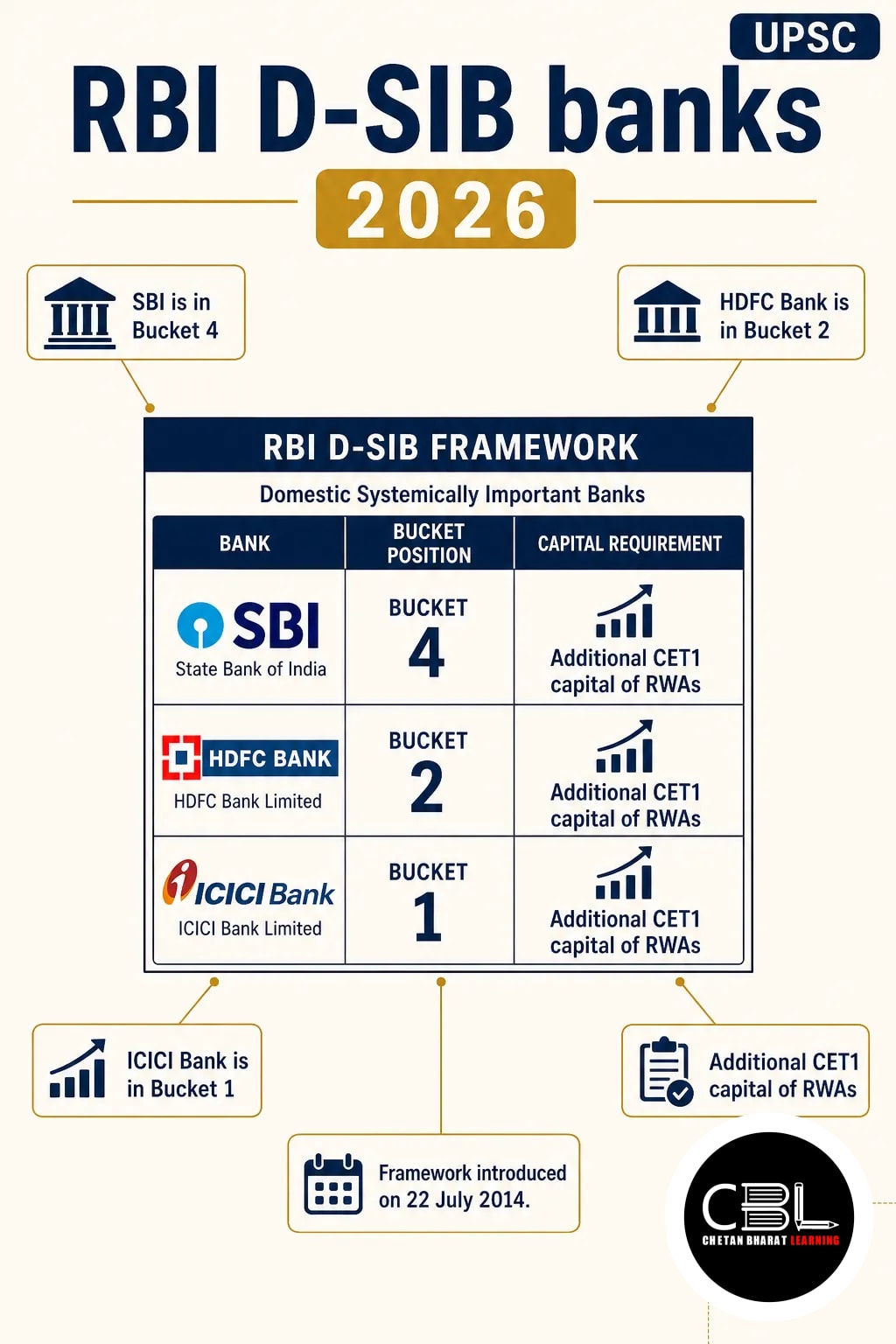
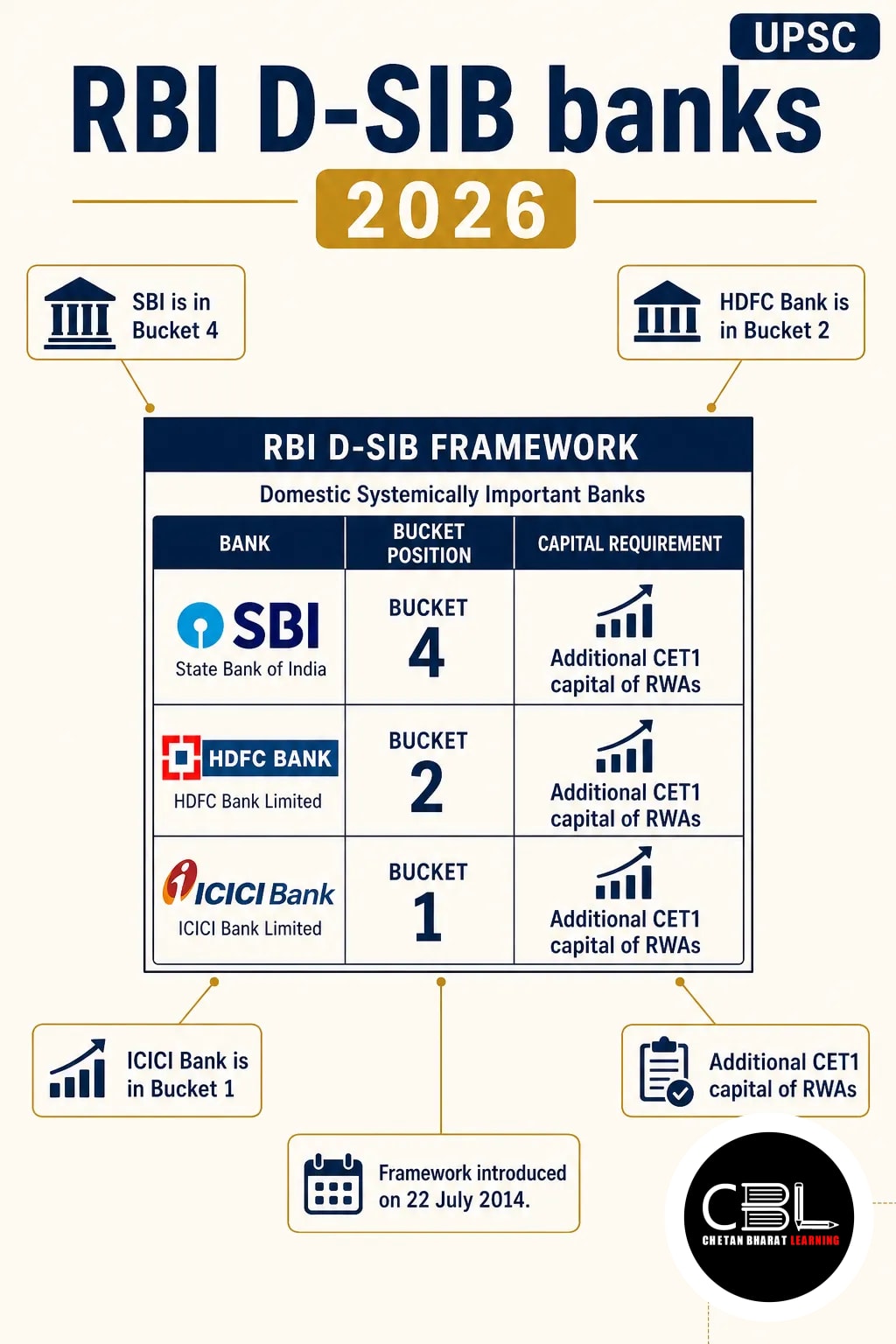
RBI D-SIB banks remain unchanged in the 2026 review, with State Bank of India (SBI), HDFC Bank and ICICI Bank retaining their positions. For related coverage, explore economy current affairs.
Quick answer: The Reserve Bank of India (RBI) retained three RBI D-SIB banks in its 2026 list: SBI, HDFC Bank and ICICI Bank. Their additional capital requirements are 0.80%, 0.40% and 0.20%, respectively, of risk-weighted assets. The requirements aim to strengthen resilience against financial shocks.
What are domestic systemically important banks?
Domestic Systemically Important Banks (D-SIBs) are banks whose distress can affect the wider financial system. Therefore, the RBI subjects them to additional capital requirements to improve their ability to absorb losses.
Under the framework, the central bank assigns banks to buckets based on their Systemic Importance Scores. A higher score attracts a higher additional capital requirement; thus, the bucket and percentage must be read together.
Which RBI D-SIB banks are on the 2026 list?
The 2026 list retains SBI, HDFC Bank and ICICI Bank in the same buckets as in 2025. The classification uses data collected from banks as of 31 March 2026.
| Bank | Bucket and additional capital |
|---|---|
| SBI | Bucket 4; 0.80% of risk-weighted assets |
| HDFC Bank | Bucket 2; 0.40% of risk-weighted assets |
| ICICI Bank | Bucket 1; 0.20% of risk-weighted assets |
These percentages refer to additional Common Equity Tier 1 (CET1) capital as a share of risk-weighted assets (RWAs). RWAs reflect the risk associated with a bank’s assets; CET1 is a core form of bank capital.
In addition, these requirements apply over and above the Capital Conservation Buffer. They are not percentages of deposits or total assets.
When did the RBI introduce the framework?
The RBI introduced its Framework for Dealing with D-SIBs on 22 July 2014 and updated it on 28 December 2023. The framework provides for annual public disclosure of designated banks, beginning in 2015.
| Year | First D-SIB designation |
|---|---|
| 2015 | SBI |
| 2016 | ICICI Bank |
| 2017 | HDFC Bank |
Why does the classification matter?
The classification aims to limit systemic risk by requiring important banks to hold extra loss-absorbing capital. Consequently, a bank’s individual resilience becomes part of the wider effort to protect financial stability.
For Prelims, distinguish the bucket from the capital percentage and remember that the latter uses RWAs as its base. Also, the 2026 review retains both the banks and their 2025 bucket positions.
Source: The Hindu, 24 November 2026
Punjab PCS and Haryana HCS General Studies may test the banks, buckets and additional capital percentages. Also revise the RBI’s role in banking regulation and financial stability.
Prelims Practice Corner
Mains Practice Questions
Frequently Asked Questions
Which banks are on the 2026 D-SIB list?
SBI, HDFC Bank and ICICI Bank are on the list. Moreover, all three retain their 2025 bucket positions.
What is SBI’s additional D-SIB capital requirement?
SBI must maintain additional CET1 capital of 0.80% of RWAs. It is in Bucket 4 and, in addition, must meet the Capital Conservation Buffer requirement.
When did the RBI introduce the D-SIB framework?
The RBI introduced it on 22 July 2014. Subsequently, it updated the framework on 28 December 2023.
Related Current Affairs
Preparing for UPSC, PCS or HCS?
Talk to a mentor at Chetan Bharat Learning, Chandigarh. Free guidance on choosing the right exam and building a study plan.
Chat on WhatsAppCall 97793 53345UPSC / IAS / PCS coaching in Chandigarh · Trusted by aspirants across Punjab & Haryana






Leave a Reply
You must be logged in to post a comment.