
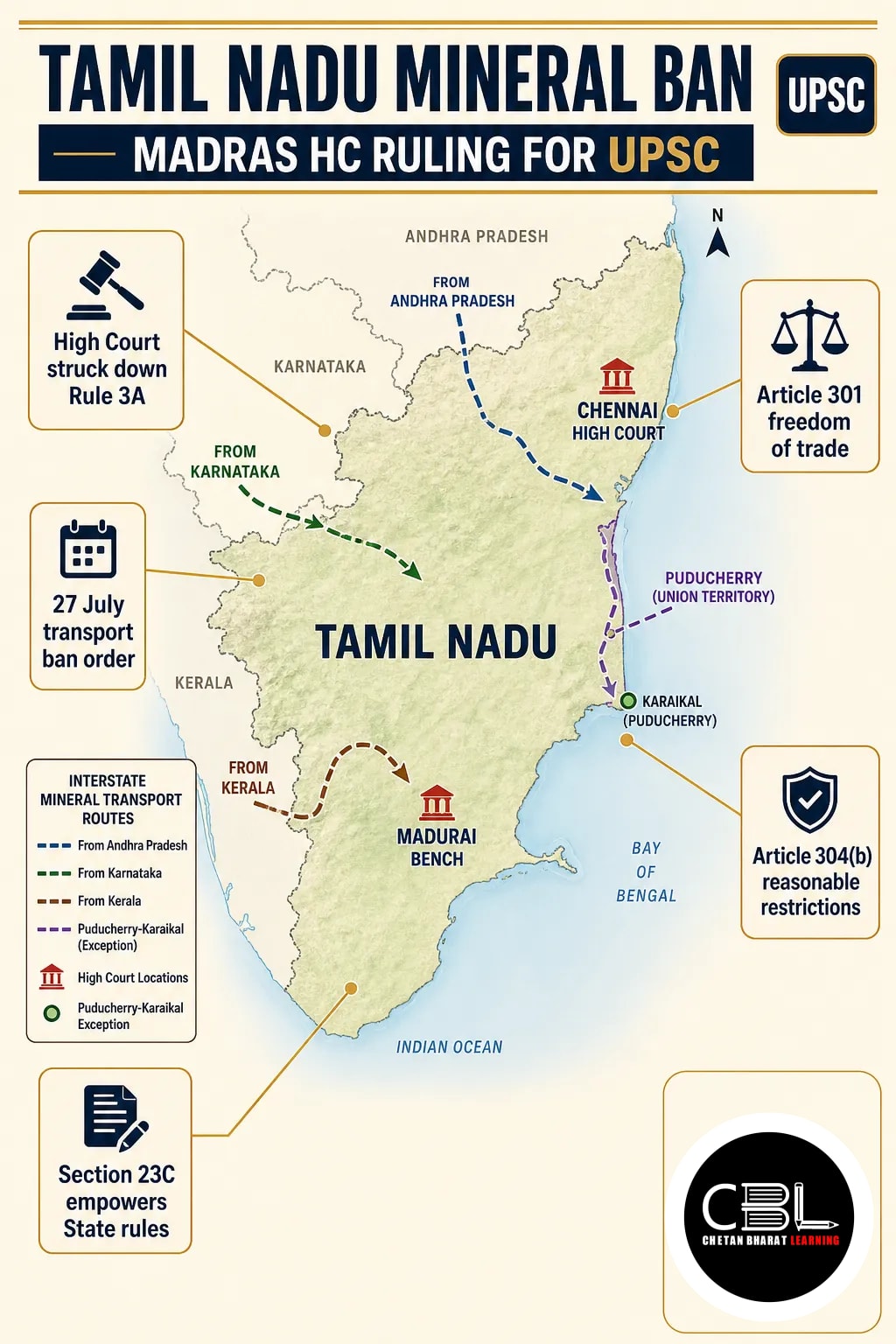
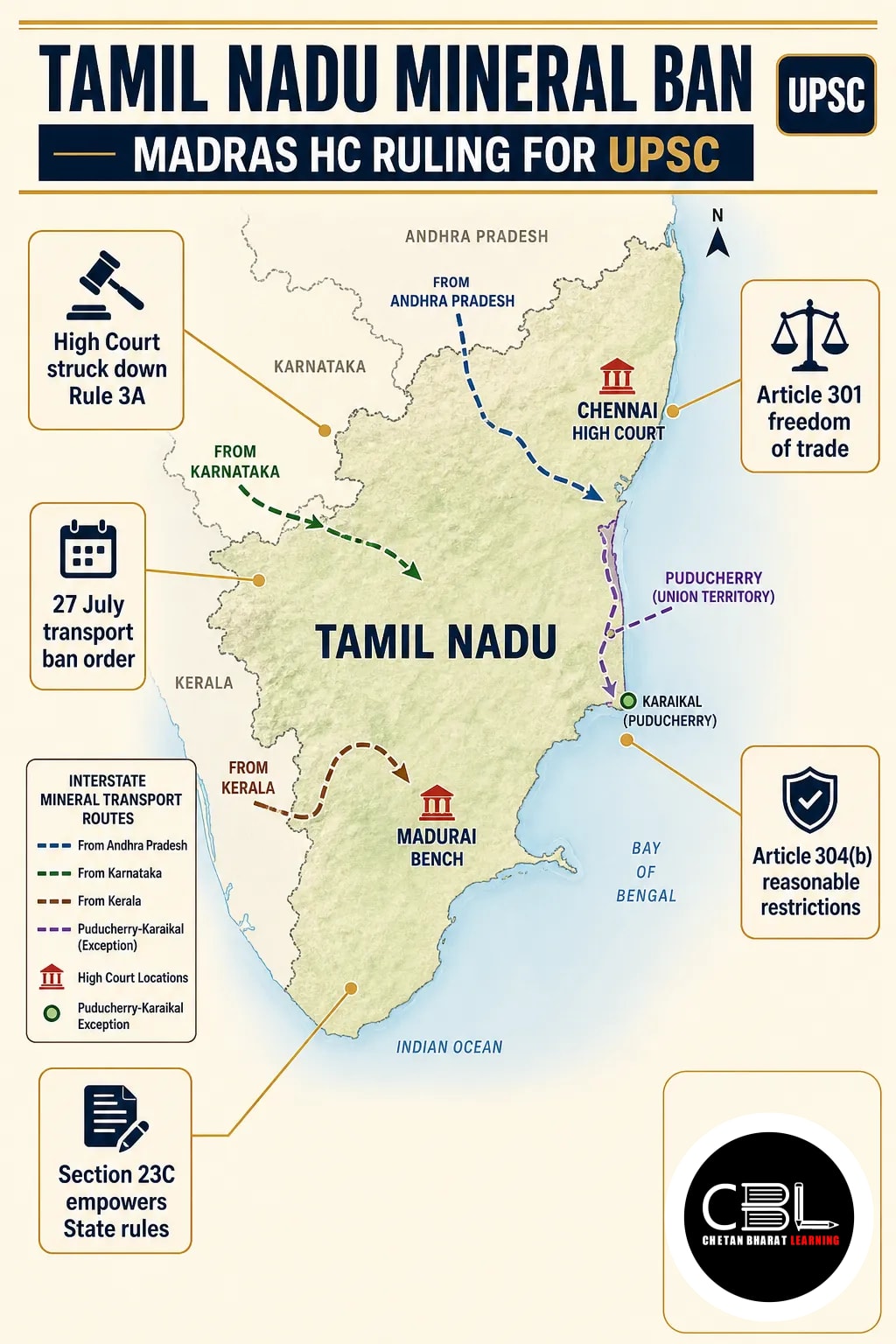
The Tamil Nadu mineral ban has been struck down by the Madras High Court, raising questions about interstate trade and state regulatory powers.
Quick answer: On 17 November 2026, the Madras High Court struck down Rule 3A, which allowed Tamil Nadu to temporarily ban mineral transport to other States. It also quashed a 27 July order restricting rough stones and aggregates. The rule sought to preserve local supply but exceeded constitutional and statutory limits.
What did the Madras High Court hold?
The court held Rule 3A unconstitutional and beyond the authority granted by the central mining law. Consequently, it quashed the Director of Geology and Mining’s temporary transport ban.
The First Division Bench comprised Chief Justice Sushrut Arvind Dharmadhikari and Justice G. Arul Murugan. It ruled on a batch of writ petitions filed at the principal seat in Chennai and the Madurai Bench.
Ultra vires means beyond legal authority. Here, the court found that the rule exceeded the Mines and Minerals (Development and Regulation) Act, 1957, under which the State framed it.
Background of the Tamil Nadu mineral ban
Tamil Nadu introduced Rule 3A to secure adequate supplies of stone materials within the State. The amendment formed part of the Tamil Nadu Prevention of Illegal Mining, Transportation and Storage of Minerals and Mineral Dealers Rules, 2011.
| Date | Event |
|---|---|
| 9 July 2026 | Amendment inserted Rule 3A. |
| 27 July 2026 | Director imposed a three-month transport ban. |
| 27 October 2026 | A further three-month extension began. |
| 17 November 2026 | High Court struck down the rule and quashed the order. |
Rule 3A covered rough stones, including khandas, boulders and crushed materials. It also listed manufactured sand, or M-sand, metal jelly, ballast, mill stones, hand chakais and construction stones.
The July order restricted rough stones and aggregates going to other States. However, it excepted Puducherry and the Karaikal region. Crusher and quarry owners’ associations and individual owners challenged the rule and the order.
Which constitutional and legal provisions matter?
Articles 301 and 304(b), together with Section 23C of the mining law, framed the petitioners’ challenge.
| Provision | Relevance |
|---|---|
| Article 301 | Provides for freedom of trade, commerce and intercourse throughout India, subject to Part XIII. |
| Article 304(b) | Allows a State legislature to impose reasonable restrictions in the public interest; its proviso requires prior presidential sanction for introducing the relevant Bill or amendment. |
| Section 23C(1), Mines and Minerals Act | Empowers States to make rules to prevent illegal mining, transportation and storage of minerals. |
Freedom under Article 301 is not absolute. However, Article 304(b) specifies a legislative route and conditions for public-interest restrictions. A rule made under an Act must also remain within the authority delegated by that Act.
The petitioners argued that Rule 3A breached Articles 301 and 304(b) and exceeded Section 23C(1). The source records the court’s conclusions, but does not reproduce its detailed reasoning on each provision. Therefore, the ruling should not be read as invalidating every form of mineral transport regulation.
What are the implications for federalism and trade?
The ruling highlights the tension between local resource availability and freedom of trade across State boundaries.
- Common market: Interstate movement matters because buyers and suppliers can operate across borders. The decision prevents reliance on the struck-down rule for this ban.
- Delegated power: State rules must serve purposes authorised by their parent legislation. Thus, a rule framed to prevent illegal activity cannot simply be assumed to authorise every supply-control measure.
- Local availability: Tamil Nadu sought adequate domestic supplies of construction materials. However, that objective must be pursued through a legally valid instrument.
- Lawful oversight: Preventing illegal mining remains a statutory objective. Therefore, the judgment should be distinguished from a general prohibition on checking unlawful mineral movement.
For a separate mineral-supply issue, see CBL’s coverage of critical minerals and Quad supply chains. That international issue concerns different minerals and should not be confused with this domestic transport dispute.
What concerns and policy choices remain?
The central policy challenge is to protect lawful trade while addressing genuine supply and enforcement concerns.
First, authorities need to distinguish documented mineral movement from illegal extraction or transport. Blanket border restrictions affect lawful operators too; therefore, targeted enforcement is a more precise policy question.
Second, any future restriction must have a sound statutory basis and satisfy applicable constitutional requirements. Policymakers should also assess whether a proposed measure is reasonable and necessary for its stated public-interest objective.
Finally, States can use consultation and better information on supply needs to anticipate cross-border pressures. Such coordination cannot replace legal authority, but it can help identify less restrictive responses.
Source: The Hindu, 17 November 2026
- Quad Critical Minerals and Supply Chains: UPSC (1 Nov 2026)
Punjab PCS and Haryana HCS may test Articles 301 and 304(b) alongside state rule-making powers. In addition, candidates should distinguish lawful mineral transport from illegal mining enforcement.
Prelims Practice Corner
Mains Practice Questions
Frequently Asked Questions
What did the court decide on the Tamil Nadu mineral ban?
It struck down Rule 3A and quashed the July transport ban order. The court held the rule unconstitutional and beyond the central mining Act.
Can States restrict interstate trade under Article 304(b)?
Yes, a State legislature can impose reasonable restrictions in the public interest. However, the provision requires prior presidential sanction before introduction of the relevant Bill or amendment.
Does the ruling end all regulation of mineral transport?
No, it struck down the particular rule and order challenged in this case. Section 23C also empowers States to frame rules against illegal mineral transport.
Which materials did Rule 3A cover?
It covered rough stones, boulders and crushed materials, among other products. In addition, it listed M-sand, metal jelly, ballast and construction stones.
Related Current Affairs
Preparing for UPSC, PCS or HCS?
Talk to a mentor at Chetan Bharat Learning, Chandigarh. Free guidance on choosing the right exam and building a study plan.
Chat on WhatsAppCall 97793 53345UPSC / IAS / PCS coaching in Chandigarh · Trusted by aspirants across Punjab & Haryana









Leave a Reply
You must be logged in to post a comment.