
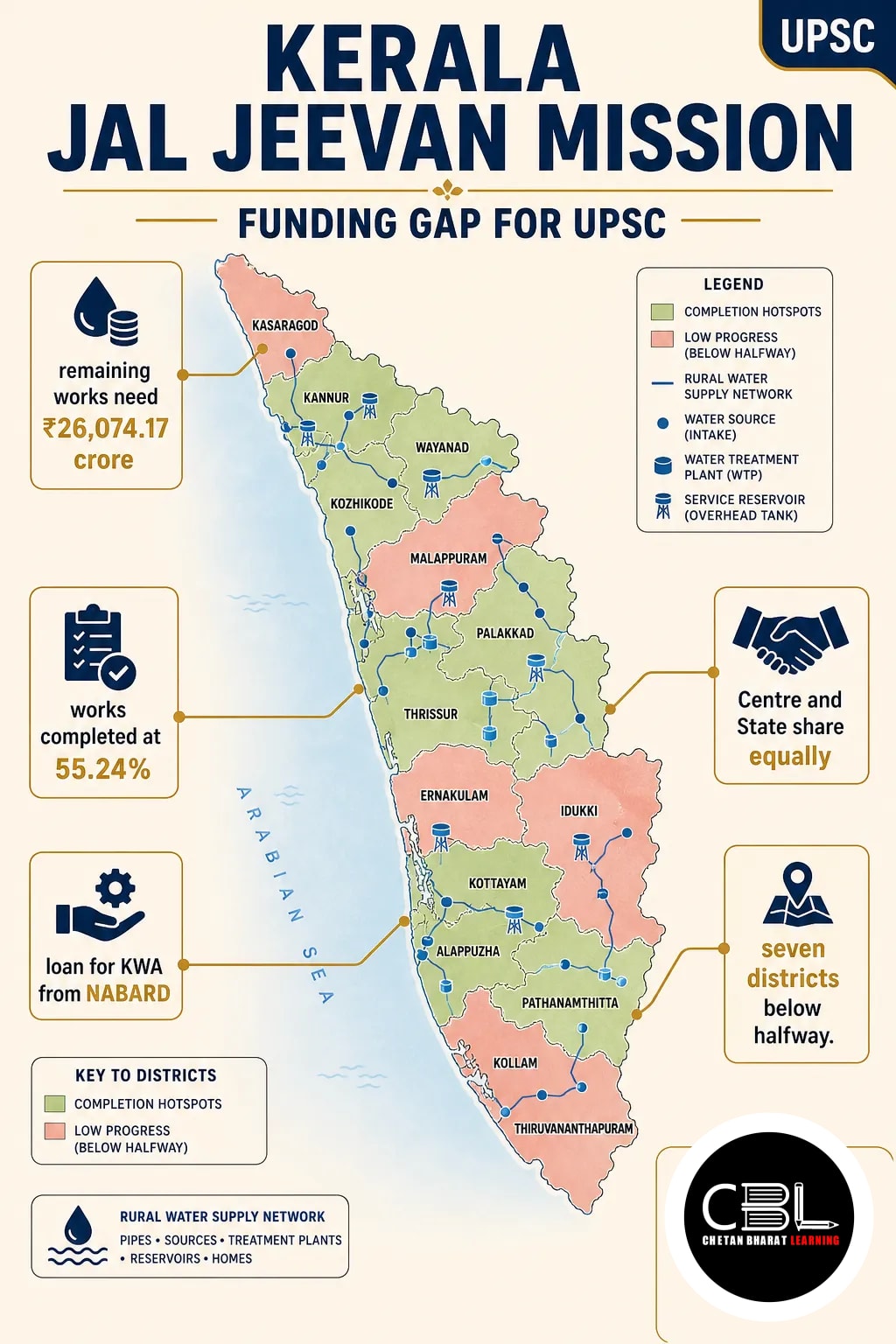

Kerala Jal Jeevan Mission faces a ₹26,074.17 crore funding requirement for its remaining works. The case raises questions about financing and delivery under national development programmes.
Quick answer: Kerala Jal Jeevan Mission needs ₹26,074.17 crore in Central and State-shared funds to finish pending works. As of the latest Union ministry update, 55.24% of works were complete. Kerala expects completion by December 2028, subject to funds; the national deadline has also been extended to December 2028.
What is the Jal Jeevan Mission?
The Jal Jeevan Mission (JJM) aims to provide piped water supply to all rural households in India. Its implementation requires both infrastructure creation and connections that bring water to households.
In Kerala, the Kerala Water Authority (KWA) is the main implementation agency. The mission also illustrates the challenges discussed in CBL’s analysis of mission-mode rural welfare schemes.
Why is Kerala’s funding requirement in the news?
Kerala’s Water Resources department estimates that the remaining works need ₹26,074.17 crore. Water Resources Minister Mons Joseph told the Legislative Assembly that completion is expected by December 2028, subject to fund availability.
The estimate is the remaining requirement, not a separate sum additional to the stated total outlay. Together, the reported expenditure and requirement equal the total outlay of ₹44,714.79 crore.
| Indicator | Kerala figure or position |
|---|---|
| Total outlay | ₹44,714.79 crore |
| Expenditure so far | ₹18,640.62 crore |
| Funds needed for remaining works | ₹26,074.17 crore |
| Centre–State cost sharing | 50:50 |
| Works completed | 55.24%, according to the latest Union ministry update |
The 55.24% figure concerns works completed; it should not be presented as the percentage of households with tap connections. Moreover, the ministry’s figures place Kerala at the bottom of the national implementation list.
How are the works financed and prioritised?
The Centre and Kerala share the mission’s cost equally, while KWA implements the programme in the State. Consequently, sustained progress depends on financing from both levels of government.
The government approved a ₹9,000 crore loan for KWA from the National Bank for Agriculture and Rural Development (NABARD). Assembly data show that KWA received ₹7,000 crore and spent it on meeting the State’s share.
Meanwhile, the department has prioritised more connections from completed projects. It also gives priority to works offering more connections and greater potential revenue. This approach seeks to use existing assets efficiently, rather than measure progress through construction alone.
What are the main governance challenges?
The case highlights financing, uneven implementation and the gap between building infrastructure and delivering a reliable service.
- Funding certainty: The completion date depends on available funds; therefore, delayed financing can disrupt the implementation schedule.
- Borrowing and future liabilities: The NABARD loan helps meet the State share, but repayment obligations must also be considered in fiscal planning.
- District disparities: Kasaragod, Idukki, Wayanad, Kozhikode, Kottayam, Malappuram and Pathanamthitta have not reached the halfway mark for works.
- Prioritisation trade-off: Projects with more connections or revenue potential may deliver quicker returns; however, remote or low-return areas also need attention.
- Service outcomes: Completed works alone do not establish whether households receive water regularly or whether supply meets quality needs.
These are governance questions, not proof of the causes of Kerala’s delays. For broader context, see CBL’s discussion of water resource governance in India.
Why does the funding gap matter for federalism?
The 50:50 arrangement makes the Kerala Jal Jeevan Mission a test of coordinated public financing. Each government’s ability to provide its share matters to the pace of a jointly funded programme.
In addition, KWA’s borrowing shows how a State can mobilise its contribution through an implementing agency. A loan, however, shifts financing needs over time rather than eliminating them. Budget planning should therefore consider both completion costs and future repayment.
The case also connects spending to accountability. A financial total shows resources deployed, while works completed and functioning household connections show different aspects of delivery. For a wider view of water security, see India Water Week and water resilience.
What should the way forward focus on?
A credible completion plan should connect funding schedules with district-level delivery and service outcomes.
- Plan financing: The Centre and State should align releases and implementation milestones, while accounting for loan repayment.
- Use completed assets: KWA can first identify projects where additional household connections are feasible from existing infrastructure.
- Protect equity: Authorities should track underserved districts alongside high-connection and higher-revenue projects.
- Measure service: Monitoring should distinguish expenditure, work completion and household connections; it should also assess supply reliability and water quality.
- Strengthen local oversight: Panchayats can help identify local needs and report service problems, alongside the implementing authority.
Overall, the goal is not merely to spend the remaining allocation. It is to convert investment into sustainable rural water services while maintaining financial accountability.
Source: The Hindu, 1 November 2026
Punjab PCS and Haryana HCS may test rural water supply through questions on scheme financing and local governance. In addition, compare expenditure, infrastructure completion and actual service delivery when analysing a State programme.
Prelims Practice Corner
Mains Practice Questions
Frequently Asked Questions
How much funding does Kerala need for remaining Jal Jeevan Mission works?
Kerala needs ₹26,074.17 crore. This is the remaining requirement within the stated ₹44,714.79 crore outlay.
When does Kerala expect to complete the works?
Kerala expects completion by December 2028, subject to fund availability. The Centre has also extended the national deadline to December 2028.
Which districts are below halfway in completion?
Seven districts are below halfway: Kasaragod, Idukki, Wayanad, Kozhikode, Kottayam, Malappuram and Pathanamthitta. This position comes from the Union ministry’s figures for mission works.
Does 55.24% mean that this share of Kerala’s rural households has tap water?
No, because 55.24% refers to completed works in the ministry update. It should not be treated as a household tap-connection statistic.
Related Current Affairs
Preparing for UPSC, PCS or HCS?
Talk to a mentor at Chetan Bharat Learning, Chandigarh. Free guidance on choosing the right exam and building a study plan.
Chat on WhatsAppCall 97793 53345UPSC / IAS / PCS coaching in Chandigarh · Trusted by aspirants across Punjab & Haryana

 Ananya RanaIAS · AIR 60
 Aditya SharmaIAS · AIR 70
 Ria Kaur SethiIPS · AIR 89
 Aman AloonIRS · AIR 295
 Sumer Singh VirkIRS · AIR 335
 Shivani PanchalIAS

Leave a Reply
You must be logged in to post a comment.