

UPSC Mapping
| Prelims | Water Resources and Government Initiatives |
|---|---|
| Mains | GS Papers I and III — Geography, Environment and Disaster Management |
Article
What is Water Resilience?
Water Resilience means the ability of water systems and communities to cope with shocks while maintaining essential services. A resilient system must handle prolonged scarcity, intense rainfall, pollution and shifting demand without leaving people unable to obtain safe water. This involves protecting sources, limiting avoidable consumption and preparing for emergencies before they occur. It also involves restoring services promptly after a flood or drought. The concept applies across a catchment, from rainfall and groundwater to irrigation, drinking water, wastewater and the rivers that support ecosystems.
The approach joins physical measures with adaptive governance. Rainwater harvesting, recharge structures and efficient irrigation can reduce pressure on freshwater sources. Forecasts, local water budgets and clear institutional duties help communities decide when and where to act. No single structure can address every risk: a reservoir may store water, but poor drainage can still expose nearby settlements to flooding. Likewise, a household tap connection needs a dependable source and functioning maintenance arrangements. Resilience therefore depends on the performance of the whole water system over time.
Why is Water Resilience in News?
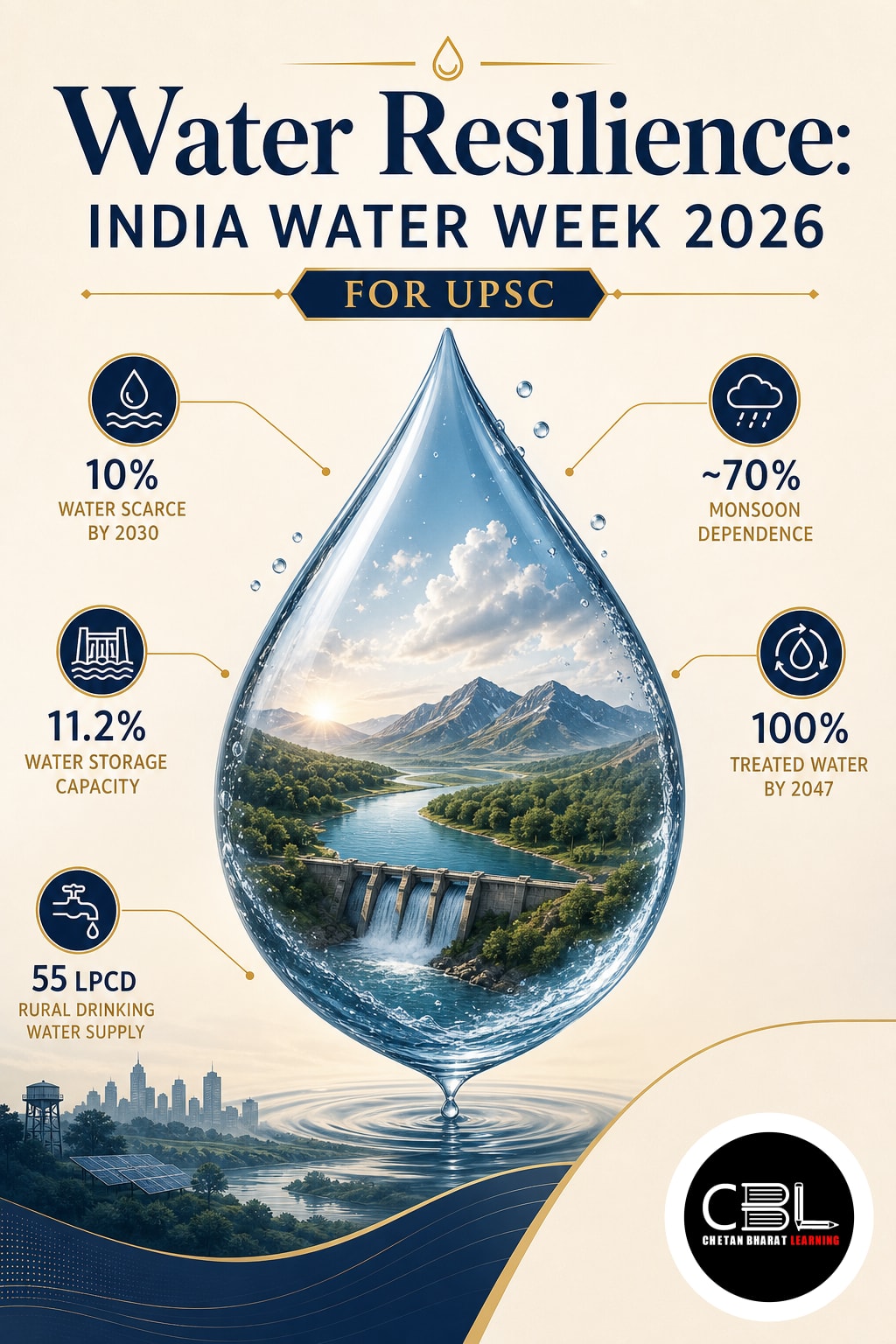
Water Resilience is in focus because the ninth India International Water Week is being held from 22 to 26 September 2026. Its theme is Climate Resilient Water Management. The Ministry of Jal Shakti announced the event at Bharat Mandapam, New Delhi, in an official PIB release. The theme directs attention to water systems that can withstand climate-related risks while meeting everyday needs. It provides a current example for connecting geography, resource management and disaster preparedness in UPSC answers.
The event’s conference programme covers equitable governance, cooperation, technology, climate risks, finance and sustainable resource management. These subjects show why water planning cannot rest with a single department. Farmers, cities, industries and ecosystems may draw on connected sources, even when different authorities manage their needs. Drought planning also affects drinking water, crops, sanitation and health at the same time. The official conference themes offer a framework for studying these links without assuming that every proposed solution will suit every river basin.
Key Features
A climate-ready approach manages supply, demand and risk together. Its measures work best when planners adapt them to local rainfall, geology and public needs.
- Whole-cycle planning: Authorities consider rain, rivers, aquifers, drinking water and treated wastewater together, so a decision to expand one use does not silently reduce water available for another.
- Source protection: Catchment restoration, rainwater harvesting and groundwater recharge help sustain supplies, provided planners select sites using local terrain, water quality and aquifer conditions rather than applying one design everywhere.
- Efficient demand: Crop choices, suitable irrigation methods, leakage control and fit-for-purpose reuse can reduce freshwater withdrawals while protecting essential household needs and the livelihoods that depend on water.
- Risk preparedness: Forecasts, floodplain awareness, drainage maintenance and drought contingency plans allow communities to act earlier, limit damage and restore safe services when extreme weather disrupts ordinary supply.
- Community participation: Local water budgets give residents and institutions a shared view of available resources, seasonal demand and maintenance responsibilities, making conservation plans easier to assess and revise.
Challenges
Building Water Resilience requires more than installing infrastructure. Institutional coordination and long-term maintenance determine whether investments continue to work.
- Fragmented responsibilities: Separate agencies may oversee drinking water, irrigation, drainage and wastewater, making it difficult to compare demands or address a failing source before it affects several services.
- Uneven local data: Decisions become less reliable when rainfall records, groundwater measurements, water-quality results and estimates of use cannot be compared across neighbouring settlements or an entire catchment.
- Competing demands: Agriculture, households, industry and ecological flows all need water, while dry periods can intensify difficult choices about access, conservation and the protection of vulnerable users.
- Pollution and inadequate treatment: Untreated sewage and poorly managed waste reduce the amount of usable water, increase treatment costs and limit safe options for reuse or recharge.
- Maintenance and affordability: Communities may lack funds or trained operators to maintain pumps, treatment plants and monitoring equipment, even when the initial project receives adequate capital support.
The pressure on farming regions is illustrated in Chetan Bharat Learning’s discussion of irrigation and groundwater dependence.
Way Forward
Water Resilience plans should begin with a local water budget that identifies sources, seasonal demand and the needs of ecosystems. States and local bodies can then prioritise repairs, conservation, safe reuse and suitable recharge rather than judging success only by new construction. Basin-level cooperation can help neighbouring jurisdictions share information and manage connected rivers and aquifers. Public reporting should show whether projects remain functional through both wet and dry seasons. This would make it easier to correct weak designs, maintain useful assets and direct limited funds towards the greatest risks.
Programmes can reinforce one another when officials connect water supply with source sustainability and greywater management. The Jal Jeevan Mission’s village planning guidance includes these measures alongside operation and maintenance arrangements. Districts can use such planning to protect drinking water sources while coordinating irrigation efficiency, sanitation and catchment work. Training local institutions and checking water quality are as important as building assets. For UPSC analysis, the guiding question is whether an intervention reduces risk across the water cycle and remains workable under changing conditions.
Prelims Practice Corner
Q1. What is the theme of the ninth India International Water Week?
- (a) Water for Industrial Growth
- (b) Climate Resilient Water Management
- (c) Oceans and Trade
- (d) Universal Irrigation Coverage
Answer: (b) The official event theme is Climate Resilient Water Management.
Q2. Which ministry is organising India International Water Week 2026?
- (a) Ministry of Earth Sciences
- (b) Ministry of Jal Shakti
- (c) Ministry of Agriculture and Farmers Welfare
- (d) Ministry of Housing and Urban Affairs
Answer: (b) The Ministry of Jal Shakti is organising the event.
Q3. Consider the following statements:
1. Groundwater recharge can support source sustainability.
2. Treating wastewater can create options for suitable reuse.
Which is correct?
- (a) 1 only
- (b) 2 only
- (c) Both 1 and 2
- (d) Neither 1 nor 2
Answer: (c) Both measures can reduce pressure on freshwater sources when properly planned.
Q4. Where is India International Water Week 2026 being held?
- (a) Hyderabad
- (b) Jaipur
- (c) New Delhi
- (d) Mumbai
Answer: (c) The venue is Bharat Mandapam, New Delhi.
Q5. Which approach best reflects climate-resilient water management?
- (a) Planning each water use without considering shared sources
- (b) Relying only on new reservoirs
- (c) Integrating source protection, efficient use and risk preparedness
- (d) Ignoring wastewater after use
Answer: (c) Resilience requires coordinated management across the water cycle.
Mains Practice Questions
Q1. Climate-resilient water management requires integration across the entire water cycle. Discuss with reference to India’s water governance challenges. (15 marks)
Answer Structure:
- Intro: Define resilience in the context of drought, floods and reliable supply.
- Body: Cover connected sources, competing uses, fragmented institutions, data, local planning and maintenance.
- Conclusion: Recommend coordinated, locally adapted decisions across the water cycle.
Q2. Examine how community water budgeting and source sustainability can strengthen drinking water security under climatic uncertainty. (10 marks)
Answer Structure:
- Intro: Link reliable supply to the condition of local water sources.
- Body: Explain seasonal budgets, recharge, demand management, quality checks and maintenance roles.
- Conclusion: Emphasise regular monitoring and community participation.
FAQs on Water Resilience
What is climate-resilient water management?
It is planning that helps water systems cope with climatic risks while maintaining essential supplies. It combines source protection, efficient use, risk preparedness and adaptable institutions.
Why does groundwater recharge matter?
Recharge can help replenish aquifers that support households and agriculture. Its design must suit local geology, water quality and rainfall conditions.
What should UPSC aspirants remember about India International Water Week 2026?
It is the ninth edition, organised by the Ministry of Jal Shakti in New Delhi from 22 to 26 September 2026. Its theme is Climate Resilient Water Management.
Related Current Affairs
Preparing for UPSC, PCS or HCS?
Talk to a mentor at Chetan Bharat Learning, Chandigarh. Free guidance on choosing the right exam and building a study plan.
Chat on WhatsAppCall 97793 53345UPSC / IAS / PCS coaching in Chandigarh · Trusted by aspirants across Punjab & Haryana
Leave a Reply
You must be logged in to post a comment.