
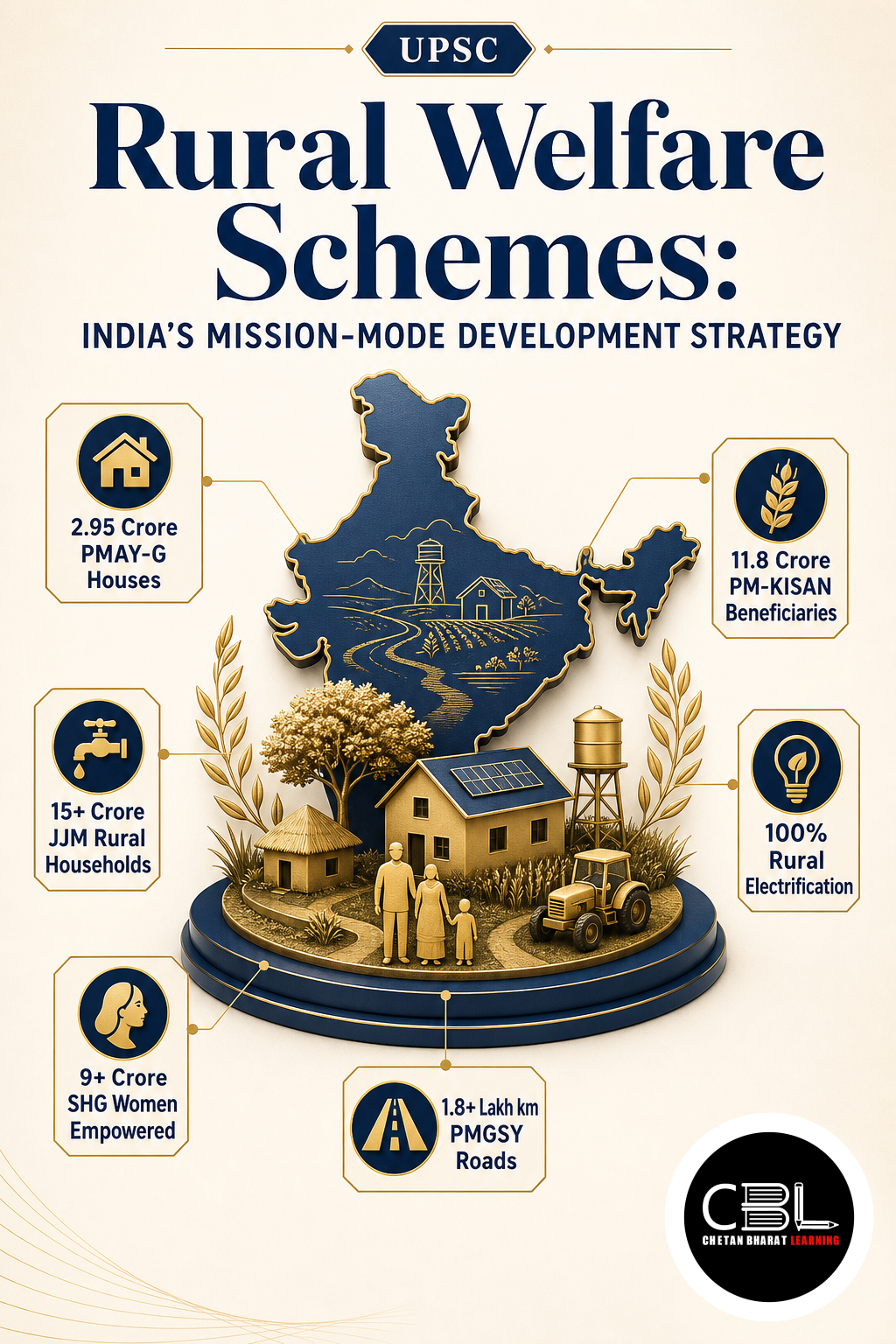

UPSC Mapping
| Prelims | Mains |
|---|---|
| Social Justice & Governance | GS Paper 2 (Social Justice & Governance) |
Article
Rural Welfare Schemes in India have undergone a paradigm shift from siloed aid to mission-mode execution, converging infrastructure, financial access, and targeted safety nets for rural and tribal communities.
For more such social justice updates, explore the social justice archive.
Quick Facts
| Jal Jeevan Villages | PM Awaas Homes | PM Jan Dhan Accounts |
|---|---|---|
| 2.89 lakh | 3.13 crore | 58.90 crore |
What are Rural Welfare Schemes?
Rural Welfare Schemes refer to the comprehensive portfolio of government programmes designed to improve the quality of life in rural and tribal areas through infrastructure, financial inclusion, social security, and skill development. These schemes are implemented in a mission-mode, converging multiple departments to achieve saturation coverage.
The strategy spans basic amenities (water, sanitation, housing, roads, electrification), governance and digital integration (fiscal devolution, broadband connectivity, banking), health and nutrition (PDS, health insurance, clean cooking), and educational empowerment (schools, scholarships, skilling). The 16th Finance Commission has increased direct fiscal transfers to gram panchayats to ₹4.35 lakh crore for 2026–31.
Why are Rural Welfare Schemes in News?
Rural Welfare Schemes are in the news following the release of cumulative data showing significant achievements across multiple sectors. Jal Jeevan Mission has provided household tap connections in 2.89 lakh fully covered villages, while PM Awaas Yojana-Grameen has completed 3.13 crore rural homes by mid-2026.
Financial inclusion milestones include 58.90 crore PM Jan Dhan accounts and 31.87 crore e-Shram registrations. The Public Distribution System delivers free foodgrains to 81.35 crore beneficiaries, with 99.8% of Fair Price Shops using Aadhaar-based authentication. For more details, refer to this PIB release.
Key Features of Rural Welfare Schemes
- Mission-Mode Execution: Converges multiple departments and schemes for saturation coverage.
- Basic Amenities: Jal Jeevan (water), Swachh Bharat (sanitation), PM Awaas (housing), PMGSY (roads), SAUBHAGYA (electrification).
- Financial Inclusion: PM Jan Dhan (banking), e-Shram (labour formalisation), MUDRA (micro-credit).
- Health and Nutrition: PDS (food security), Ayushman Bharat (health insurance), Ujjwala (clean cooking).
- Education and Skilling: Samagra Shiksha, Beti Bachao Beti Padhao, PM Kaushal Vikas Yojana.
Challenges in Rural Welfare Schemes
- Last-Mile Delivery: Ensuring benefits reach the intended beneficiaries in remote areas remains difficult.
- Coordination Gaps: Converging multiple schemes requires effective inter-departmental coordination.
- Fiscal Constraints: Sustaining large-scale welfare programmes requires adequate budgetary allocation.
- Leakages: Despite Aadhaar-based authentication, some leakages persist.
- Quality Concerns: The quality of infrastructure (schools, roads, housing) sometimes falls short of standards. For more on governance challenges, visit the governance section.
Way Forward for Rural Welfare Schemes
To strengthen Rural Welfare Schemes, the focus should shift from coverage to quality and outcomes. Regular third-party audits and citizen feedback mechanisms can improve service delivery. Integrating technology for real-time monitoring and grievance redressal is essential.
Building community ownership through local governance structures (gram panchayats) and empowering women’s self-help groups can enhance sustainability. A lifecycle approach—from birth to old age—should guide welfare delivery. For international best practices, refer to the World Bank.
Prelims Practice Corner
-
Q1. How many villages have been fully covered under Jal Jeevan Mission?
(a) 1.5 lakh (b) 2.89 lakh (c) 3.5 lakh (d) 5 lakh
Answer: (b) 2.89 lakh villages have been fully covered.
-
Q2. How many rural homes have been completed under PM Awaas Yojana-Grameen by mid-2026?
(a) 1.5 crore (b) 2.5 crore (c) 3.13 crore (d) 4 crore
Answer: (c) 3.13 crore rural homes have been completed.
-
Q3. How many beneficiaries are covered under PM Jan Dhan Yojana?
(a) 30 crore (b) 45 crore (c) 58.90 crore (d) 75 crore
Answer: (c) 58.90 crore beneficiaries have been covered.
-
Q4. What is the fiscal devolution to gram panchayats for 2026–31?
(a) ₹2.5 lakh crore (b) ₹3.5 lakh crore (c) ₹4.35 lakh crore (d) ₹5 lakh crore
Answer: (c) The 16th Finance Commission has allocated ₹4.35 lakh crore.
-
Q5. Under which scheme are free LPG connections provided to women below the poverty line?
(a) PM Ujjwala Yojana (b) PM Suraksha Bima Yojana (c) Atal Pension Yojana (d) PM SVANidhi
Answer: (a) PM Ujjwala Yojana provides free LPG connections.
Mains Practice Questions
-
Q1. Discuss the role of mission-mode convergence in implementing rural welfare schemes in India. How has it impacted development outcomes? (250 words, 15 marks)
Answer Structure:
- Intro: Introduce mission-mode convergence and its rationale.
- Body: Discuss key schemes across water, sanitation, housing, financial inclusion, health, and education. Analyse impact: saturation coverage, improved access, and livelihood generation. Address challenges: last-mile delivery, quality concerns.
- Conclusion: Suggest a shift from coverage to quality and outcome-based monitoring.
-
Q2. What are the key challenges in achieving saturation coverage under rural welfare schemes, and what measures can be taken to address them? (150 words, 10 marks)
Answer Structure:
- Intro: Frame the challenge of achieving full coverage.
- Body: Discuss last-mile delivery, coordination gaps, fiscal constraints, and quality issues. Suggest measures: technology integration, community ownership, and regular audits.
- Conclusion: Conclude that a lifecycle approach and outcome-based monitoring are essential.
FAQs on Rural Welfare Schemes
- What is mission-mode execution of welfare schemes?
- It is a strategy that converges multiple departments and programmes to achieve saturation coverage with a time-bound approach.
- What are the major rural welfare schemes?
- Major schemes include Jal Jeevan Mission, Swachh Bharat, PM Awaas Yojana, PM Jan Dhan, Ayushman Bharat, Ujjwala, and PM Kaushal Vikas Yojana.
- How does the e-Shram portal help rural workers?
- It registers unorganised sector workers, creating a centralised database for targeted welfare delivery and social security.
Related Current Affairs
Preparing for UPSC, PCS or HCS?
Talk to a mentor at Chetan Bharat Learning, Chandigarh. Free guidance on choosing the right exam and building a study plan.
Chat on WhatsAppCall 97793 53345UPSC / IAS / PCS coaching in Chandigarh · Trusted by aspirants across Punjab & Haryana
Leave a Reply
You must be logged in to post a comment.