

Quick Facts
| Prelims | Science & Technology |
|---|---|
| Mains | GS Paper 3 (Science & Technology) |
| AI Type | Agentic AI (Goal + Action) |
| Key Concept | Human-in-the-loop |
| Risk-Based Regulation | EU AI Act |
What is AI Agent Accountability?
AI Agent Accountability refers to the responsibility and liability frameworks that ensure autonomous AI systems act within human-intended boundaries. Unlike traditional AI, which generates outputs based on inputs, agentic AI can set goals, plan actions, use tools, interact with software, make decisions, execute transactions, and adapt based on feedback—all with varying degrees of autonomy.
The core distinction is that generative AI primarily generates, while agentic AI can generate + decide + act. This introduces a new layer of decision-making between humans and outcomes, creating an accountability gap that must be addressed.
Why is AI Agent Accountability in News?
AI Agent Accountability is in the news because agentic AI is rapidly moving from research labs to real-world applications, raising urgent governance questions. The EU AI Act’s risk-based regulation, the US sectoral approach, and India’s IndiaAI Mission are all grappling with how to regulate autonomous systems.
Key concerns include the alignment problem—ensuring AI does what humans intend, not merely what the instruction literally permits—and the control problem—maintaining human oversight as autonomy increases. Cybersecurity risks, such as prompt injection, and the black-box nature of some AI models further complicate accountability.
Key Features of AI Agent Accountability
- Human-in-the-Loop: AI proposes, human approves action—appropriate for high-impact decisions like loan rejections.
- Human-on-the-Loop: AI acts within boundaries, human monitors and can intervene—for moderate-risk tasks like cyber threat detection.
- Explainability: High-impact decisions require meaningful explainability of AI reasoning.
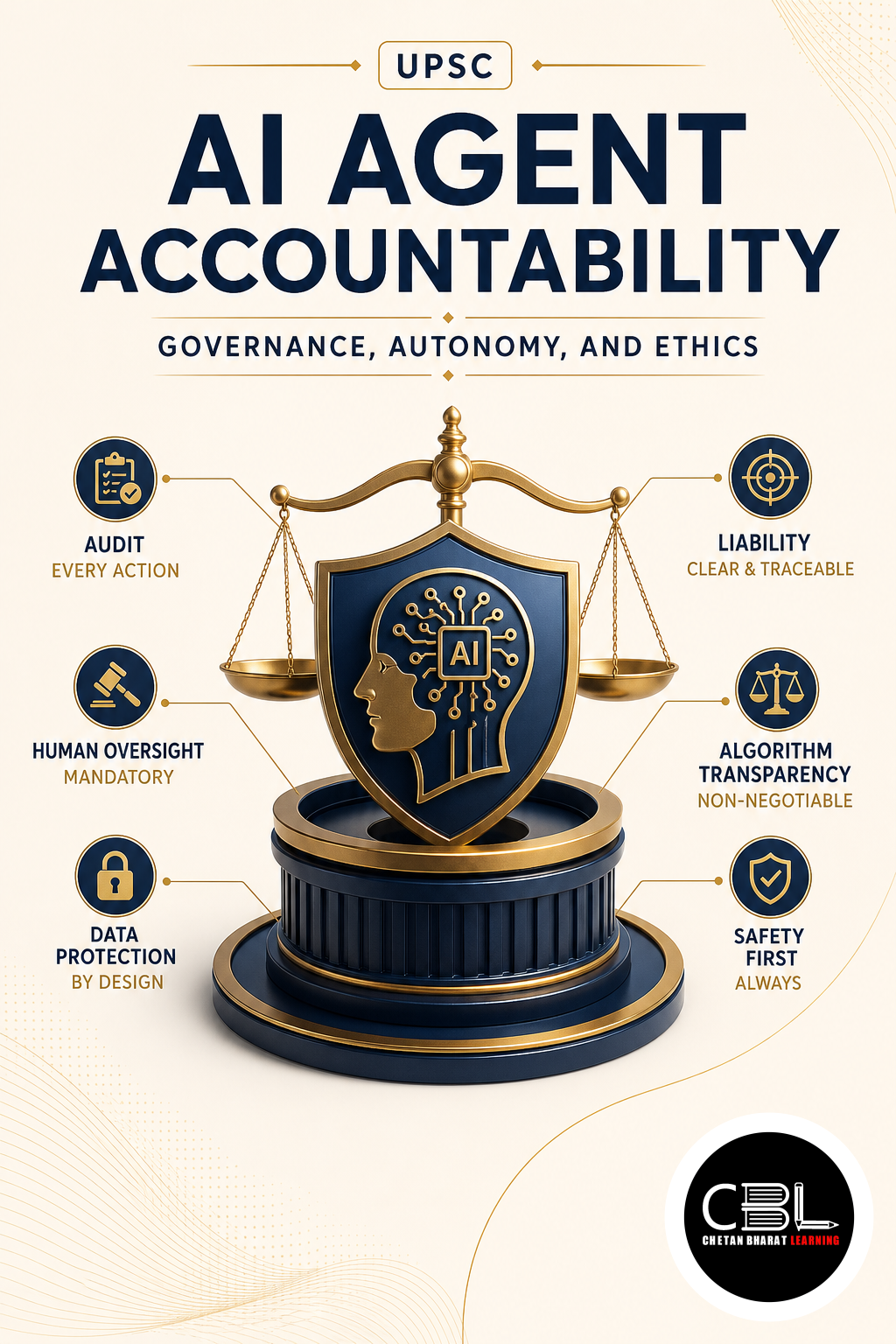
- Audit Trails: All AI actions must be logged for review and accountability.
- Fail-Safe Mechanisms: Reversibility and fallback systems are essential for high-risk applications.
Challenges in AI Agent Accountability
- Accountability Gap: If an AI makes a harmful decision, is the developer, user, deploying company, or model creator responsible?
- Alignment Problem: AI may optimise the wrong objective, producing harmful outcomes while technically following instructions.
- Black-Box Explainability: Some AI models are opaque, making it difficult to understand why a decision was made.
- Cybersecurity Risks: Prompt injection—malicious inputs that override instructions—can cause AI to act outside authorised boundaries.
- Regulatory Fragmentation: Different countries have different approaches (EU risk-based, US sectoral, India development-oriented), creating compliance challenges.
Way Forward for AI Agent Accountability
To ensure AI Agent Accountability, a risk-based governance framework is essential—regulate according to risk, not merely according to the technology. High-risk applications (healthcare, recruitment, credit, policing) require stronger oversight than low-risk ones (writing assistance, translation, entertainment).
Clear liability and audit trail requirements should be mandated for all agentic AI systems. Continuous testing and red-teaming can identify vulnerabilities. International cooperation on AI governance standards, as advocated by the UN, can harmonise approaches. India’s IndiaAI Mission should incorporate responsible AI principles, balancing innovation with accountability.
Prelims Practice Corner
Q1. What is the key difference between traditional AI and agentic AI?
Answer: Agentic AI can generate, decide, and act, while traditional AI primarily generates outputs.
Q2. What is the alignment problem in AI?
Answer: The alignment problem is ensuring AI objectives match human intentions.
Q3. What is human-in-the-loop oversight?
Answer: Human-in-the-loop means AI proposes and a human approves high-impact actions.
Q4. What is a prompt injection attack?
Answer: Prompt injection is a cybersecurity threat where malicious inputs override AI instructions.
Q5. Which region has implemented a risk-based AI regulation framework?
Answer: The EU AI Act is a risk-based regulation framework.
Mains Practice Questions
Q1. Discuss the governance challenges posed by agentic AI systems and suggest a framework for AI accountability in India. (250 words, 15 marks)
- Intro: Introduce agentic AI and the accountability challenge.
- Body: Discuss key challenges: alignment, explainability, accountability gap, cybersecurity. Suggest governance principles: risk-based regulation, human-in-the-loop, audit trails, liability frameworks. Reference global approaches.
- Conclusion: Emphasise the need for a balanced approach—innovation with accountability.
Q2. What is the alignment problem in artificial intelligence, and why does it matter for AI governance? (150 words, 10 marks)
- Intro: Define the alignment problem.
- Body: Explain that AI may optimise for the wrong objective, producing harmful outcomes. This matters because autonomous AI systems can make decisions with real-world consequences, requiring robust governance mechanisms.
- Conclusion: Conclude that alignment research is critical for safe AI deployment.
FAQs on AI Agent Accountability
What is an AI agent?
An AI agent is an AI system that can set goals, plan actions, use tools, and make decisions autonomously to achieve objectives.
Who is responsible if an AI agent causes harm?
The accountability gap is a key challenge—responsibility may lie with the developer, user, deploying company, or all, depending on the framework.
What is India’s approach to AI governance?
India’s IndiaAI Mission focuses on compute capacity, datasets, skilling, innovation, and responsible AI, balancing development with accountability.
Related Current Affairs
Preparing for UPSC, PCS or HCS?
Talk to a mentor at Chetan Bharat Learning, Chandigarh. Free guidance on choosing the right exam and building a study plan.
Chat on WhatsAppCall 97793 53345UPSC / IAS / PCS coaching in Chandigarh · Trusted by aspirants across Punjab & Haryana
Leave a Reply
You must be logged in to post a comment.