
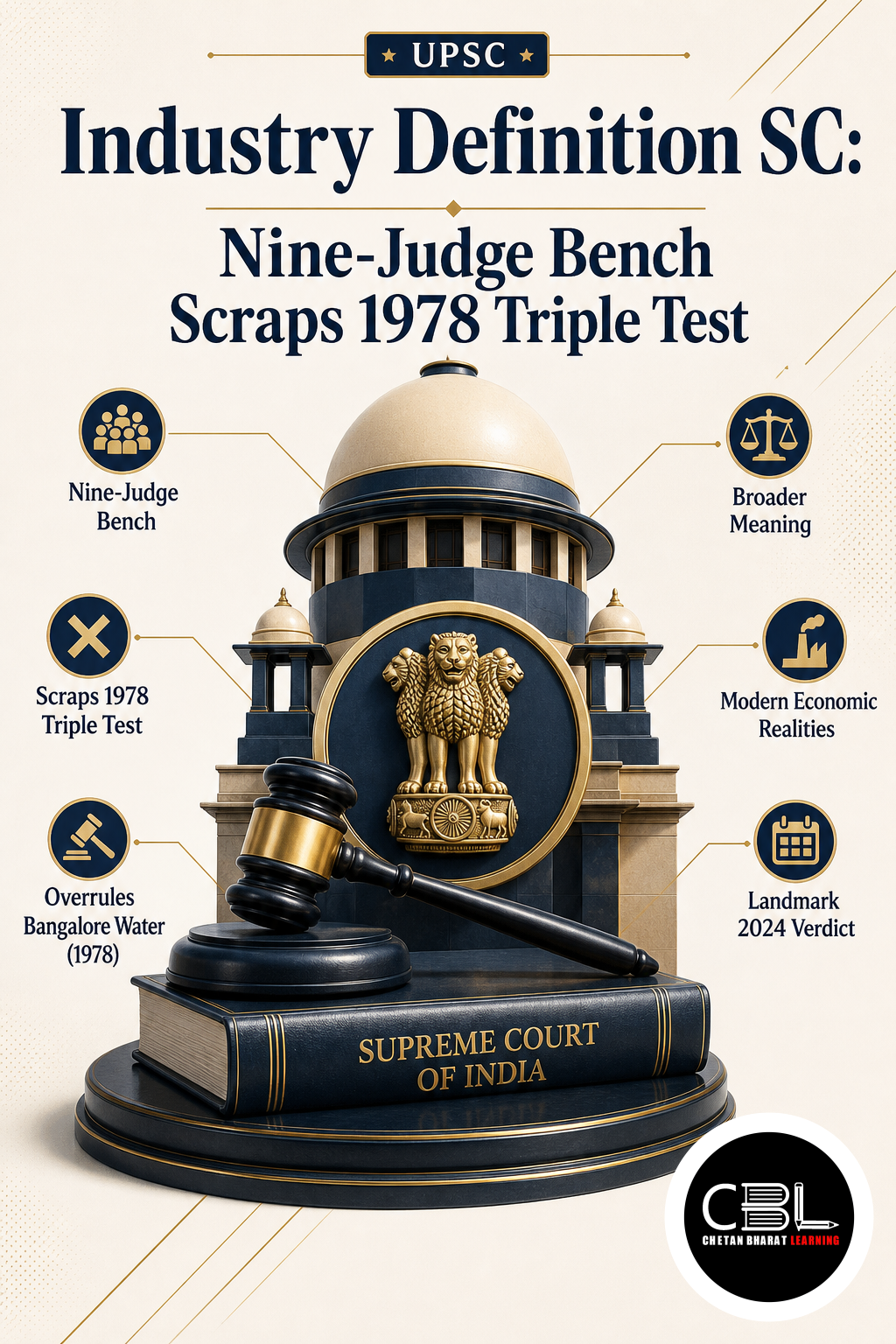
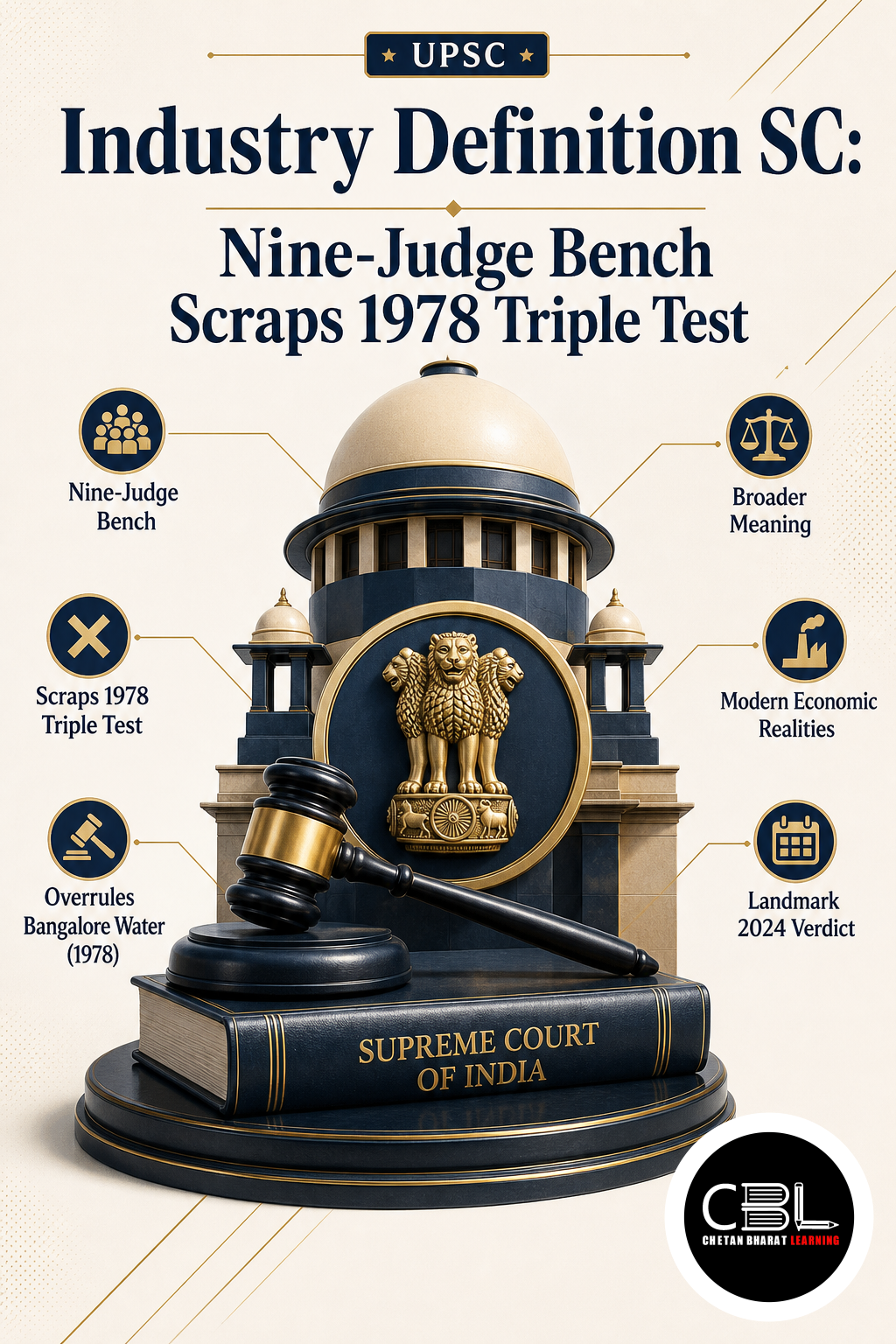
Industry Definition SC has been clarified by a nine-judge bench of the Supreme Court, which held that the expansive interpretation of ‘industry’ laid down in the Bangalore Water Supply and Sewerage Board v. R. Rajappa judgment (1978) will not govern the interpretation of ‘industry’ under the Industrial Relations Code (IRC), 2020. However, the 1978 judgment will continue to govern legacy disputes and pending proceedings under the Industrial Disputes Act, 1947. For more such polity updates, explore the polity and governance archive.
Important for
| Prelims | Polity & Labour Law |
|---|---|
| Mains | GS Paper 2 (Polity & Labour Law) |
Key Case
Bangalore Water Supply v. R. Rajappa (1978)
New Code
Industrial Relations Code, 2020
What is Industry Definition SC?
Industry Definition SC refers to the Supreme Court’s interpretation of the term ‘industry’ under labour laws. The 1978 Bangalore Water Supply judgment introduced a ‘triple test’—any activity that was systematic or organised, operated on the basis of employer-employee cooperation, and dealt in the production of goods and services to satisfy human wants came within the ambit of ‘industry’. This judgment brought even hospitals, educational institutions, and municipalities within the fold of ‘industry’.
The nine-judge bench has now held that this expansive interpretation will not apply to the Industrial Relations Code (IRC), 2020. The definition of ‘industry’ determines the entities and workers covered by important labour protections, including mechanisms relating to industrial disputes and collective bargaining.
Why is Industry Definition SC in News?
Industry Definition SC is in the news because the nine-judge bench’s ruling has significant implications for labour law. A narrower interpretation in the future could potentially affect the scope of labour-law protection. The ruling clarifies that the 1978 judgment will continue to govern legacy disputes under the Industrial Disputes Act, 1947.
The decision has sparked debate on whether this will limit the coverage of labour protections for workers in sectors like education, healthcare, and municipal services. For more details, refer to this PIB release.
Key Features of Industry Definition SC
- Triple Test: Systematic, employer-employee cooperation, production of goods/services.
- 1978 Judgment: Brought hospitals, educational institutions, and municipalities under ‘industry’.
- IRC 2020: The expansive interpretation will not apply to the new code.
- Legacy Disputes: The 1978 judgment will continue to govern pending proceedings under the Industrial Disputes Act.
- Implications: A narrower interpretation could affect labour-law protection.
Challenges in Industry Definition SC
- Labour Protection: Narrower definition may exclude workers in certain sectors.
- Interpretation: Clarity on what constitutes ‘industry’ under the new code.
- Legacy vs New: Distinguishing between disputes under the old Act and the new Code.
- Judicial Precedent: The 1978 judgment was a landmark; changing it has far-reaching consequences.
- Implementation: The new Code’s provisions must be interpreted consistently. For more on labour law, visit the polity section.
Way Forward for Industry Definition SC
To ensure clarity on Industry Definition SC, the government should issue clear guidelines on the interpretation of ‘industry’ under the IRC. The Supreme Court’s ruling provides an opportunity to modernise labour law while ensuring adequate worker protection.
Stakeholder consultations, including with trade unions and employer organisations, can help shape a balanced approach. The definition should be broad enough to protect workers but not so broad as to create uncertainty. For international best practices, refer to the ILO.
Prelims Practice Corner
- Q1. What was the Bangalore Water Supply judgment about? (a) Water supply regulation (b) Interpretation of ‘industry’ under labour law (c) Environmental protection (d) Tax law – Answer: (b) It interpreted the term ‘industry’ broadly.
- Q2. Which new code will not be governed by the 1978 interpretation? (a) Companies Act (b) Industrial Relations Code, 2020 (c) GST Act (d) Income Tax Act – Answer: (b) The IRC, 2020, will not be governed by the 1978 interpretation.
- Q3. What was the ‘triple test’? (a) Systematic activity, employer-employee cooperation, production of goods/services (b) Profit motive, employer-employee, government control (c) Scale, location, technology (d) None of the above – Answer: (a) The triple test required systematic activity, employer-employee cooperation, and production of goods/services.
- Q4. Will the 1978 judgment continue to apply? (a) No, it is completely overruled (b) Yes, for legacy disputes under the Industrial Disputes Act (c) Yes, for all cases (d) Only for government institutions – Answer: (b) It will govern legacy disputes under the Industrial Disputes Act.
- Q5. What is the significance of the ‘industry’ definition? (a) It determines tax liability (b) It determines the entities and workers covered by labour protections (c) It determines company registration (d) It determines export eligibility – Answer: (b) It determines labour law coverage.
Mains Practice Questions
Q1. Discuss the implications of the Supreme Court’s ruling on the definition of ‘industry’ for labour law protections in India. (250 words, 15 marks)
Answer Structure:
Intro: Introduce the Bangalore Water Supply judgment and the recent ruling.
Body: Explain the triple test, the 1978 judgment, and the new IRC. Analyse the implications for workers in education, healthcare, and municipal services. Discuss the balance between flexibility and protection.
Conclusion: Suggest a balanced approach to labour law reform.
Q2. What is the Industrial Relations Code, 2020? (150 words, 10 marks)
Answer Structure:
Intro: Define the IRC as one of the new labour codes.
Body: Explain its objectives: simplifying labour laws, improving industrial relations, and providing flexibility. Mention the recent SC ruling on the definition of ‘industry’.
Conclusion: Conclude that the IRC aims to modernise labour regulation.
FAQs on Industry Definition SC
What was the Bangalore Water Supply judgment?
It expanded the definition of ‘industry’ to include hospitals, schools, and municipalities.
What is the implication of the SC ruling?
A narrower interpretation of ‘industry’ under the IRC could affect labour-law protection.
What is the Industrial Relations Code?
It is a new labour code that simplifies and consolidates labour laws in India.
Related Current Affairs
Preparing for UPSC, PCS or HCS?
Talk to a mentor at Chetan Bharat Learning, Chandigarh. Free guidance on choosing the right exam and building a study plan.
Chat on WhatsAppCall 97793 53345UPSC / IAS / PCS coaching in Chandigarh · Trusted by aspirants across Punjab & Haryana
Leave a Reply
You must be logged in to post a comment.