
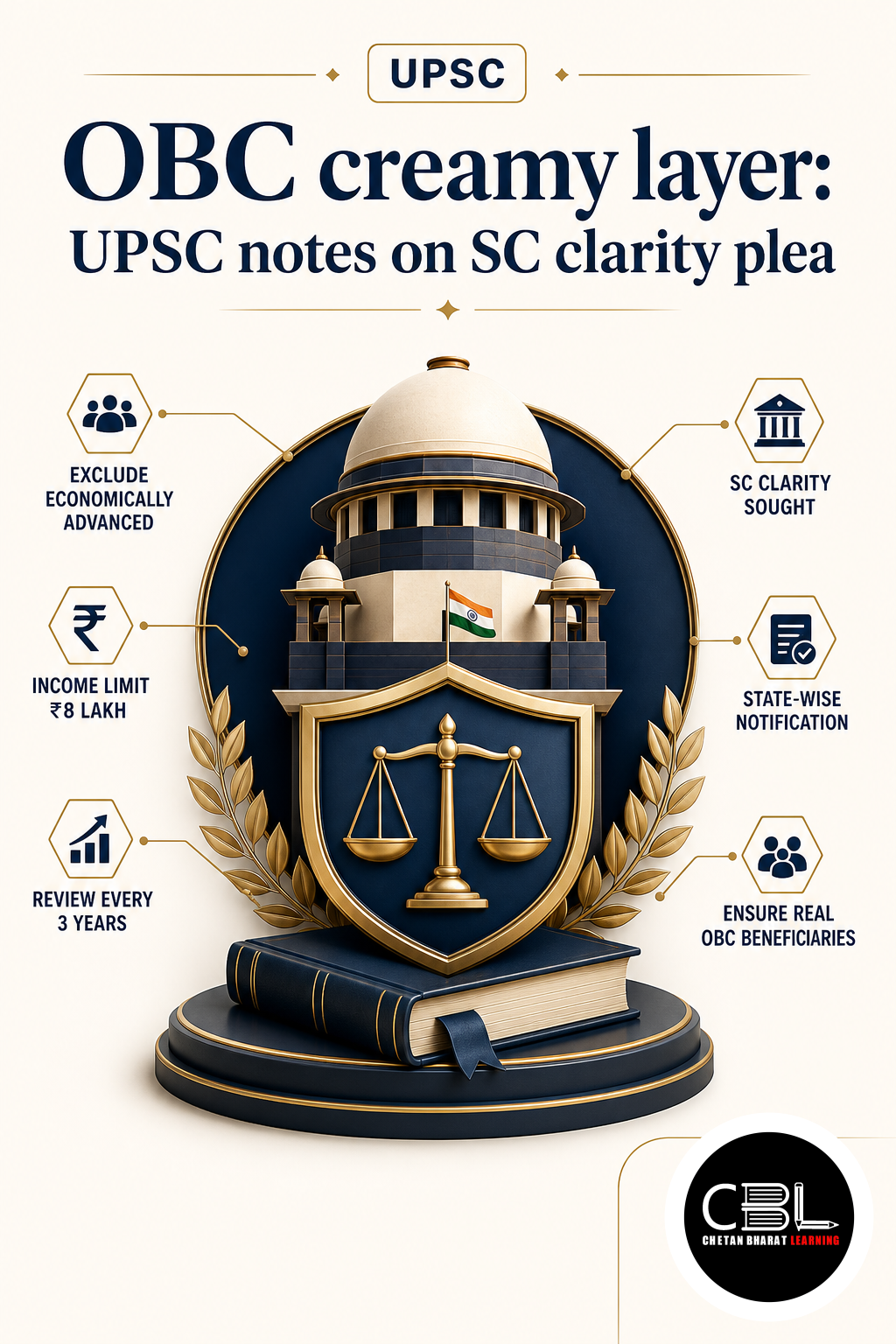

UPSC Mapping
| Important for | |
|---|---|
| Prelims | Polity (Reservations, Fundamental Rights) |
| Mains | GS Paper II (Constitution, Social Justice) |
| Landmark case | Key provisions | Core idea | Administrative issue |
|---|---|---|---|
| Indra Sawhney (1992) | Articles 15(4) and 16(4) | Exclude advanced sections within OBCs | Application during live process |
Article
What is OBC creamy layer?
OBC creamy layer refers to the relatively advanced sections within Other Backward Classes who are excluded from certain reservation benefits so that the policy reaches the more disadvantaged households within the group. In simple terms, it is a filtering principle that tries to prevent better-off families from capturing a disproportionate share of opportunities meant for social advancement.
The state uses notified criteria to identify this advanced section, typically combining an economic threshold with non-income indicators linked to parental status in higher services or positions of influence. Since society and incomes change over time, governments also revisit these criteria, which is where legal disputes often arise.
From a constitutional perspective, reservations under Articles 15(4) and 16(4) are enabling measures for social justice, not an unconditional entitlement. The OBC creamy layer filter aims to align affirmative action with the constitutional goal of substantive equality by prioritising those who remain genuinely backward.
Why is OBC creamy layer in News?
Reports indicate that the Union government has sought the Supreme Court’s clarity on how revised eligibility norms should operate in ongoing selections, raising the classic issue of ‘rules of the game’. This matters because candidate rights and administrative fairness can get affected if criteria change after applications, shortlisting, or counselling has begun.
The news also refreshes the jurisprudence that started with Indra Sawhney v. Union of India (1992), where the Court articulated the principle of excluding the advanced section within OBCs from reservation benefits. For authentic institutional background and court-related updates, aspirants can refer to the Supreme Court of India website for official information and then connect the reasoning to GS-II themes.
In UPSC Mains, the focus is rarely just the headline. The deeper question is whether applying updated creamy layer norms prospectively or midstream better serves equality, administrative certainty, and the credibility of affirmative action.
Key Features
- Articles 15(4) and 16(4) as enabling provisions allow the state to make special provisions for socially and educationally backward classes and for backward classes in public employment.
- Indra Sawhney’s targeting logic treats the advanced section within OBCs as less in need of reservation, strengthening intra-group equity.
- Criteria are policy instruments because governments notify income/wealth and status-based rules, and they can revise these to reflect changing economic realities.
- ‘Rules of the game’ principle in service law stresses fairness when selection criteria change after a process starts, affecting predictability for candidates.
- Social justice objective remains to widen representation and opportunity for those facing structural disadvantage, not to create permanent monopoly over benefits.
Challenges
The biggest difficulties come from translating a judicial principle into consistent administration across different selection cycles and institutions.
- Timing of applicability becomes contentious when updated criteria are issued during an ongoing recruitment or admission cycle, raising claims of unfair surprise.
- Verification and documentation burden increases when authorities must confirm income and status indicators, while delays can harm both candidates and institutions.
- Heterogeneity within OBCs means a single filter may not fully address intra-category inequality, which keeps debates alive on better targeting methods.
- Litigation risk and uncertainty rises when policies change frequently or communication is unclear, leading to stays, re-notifications, and repeated counselling rounds.
- Social legitimacy concerns appear if beneficiaries perceive arbitrary exclusion or if non-beneficiaries perceive capture by better-off groups, weakening trust in the system.
The core legal dilemma often reduces to a clean question: when the state updates the OBC creamy layer yardstick, should it apply to applications already submitted, or only to future cycles? Courts then weigh equal opportunity against legitimate expectation and the need for consistent rules.
Way Forward
A stable approach is to publish clear transition rules whenever criteria change, so candidates and institutions know whether a revision applies prospectively, from the next notification, or from a defined cut-off stage. Governments can also schedule periodic updates at predictable intervals, which reduces the chance of midstream changes and strengthens administrative fairness.
Policy design should also improve implementation quality: digital verification where feasible, standardised FAQs by recruiting bodies, and robust grievance redress to reduce avoidable litigation. For broader context on reservation design and legislative-constitutional debates, aspirants may consult explainers and bill-tracking resources such as PRS Legislative Research and integrate them with case-law principles in GS-II answers.
Finally, social justice goals improve when the state combines exclusion filters with evidence-based inclusion tools, like credible backwardness assessment and better access to schooling, skilling, and scholarships. This keeps the OBC creamy layer principle aligned with outcomes, not only with paperwork.
Prelims Practice Corner
Q1. The concept of excluding the ‘creamy layer’ for OBC reservations is most closely associated with which judgment?
(a) Kesavananda Bharati (b) Indra Sawhney v. Union of India (c) Maneka Gandhi v. Union of India (d) Minerva Mills
Show answer
Answer: (b) Indra Sawhney (1992) articulated creamy layer exclusion for OBCs.
Q2. Articles 15(4) and 16(4) of the Constitution are best described as:
(a) Absolute prohibitions on reservations (b) Enabling provisions for affirmative action (c) Provisions on emergency powers (d) Provisions on money bills
Show answer
Answer: (b) They enable the state to make special provisions for backward classes.
Q3. The ‘rules of the game’ principle in selections broadly means:
(a) Rules can change anytime without notice (b) Selection criteria should not be altered mid-process (c) Only interview marks matter (d) Courts cannot review selection processes
Show answer
Answer: (b) Courts often disapprove changing essential criteria after the process begins.
Q4. The primary purpose of excluding the creamy layer is to:
(a) Abolish reservations (b) Improve targeting of benefits to the more disadvantaged (c) Replace constitutional provisions (d) Reduce the number of OBC communities
Show answer
Answer: (b) The idea is to prevent capture by the advanced sections within the group.
Q5. Which of the following is the most appropriate UPSC framing of creamy layer debates?
(a) Only a budget issue (b) A balance between targeted inclusion and procedural fairness (c) A purely foreign policy issue (d) A matter limited to municipal law
Show answer
Answer: (b) It combines constitutional equality, affirmative action design, and administrative fairness.
Mains Practice Questions
Q1. Explain the constitutional and judicial basis of excluding the creamy layer among OBCs. Why does the ‘rules of the game’ principle become relevant when criteria are revised? (10 marks)
Answer Structure:
Intro: Define creamy layer exclusion as a targeting tool within affirmative action.
Body: (1) Articles 15(4), 16(4) enabling nature, (2) Indra Sawhney rationale, (3) why criteria updates are needed, (4) ‘rules of the game’ and legitimate expectation in ongoing selections.
Conclusion: Stress predictable transitions and clarity to protect both justice and fairness.
Q2. The creamy layer debate reflects tensions within social justice policy design. Discuss key administrative and ethical challenges and suggest a way forward for more equitable targeting. (15 marks)
Answer Structure:
Intro: Frame the issue as intra-category equity plus rule-of-law in implementation.
Body: (1) verification and compliance capacity, (2) timing of rule changes and litigation, (3) heterogeneity within OBCs, (4) social legitimacy, (5) reforms: predictable revisions, cut-off rules, better data and grievance redress.
Conclusion: Link targeted reservation with long-term capability building in education and skilling.
FAQs on OBC creamy layer
Does creamy layer exclusion mean reservations are unconstitutional?
No. Reservations under Articles 15(4) and 16(4) are enabling provisions, and courts have examined how to target benefits effectively. The exclusion principle tries to ensure the policy reaches the more disadvantaged within OBCs.
Why do courts care about changing eligibility criteria during a recruitment or admission process?
Because midstream changes can disadvantage candidates who applied under earlier conditions and undermine predictability. This is why the ‘rules of the game’ principle becomes relevant in many selection disputes.
What should I write in UPSC Mains about solutions?
Emphasise predictable revision schedules, clear cut-off rules, stronger verification systems, and grievance redress. Add the broader point that social justice also depends on education, skilling, and access to opportunity, not only category filters.
Related Current Affairs
Preparing for UPSC, PCS or HCS?
Talk to a mentor at Chetan Bharat Learning, Chandigarh. Free guidance on choosing the right exam and building a study plan.
Chat on WhatsAppCall 97793 53345UPSC / IAS / PCS coaching in Chandigarh · Trusted by aspirants across Punjab & Haryana
Leave a Reply
You must be logged in to post a comment.