
UPSC Mapping
| Prelims | Mains |
|---|---|
| Science & Technology | GS Paper 3 (Science & Technology & Economy) |
Quick Facts
| Registered Startups | 400+ |
|---|---|
| Private Investment (2026) | $618.5 million |
| Key Institutions | IN-SPACe, NSIL |
What are India Space Startups?
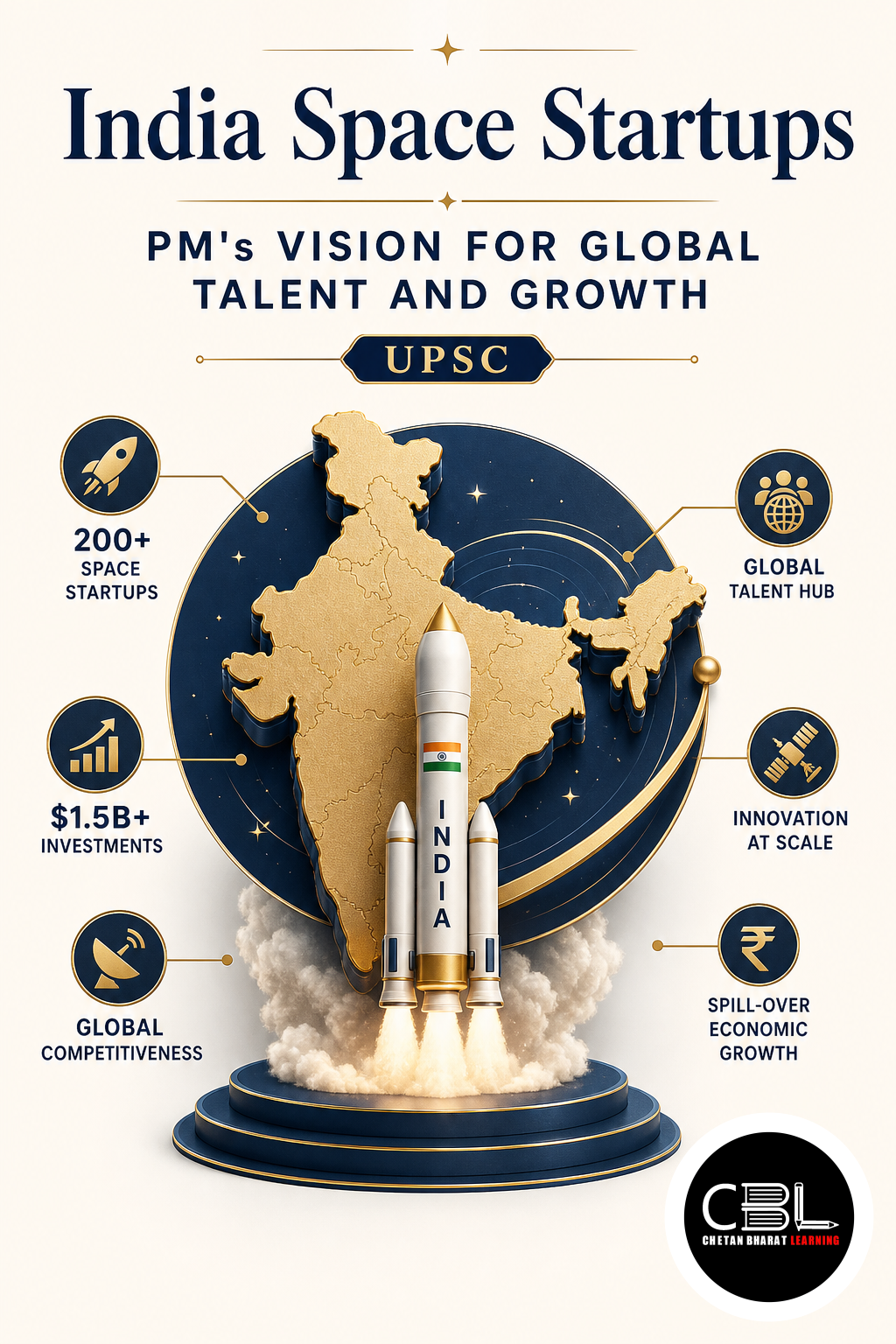
India Space Startups are private companies engaged in space-related activities, including launch vehicles, satellite manufacturing, data analytics, and space-based applications. The 2020 reforms opened the space sector to Non-Government Entities (NGEs), and the Indian Space Policy 2023 promotes private participation across the value chain. There are over 400 registered space start-ups, with private investment reaching $618.5 million by March 2026, up from $100.5 million in 2021–22.
Key institutions include IN-SPACe, which enables and authorises private space activities, and NSIL, the commercial arm of the Department of Space. The PM envisions these start-ups becoming a ‘magnet’ attracting global scientific and technological talent to India.
Why are India Space Startups in News?
India Space Startups are in the news following the Prime Minister’s meeting with over 20 space entrepreneurs ahead of National Space Day. Modi praised their courage and vision, stating that the private space ecosystem can become a major force for India and the world. He emphasised that India can attract global talent in science and technology through its space sector.
Startups like Serendipity Space, which tested a satellite for space-based drug manufacturing, and GalaxEye, are examples of the innovation emerging from this sector. For more details, refer to the PIB release.
Key Features of India Space Startups
- Diverse Activities: Launch vehicles, satellite manufacturing, data applications, and space-based manufacturing.
- Government Support: IN-SPACe authorises and supervises private space activities; NSIL commercialises space technologies.
- Investment Growth: Private investment has grown six-fold since 2021–22.
- Global Ambition: Targeting global markets for launches, satellites, and data services.
- Innovation: Focus on reusable systems, small satellites, advanced sensors, and propulsion.
Challenges for India Space Startups
- High Capital Requirements: Space ventures require large upfront investment and long development cycles.
- Infrastructure Constraints: Testing, launch, and specialised facilities are expensive and limited.
- Supply Chain Dependence: Dependence on global sources for advanced components.
- Regulatory Complexity: Navigating safety, liability, spectrum, and security regulations.
- Space Debris: More satellites increase orbital congestion and collision risk. For more on space economy, visit the science and technology section.
Way Forward for India Space Startups
To strengthen India Space Startups, the government should ensure stable regulation, better infrastructure, patient capital, technology transfer from ISRO, and strong domestic supply chains. The ₹1,000 crore venture capital fund for the space sector is a positive step. Government procurement can create an initial market, while global market access can help scale Indian companies.
Space sustainability—debris management, space situational awareness, and traffic management—must be prioritised. A whole-of-ecosystem approach is needed to build a self-reliant, innovative, and globally competitive space economy. For international best practices, refer to the Space Foundation.
Prelims Practice Corner
Q1. How many space start-ups are registered in India as of August 2026?
(a) 200 (b) 300 (c) 400+ (d) 500+
Answer: (c) Over 400 space start-ups are registered.
Q2. What is IN-SPACe?
(a) A space research centre (b) An agency to authorise and supervise private space activities (c) A commercial arm of ISRO (d) A satellite launch vehicle
Answer: (b) IN-SPACe enables and authorises private space activities.
Q3. What is the private investment in India’s space sector as of March 2026?
(a) $100.5 million (b) $300 million (c) $618.5 million (d) $1 billion
Answer: (c) Private investment reached $618.5 million.
Q4. What is NSIL?
(a) A regulatory body (b) The commercial arm of the Department of Space (c) A satellite manufacturer (d) A launch vehicle
Answer: (b) NSIL is the commercial arm of the Department of Space.
Q5. What is the PM’s vision for India’s space startups?
(a) To replace ISRO (b) To become a magnet for global talent (c) To focus only on domestic launches (d) To limit private participation
Answer: (b) The PM envisions them attracting global scientific and technological talent.
Mains Practice Questions
Q1. Discuss the transformation of India’s space sector with the entry of private players and the role of space start-ups in this ecosystem. (250 words, 15 marks)
Answer Structure
- Intro: Introduce India’s space sector transformation and the PM’s meeting.
- Body: Discuss the 2020 reforms, IN-SPACe, NSIL, and the growth of start-ups. Analyse the opportunities (investment, innovation, global markets) and challenges (capital, infrastructure, regulation). Suggest a way forward.
- Conclusion: Emphasise the need for a whole-of-ecosystem approach.
Q2. What is the significance of the ₹1,000 crore venture capital fund for the space sector? (150 words, 10 marks)
Answer Structure
- Intro: Mention the venture capital fund.
- Body: Explain its purpose: to provide patient capital for long-cycle space projects, support start-ups, and reduce dependence on external funding.
- Conclusion: Conclude that it is a critical enabler for the space ecosystem.
FAQs on India Space Startups
What is the role of IN-SPACe?
It promotes, enables, authorises, and supervises private space activities in India.
How many space start-ups are there in India?
Over 400 registered space start-ups as of August 2026.
What is India’s space policy for the private sector?
The Indian Space Policy 2023 promotes private participation across the value chain.
Related Current Affairs
Preparing for UPSC, PCS or HCS?
Talk to a mentor at Chetan Bharat Learning, Chandigarh. Free guidance on choosing the right exam and building a study plan.
Chat on WhatsAppCall 97793 53345UPSC / IAS / PCS coaching in Chandigarh · Trusted by aspirants across Punjab & Haryana
Leave a Reply
You must be logged in to post a comment.