

UPSC Mapping
- Prelims: Environment & Chemistry
- Mains: GS Paper III
| WHO limit | India’s reserves | Main chromite region |
|---|---|---|
| 0.05 mg/L (50 ppb) | 4th globally | Sukinda Valley, Odisha |
Article
What is Chromium Contamination?
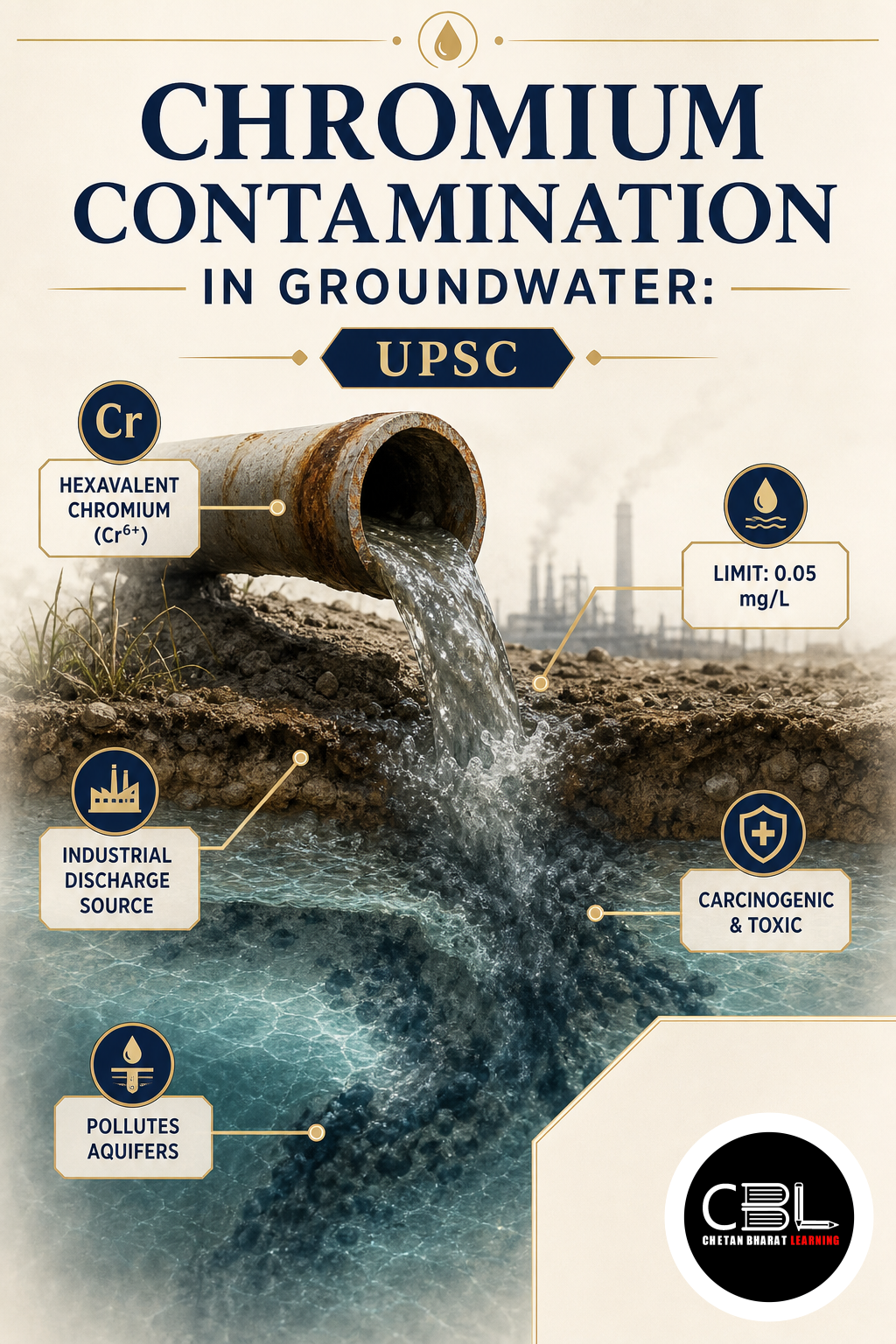
Chromium contamination refers to the presence of toxic levels of chromium, particularly hexavalent chromium (Cr(VI)), in water, soil, or air due to industrial and mining activities. Chromium occurs naturally as trivalent Cr(III), which is stable and essential in trace amounts, but anthropogenic processes oxidise it to the highly toxic, carcinogenic Cr(VI). Sources include leather tanning, electroplating, stainless steel welding, and chromite mining.
The World Health Organization (WHO) and Indian IS 10500 set the limit for total chromium in drinking water at 0.05 mg/L (50 ppb). Chromium contamination can cause severe health impacts, including lung cancer, liver damage, and skin lesions, and environmental effects like reduced soil fertility and bioaccumulation in food chains.
Why is Chromium Contamination in News?
Decades of improper waste disposal from tanneries and other industries have contaminated groundwater in central Uttar Pradesh, bringing chromium contamination back into the limelight. The issue highlights the failure of environmental regulations and the need for effective remediation. Similar problems have been reported in Odisha’s Sukinda Valley, which holds over 95% of India’s chromite reserves.
The recent Supreme Court interventions on pollution in other rivers have also drawn attention to heavy metal contamination. For official updates on environmental quality, refer to the Central Pollution Control Board notifications.
Key Features of Chromium Contamination
Understanding the characteristics of chromium contamination is vital for framing policies and remediation strategies. Key features include its sources, mobility, and persistence.
- Toxic form: Hexavalent chromium (Cr(VI)) is water-soluble, highly mobile, and carcinogenic.
- Industrial sources: Major contributors are tanneries, chromite mining, stainless steel production, electroplating, and dyeing.
- Environmental persistence: Cr(VI) can remain in groundwater for decades, necessitating long-term remediation.
- Health impacts: Exposure can lead to lung cancer, skin ulcers, anaemia, and damage to liver and kidneys.
- Ecological damage: It reduces soil fertility, inhibits photosynthesis and seed germination, and bioaccumulates in aquatic food webs.
Challenges in Addressing Chromium Contamination
Dealing with chromium contamination presents multiple challenges, from identification to cleanup. These obstacles are crucial for understanding the complexity of the issue.
- Lack of monitoring: Many industrial areas lack regular groundwater quality monitoring, leading to delayed detection.
- Remediation cost: Advanced treatments like reverse osmosis and ion exchange are expensive and energy-intensive.
- Regulatory enforcement: Weak enforcement of environmental laws allows industries to continue illegal dumping.
- Legacy waste: Historical dumping of chrome-tanning waste creates long-lasting contamination that is hard to clean.
- Public awareness: Communities are often unaware of the risks, leading to continued consumption of contaminated water.
Way Forward for Chromium Contamination
Addressing chromium contamination requires a multi-pronged approach: strict enforcement of zero-liquid discharge norms for industries, regular groundwater monitoring, and remediation of contaminated sites using bioremediation (Bacillus/Pseudomonas), phytoremediation (hyperaccumulators like mustard), and chemical reduction (ferrous sulphate precipitation).
Promoting cleaner production technologies in tanneries and chrome plating units, alongside a transition to less toxic alternatives, can reduce contamination at source. Public awareness campaigns and provision of safe drinking water in affected areas are immediate priorities. For global remediation techniques, refer to the EPA on chromium treatment.
Prelims Practice Corner
-
Q1. What is the permissible limit of total chromium in drinking water as per WHO and Indian standards?
- (a) 0.005 mg/L
- (b) 0.05 mg/L
- (c) 0.5 mg/L
- (d) 5 mg/L
Answer: (b) The limit is 0.05 mg/L (50 ppb).
-
Q2. Which state in India holds more than 95% of the country’s chromite reserves?
- (a) Karnataka
- (b) Odisha
- (c) Jharkhand
- (d) Rajasthan
Answer: (b) Sukinda Valley in Odisha contains over 95% of India’s chromite reserves.
-
Q3. Which is the most toxic form of chromium?
- (a) Trivalent chromium (Cr(III))
- (b) Hexavalent chromium (Cr(VI))
- (c) Metallic chromium
- (d) Chromium oxide
Answer: (b) Hexavalent chromium is highly toxic, carcinogenic, and water-soluble.
-
Q4. What is one effective bioremediation technique for chromium contamination?
- (a) Using Eucalyptus
- (b) Using Bacillus/Pseudomonas bacteria
- (c) Adding lime
- (d) Burning the soil
Answer: (b) Bacillus and Pseudomonas species can reduce Cr(VI) to less toxic Cr(III).
-
Q5. Which plant is known as a hyperaccumulator of chromium?
- (a) Sunflower
- (b) Mustard
- (c) Rice
- (d) Wheat
Answer: (b) Mustard (Brassica spp.) is a known hyperaccumulator for heavy metals including chromium.
Mains Practice Questions
-
Q1. Analyse the causes and consequences of chromium contamination in India and suggest effective remediation strategies. (15 marks)
Answer Structure:
- Intro: Define chromium contamination and its sources.
- Body: Discuss health and environmental impacts, with examples from Uttar Pradesh and Odisha. Evaluate existing regulations and enforcement gaps. Propose bioremediation, phytoremediation, and policy measures.
- Conclusion: Emphasise the need for preventive measures and public health safeguards.
-
Q2. Evaluate the effectiveness of the existing regulatory framework in controlling industrial heavy metal pollution in India. (10 marks)
Answer Structure:
- Intro: Outline major laws (Water Act, Environment Protection Act, EIA).
- Body: Evaluate strengths—standards, institutions (CPCB, SPCBs). Weaknesses—enforcement, monitoring, lack of pollution control infrastructure, and limited remediation capacity. Suggest improvements.
- Conclusion: Call for stricter compliance, pollution taxation, and technology adoption.
FAQs on Chromium Contamination
What is the difference between Cr(III) and Cr(VI)?
Trivalent chromium (Cr(III)) is stable, naturally occurring, and essential in small amounts. Hexavalent chromium (Cr(VI)) is toxic, soluble, and primarily anthropogenic, known for its carcinogenic properties.
Which industries are major contributors to chromium contamination?
Tanneries, chromite mining, electroplating, stainless steel manufacturing, textile dyeing, and improper disposal of slag are primary sources.
What are the health effects of hexavalent chromium exposure?
It can cause lung and stomach cancer, liver and kidney damage, anaemia, skin lesions, and respiratory issues. Chronic exposure increases cancer risk.
Related Current Affairs
Preparing for UPSC, PCS or HCS?
Talk to a mentor at Chetan Bharat Learning, Chandigarh. Free guidance on choosing the right exam and building a study plan.
Chat on WhatsAppCall 97793 53345UPSC / IAS / PCS coaching in Chandigarh · Trusted by aspirants across Punjab & Haryana
Leave a Reply
You must be logged in to post a comment.