

Important For
| Prelims | Mains |
|---|---|
| International Humanitarian Law, Defence Exports, India–Israel Relations | GS Paper II – International Relations, GS Paper III – Defence Technology |
Quick Facts
| Core Issue | Defence exports during armed conflict |
|---|---|
| Strategic Focus | Technology, joint production and strategic autonomy |
| Legal Focus | Distinction, proportionality and precaution |
What are India Israel Ties?
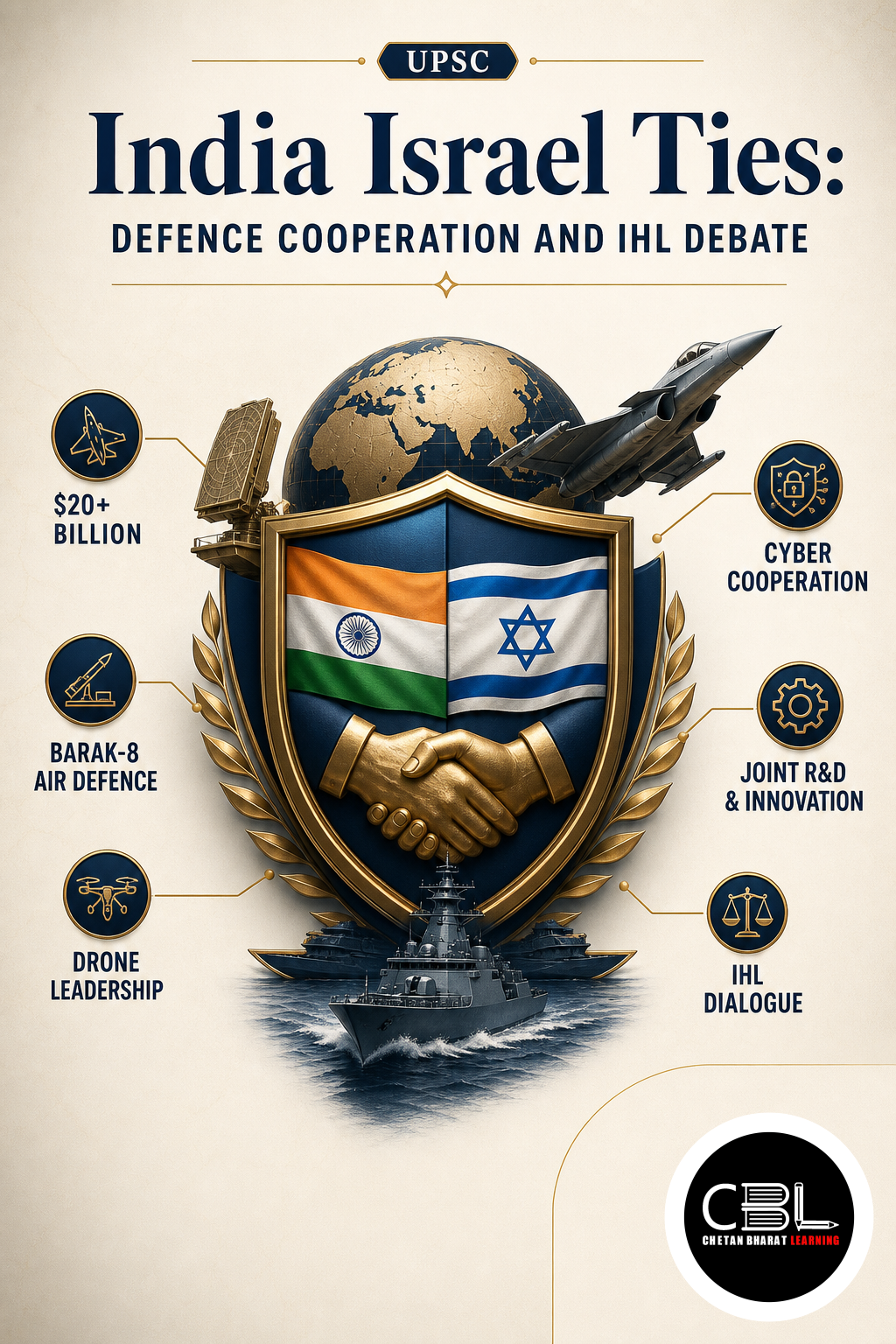
India Israel Ties in defence have evolved from relatively limited military engagement into a broader strategic relationship involving defence technology, research and development, cyber cooperation, intelligence sharing and industrial collaboration. The material presents this evolution through three broad stages: buyer–seller relations, technology partnership and joint production.
The defence relationship has therefore expanded beyond the purchase of military equipment. The material highlights the growing importance of Make in India, domestic manufacturing and defence industrialisation in shaping bilateral cooperation.
This evolution is significant because a defence partnership can involve several layers of engagement. Procurement provides access to equipment, while technology cooperation and joint production can contribute to domestic capabilities and industrial supply chains.
The material also places the relationship within a broader strategic framework. Defence cooperation is connected with India’s security requirements, technological capabilities and approach towards strategic autonomy.
Why are India Israel Ties in News?
According to the material, the immediate debate concerns India’s licensed defence exports to Israel during an ongoing armed conflict. The discussion raises questions about how strategic partnerships and defence-industrial interests should be considered alongside international humanitarian principles.
The material does not frame the issue as a question involving one isolated procurement decision. Instead, it examines the broader policy relationship and the responsibilities associated with defence exports when the recipient state is involved in an armed conflict.
The central challenge is to balance strategic interests with humanitarian and legal considerations. India has interests in defence capability, industrial development and strategic partnerships, while international humanitarian norms provide principles governing the conduct of hostilities.
The material specifically highlights International Humanitarian Law (IHL) in this context. The principles of distinction, proportionality and precaution are presented as important standards for assessing conduct during armed conflict.
For UPSC aspirants, the development is relevant because it brings together International Relations, defence production, strategic autonomy and international law. It also illustrates how foreign-policy decisions can involve overlapping strategic, economic, legal and ethical considerations.
Key Features
- Strategic partnership: Defence cooperation has expanded from equipment purchases towards technology development, research and industrial collaboration.
- Make in India: The material links bilateral defence cooperation with domestic production and the development of local defence capabilities.
- Technology partnership: Cooperation increasingly involves technology sharing and joint development rather than only conventional buyer–seller transactions.
- IHL principles: Distinction, proportionality and precaution provide important humanitarian principles for conduct during armed conflict.
- Export controls: India maintains a domestic framework governing defence exports and related policy decisions.
Challenges
- Strategic versus humanitarian considerations: Policymakers must balance national-security interests with humanitarian concerns and applicable legal principles.
- Ethical questions: Defence exports during an active conflict can generate difficult questions about responsible state conduct.
- International scrutiny: Defence-export decisions can attract legal, diplomatic and international attention.
- Conflict sensitivity: Export decisions require careful assessment of the wider conflict environment and applicable domestic controls.
- Strategic autonomy: India must pursue its interests while retaining policy flexibility and responsible decision-making.
Way Forward
The material presents a policy approach based on balancing strategic partnerships, defence-industrial development and humanitarian principles. Such an approach requires decisions to remain grounded in India’s national interests while considering applicable legal and regulatory frameworks.
India can strengthen the credibility of its defence-export policy through transparent domestic procedures, careful end-use assessment and continued attention to international humanitarian considerations. A structured assessment can help reconcile defence-industry objectives with responsible export practices.
The defence relationship can also continue to evolve towards technology development, joint production and domestic capability building. This would support the broader objective of strengthening India’s defence industrial ecosystem while reducing excessive dependence on imported systems.
At the diplomatic level, maintaining independent decision-making is important for strategic autonomy. India can pursue issue-based partnerships while retaining flexibility to assess each conflict and defence-export situation according to its strategic and legal context.
For UPSC, the broader lesson is that foreign-policy choices rarely involve only one objective. Security, technology, industrial development, diplomacy and international law can operate simultaneously, requiring a balanced and evidence-based approach.
Official information on India’s defence policies and institutional framework can be accessed through the Ministry of Defence website: https://mod.gov.in
Prelims Practice Corner
- Which International Humanitarian Law principle requires parties to distinguish between civilians and combatants?
(a) Reciprocity
(b) Distinction
(c) Sovereignty
(d) Neutrality
Answer: (b) Distinction - Which initiative is associated with the domestic-production dimension of defence cooperation?
(a) Digital India
(b) Make in India
(c) Skill India
(d) Start-up India
Answer: (b) Make in India - Which three IHL principles are highlighted in the material?
(a) Sovereignty, neutrality and reciprocity
(b) Distinction, proportionality and precaution
(c) Equality, taxation and neutrality
(d) Self-determination, sovereignty and intervention
Answer: (b) Distinction, proportionality and precaution - According to the material, India’s approach involves balancing strategic autonomy with:
(a) Isolation from all partners
(b) International law and humanitarian considerations
(c) Complete dependence on one supplier
(d) Withdrawal from defence cooperation
Answer: (b) International law and humanitarian considerations - According to the material, India–Israel defence cooperation has evolved from:
(a) Trade relations to agricultural cooperation
(b) Buyer–seller relations to technology partnership and joint production
(c) Cultural relations to tourism cooperation
(d) Maritime cooperation to financial integration
Answer: (b) Buyer–seller relations to technology partnership and joint production
Mains Practice Questions
- Discuss the evolution of India–Israel defence cooperation and examine its strategic significance for India. (10 Marks)
Answer Structure:
- Intro: Introduce the evolution of bilateral defence cooperation from buyer–seller relations towards broader strategic collaboration.
- Body: Cover technology partnerships, joint production, Make in India, defence industrialisation, research and development, strategic capability and autonomy.
- Conclusion: Conclude that deeper cooperation can strengthen India’s defence capabilities while supporting domestic industrial development.
- Examine the ethical and legal considerations associated with defence exports during armed conflicts. (15 Marks)
Answer Structure:
- Intro: Introduce the policy dilemma created when defence exports intersect with an ongoing armed conflict.
- Body: Discuss International Humanitarian Law, distinction, proportionality, precaution, domestic export controls, strategic interests, humanitarian concerns and international scrutiny.
- Conclusion: Conclude that responsible defence-export policy should balance strategic autonomy with legal compliance and humanitarian considerations.
FAQs on India Israel Ties
How have India–Israel defence ties evolved?
The relationship has moved from buyer–seller transactions towards technology partnerships and joint production, including research, cyber cooperation, intelligence sharing and defence industrial collaboration.
Why is International Humanitarian Law relevant?
It governs defence exports during an armed conflict and highlights the principles of distinction, proportionality and precaution as key humanitarian standards.
What is the role of Make in India in defence cooperation?
Make in India links bilateral defence cooperation with domestic production and joint manufacturing, reflecting a shift towards stronger defence-industrial capabilities.
What is the principle of distinction?
Distinction requires parties to differentiate between civilians and combatants to protect civilians during armed conflict.
What does proportionality mean under IHL?
Proportionality concerns avoiding excessive civilian harm relative to the anticipated military advantage.
What is the precaution principle?
Precaution involves measures taken to minimise harm to civilians during military operations.
Why do defence exports raise ethical questions?
They can support strategic and industrial objectives but may raise humanitarian and legal concerns when transferred during conflict.
Why are India Israel Ties important for UPSC?
The topic integrates International Relations, defence production, strategic autonomy, international humanitarian law and defence exports, relevant to GS Paper II and GS Paper III.
Related Current Affairs
Preparing for UPSC, PCS or HCS?
Talk to a mentor at Chetan Bharat Learning, Chandigarh. Free guidance on choosing the right exam and building a study plan.
Chat on WhatsAppCall 97793 53345UPSC / IAS / PCS coaching in Chandigarh · Trusted by aspirants across Punjab & Haryana
Leave a Reply
You must be logged in to post a comment.