
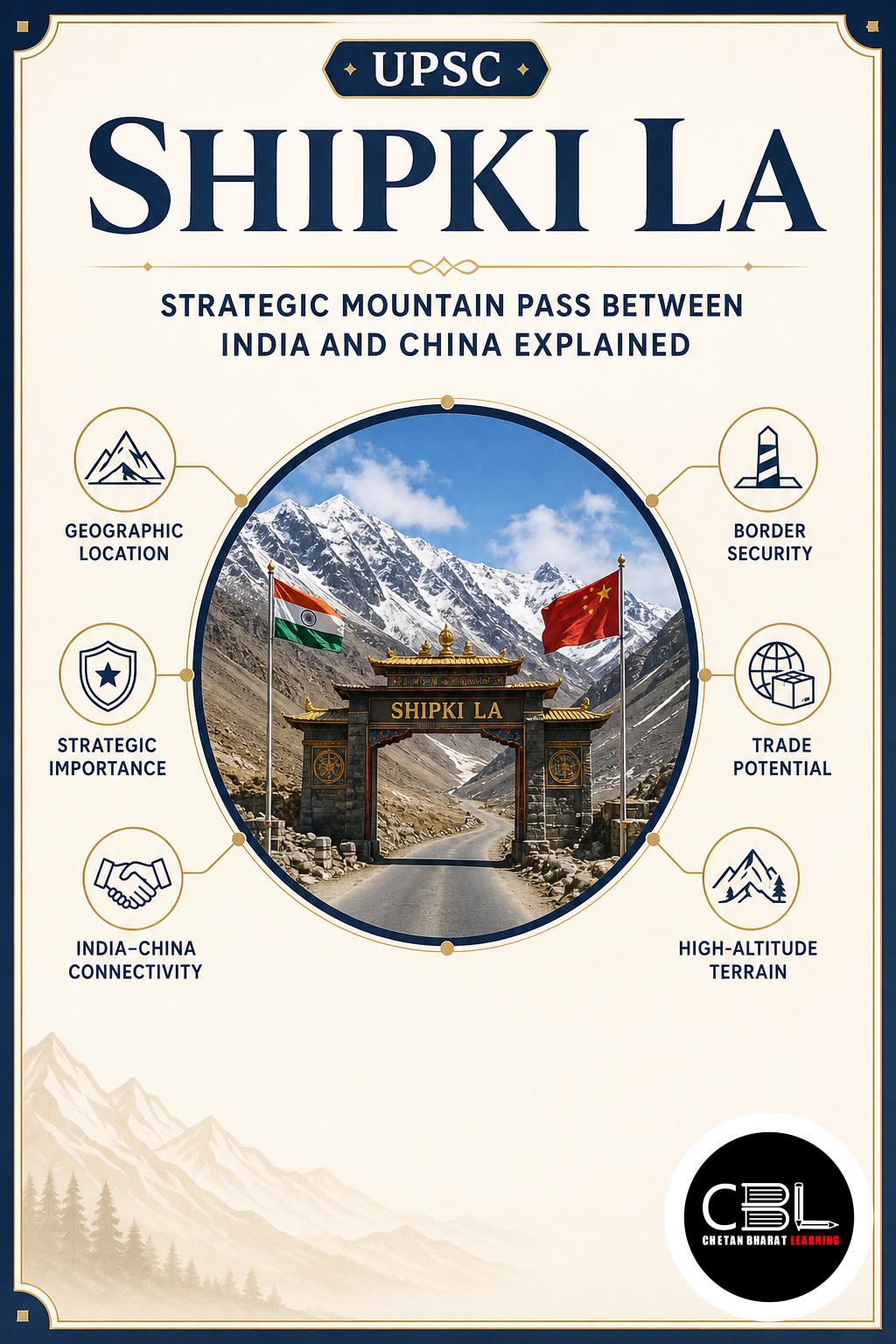

UPSC Mapping
- Prelims: Mountain Passes, India-China Border, Rivers of India
- Mains: GS Paper I – Physical Geography; GS Paper II – India and Neighbourhood Relations
Shipki La is in the news after India and China resumed border trade through the newly established Chhuppan Trade Mart at Namgya village following a six-year suspension since 2020. Aspirants should regularly follow the daily current affairs archive to revise strategically important mountain passes for UPSC. Shipki La is an important Prelims topic because of its geographical location, border trade significance and association with the Sutlej River.
| Altitude | About 3,930 metres |
|---|---|
| State | Himachal Pradesh |
| Connected Region | Tibet Autonomous Region |
| River | Sutlej enters India |
What is Shipki La?
Shipki La is a motorable mountain pass situated at an altitude of about 3,930 metres. It connects Kinnaur district of Himachal Pradesh with China’s Tibet Autonomous Region and is located on National Highway 5.
Historically known as Pema La (Shared Pass), it formed part of the ancient Silk Route. Following the 1962 India-China conflict, the pass became part of the Line of Actual Control (LAC).
Why is Shipki La in News?
Shipki La is in the news because India and China have resumed border trade through the newly established Chhuppan Trade Mart at Namgya village after a suspension that began in 2020.
The reopening is significant for border trade and regional connectivity.
Key Features
- Strategic location: It connects Himachal Pradesh with Tibet through a motorable mountain pass.
- Historic significance: The pass was historically called Pema La and formed part of the ancient Silk Route.
- Sutlej River: The Sutlej River, known as Langqen Zangbo in Tibet, enters India through Shipki La.
- Border trade: It is one of the three official bilateral land routes for India-China border trade, alongside Nathu La in Sikkim and Lipulekh in Uttarakhand.
- Connectivity: The pass lies on National Highway 5 and supports cross-border movement under approved arrangements.
Challenges
- Harsh climate: Snowfall and severe weather frequently affect transportation.
- Difficult terrain: Mountainous conditions make infrastructure maintenance challenging.
- Border sensitivities: The pass lies along the Line of Actual Control, requiring careful management.
- Seasonal accessibility: Trade and travel remain dependent on favourable weather conditions.
- Strategic importance: Border infrastructure requires continuous monitoring and development.
Way Forward
The resumption of border trade through Shipki La highlights the importance of maintaining well-developed border infrastructure while ensuring security and economic cooperation. Improved connectivity can strengthen livelihoods in border regions and facilitate regulated trade.
For UPSC, candidates should remember Shipki La’s location, altitude, connection with the Sutlej River, historical Silk Route significance and its status as one of the three official India-China border trade routes.
Prelims Practice Corner
Q1. Shipki La connects Himachal Pradesh with which region?
- (a) Xinjiang
- (b) Tibet Autonomous Region
- (c) Nepal
- (d) Bhutan
Answer: (b) Tibet Autonomous Region.
Q2. The Sutlej River enters India through:
- (a) Nathu La
- (b) Lipulekh
- (c) Shipki La
- (d) Rohtang Pass
Answer: (c) Shipki La.
Q3. Shipki La was historically known as:
- (a) Zoji La
- (b) Pema La
- (c) Jelep La
- (d) Bara La
Answer: (b) Pema La.
Q4. Shipki La lies on which National Highway?
- (a) NH-1
- (b) NH-5
- (c) NH-44
- (d) NH-10
Answer: (b) National Highway 5.
Q5. Which of the following is NOT an official India-China border trade route?
- (a) Shipki La
- (b) Nathu La
- (c) Lipulekh
- (d) Rohtang Pass
Answer: (d) Rohtang Pass.
Mains Practice Questions
Q1. Discuss the strategic and economic importance of mountain passes along the India-China border with special reference to Shipki La. (10 Marks)
- Intro: Introduce the role of Himalayan mountain passes.
- Body: Location, border trade, strategic value, connectivity and regional development.
- Conclusion: Highlight balanced development with border security.
Q2. Explain the geographical significance of the Sutlej River with reference to its origin and entry into India. (15 Marks)
- Intro: Introduce the Sutlej River.
- Body: Source, course, entry through Shipki La, tributaries and economic importance.
- Conclusion: Emphasise its strategic and developmental significance.
FAQs on Shipki La
Where is Shipki La located?
Shipki La is a mountain pass in Kinnaur district of Himachal Pradesh connecting India with Tibet Autonomous Region of China.
Which river enters India through Shipki La?
The Sutlej River, known as Langqen Zangbo in Tibet, enters India through Shipki La.
Why is Shipki La important for UPSC?
Shipki La is important because of its strategic location, historical Silk Route connection, border trade significance and association with the Sutlej River.
Related Current Affairs
Preparing for UPSC, PCS or HCS?
Talk to a mentor at Chetan Bharat Learning, Chandigarh. Free guidance on choosing the right exam and building a study plan.
Chat on WhatsAppCall 97793 53345UPSC / IAS / PCS coaching in Chandigarh · Trusted by aspirants across Punjab & Haryana
Leave a Reply
You must be logged in to post a comment.