

UPSC Mapping
| Prelims | Mains |
|---|---|
| Articles 75 & 77; Council of Ministers; President; Prime Minister | GS Paper II – Constitution; Executive & Parliamentary Government |
What is Union Minister Resignation?
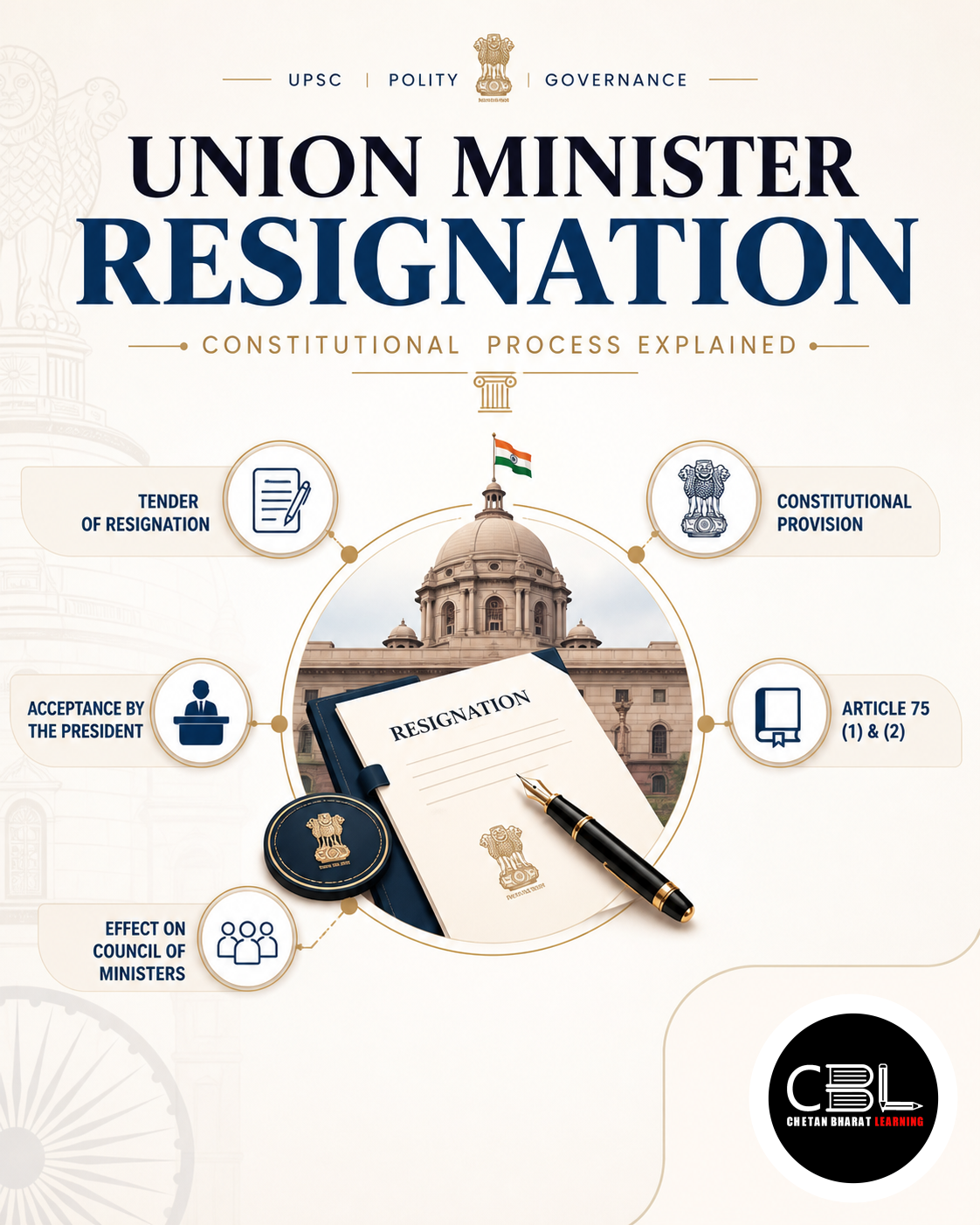
Union Minister Resignation refers to the process through which a member of the Union Council of Ministers voluntarily leaves office or is required to vacate office on the advice of the Prime Minister. Although the Constitution does not prescribe a detailed resignation procedure, constitutional conventions and executive practice govern the process.
Under Article 75(2), Ministers hold office during the pleasure of the President. However, the President acts on the advice of the Prime Minister, who determines the composition of the Council of Ministers and recommends acceptance of resignations and allocation of portfolios.
Why is Union Minister Resignation in News?
The issue gained attention after the resignation of the Union Minister for Education following the entrance examination paper leak controversy. Subsequently, another Cabinet Minister was entrusted with the additional charge of the Ministry of Education until further arrangements were made.
The development highlights the constitutional mechanism governing ministerial resignations, portfolio allocation and continuity of executive administration. Official constitutional information is available through the Constitution of India.
Key Features of Union Minister Resignation
The Constitution and established conventions ensure continuity and accountability within the Union Executive.
- Article 75(1): The President appoints the Prime Minister, while other Ministers are appointed on the Prime Minister’s advice.
- Article 75(2): Ministers hold office during the pleasure of the President, enabling acceptance of resignations and removal when advised by the Prime Minister.
- Article 75(3): The Council of Ministers is collectively responsible to the Lok Sabha, allowing individual ministerial changes without affecting the government’s continuity.
- Article 77(3): The President allocates government business among Ministers under the Government of India (Allocation of Business) Rules.
- Additional charge: An existing Minister may receive temporary responsibility for another ministry without taking a fresh oath because the constitutional oath has already been administered.
Challenges
Ministerial changes may present administrative and governance challenges despite constitutional continuity.
- Administrative continuity: Frequent portfolio changes may temporarily affect policy implementation.
- Public accountability: Resignations often raise questions regarding ministerial responsibility and governance standards.
- Policy coordination: Additional charge arrangements may increase the workload of existing Cabinet Ministers.
- Political considerations: Cabinet reshuffles require balancing governance priorities with political representation.
- Institutional efficiency: Smooth transfer of responsibilities is essential for uninterrupted public administration.
Way Forward
Constitutional conventions governing ministerial resignations ensure that executive accountability is balanced with administrative continuity. Timely allocation of portfolios and adherence to the principle of collective responsibility strengthen the functioning of parliamentary democracy.
A transparent and efficient process of resignation and reappointment reinforces public confidence in the constitutional framework while ensuring uninterrupted governance. Additional information regarding executive functioning is available on the Cabinet Secretariat.
Prelims Practice Corner
Q1. Under which Article do Union Ministers hold office during the pleasure of the President?
- (a) Article 74
- (b) Article 75(2)
- (c) Article 77
- (d) Article 78
Answer: Article 75(2) provides that Ministers hold office during the pleasure of the President.
Q2. The Council of Ministers is collectively responsible to:
- (a) Rajya Sabha
- (b) President
- (c) Lok Sabha
- (d) Supreme Court
Answer: Article 75(3) makes the Council of Ministers collectively responsible to the Lok Sabha.
Q3. Government business among Union Ministers is allocated under:
- (a) Article 72
- (b) Article 77(3)
- (c) Article 80
- (d) Article 85
Answer: Article 77(3) authorises allocation of government business among Ministers.
Q4. If an existing Cabinet Minister receives additional charge of another Ministry:
- (a) A fresh election is required
- (b) A fresh oath of office is mandatory
- (c) No fresh oath is required
- (d) Parliament must approve the appointment
Answer: No fresh oath is required for additional charge.
Q5. Union Ministers are appointed by the President on the advice of the:
- (a) Chief Justice of India
- (b) Vice-President
- (c) Prime Minister
- (d) Speaker of Lok Sabha
Answer: Article 75(1) provides that Ministers are appointed by the President on the advice of the Prime Minister.
Mains Practice Questions
Q1. Explain the constitutional provisions governing the resignation and appointment of Union Ministers in India. (10 marks)
Answer Structure:
- Intro: Introduce the constitutional framework.
- Body: Discuss Articles 75 and 77, constitutional conventions, collective responsibility and additional charge.
- Conclusion: Emphasise executive accountability and continuity.
Q2. Examine the significance of the doctrine of collective responsibility in the functioning of the Union Council of Ministers. (15 marks)
Answer Structure:
- Intro: Define collective responsibility.
- Body: Explain constitutional basis, practical operation, ministerial accountability and contemporary relevance.
- Conclusion: Highlight its importance in parliamentary democracy.
FAQs on Union Minister Resignation
Which constitutional provision governs the resignation of Union Ministers?
Article 75(2) states that Union Ministers hold office during the pleasure of the President, while resignations are processed on the advice of the Prime Minister through constitutional convention.
Is a fresh oath required when an existing Minister receives an additional portfolio?
No. Since the Minister has already taken the constitutional oath of office and secrecy, no fresh oath is required for an additional charge.
Why is this topic important for UPSC?
It is relevant for GS Paper II because it covers the Union Executive, constitutional provisions, parliamentary conventions, ministerial responsibility and governance.
Related Current Affairs
Preparing for UPSC, PCS or HCS?
Talk to a mentor at Chetan Bharat Learning, Chandigarh. Free guidance on choosing the right exam and building a study plan.
Chat on WhatsAppCall 97793 53345UPSC / IAS / PCS coaching in Chandigarh · Trusted by aspirants across Punjab & Haryana
Leave a Reply
You must be logged in to post a comment.