
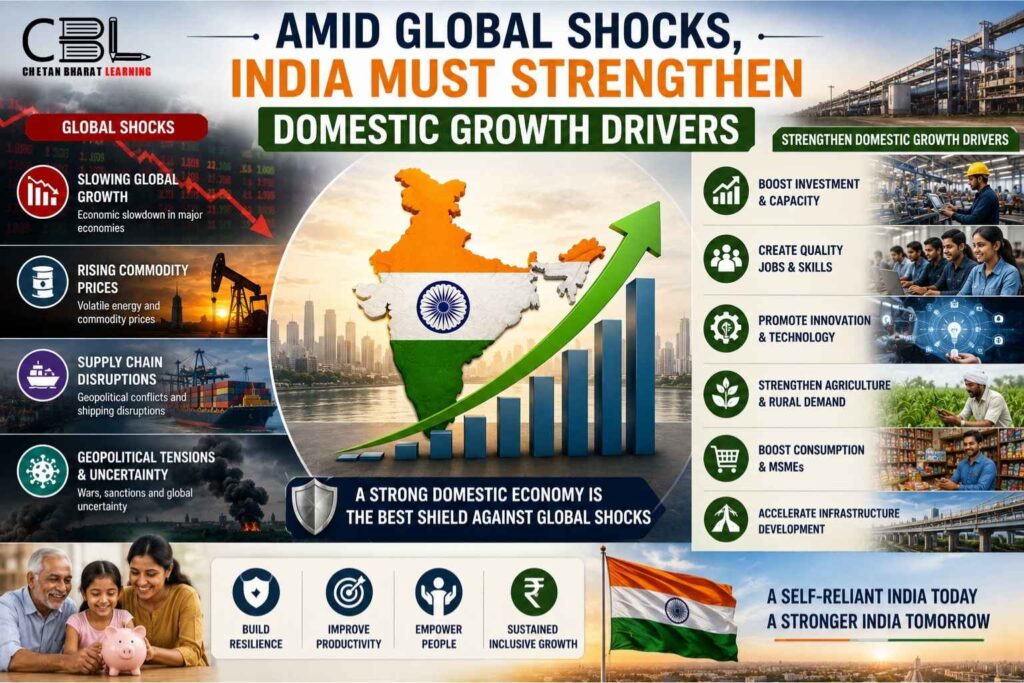
India’s economy demonstrated remarkable resilience during FY 2025-26, recording a growth rate of 7.7% despite global uncertainties, geopolitical tensions, and trade disruptions. However, the economic environment for FY 2026-27 appears more challenging. Rising energy prices, inflationary pressures, slowing global demand, and climate-related risks are creating fresh concerns for policymakers.
Against this backdrop, economists argue that India must increasingly rely on domestic growth drivers rather than external factors. Strengthening investment, consumption, infrastructure development, and ease of doing business will be essential to sustaining long-term economic growth.
For aspirants preparing through UPSC Coaching in Chandigarh and IAS Coaching in Chandigarh, this topic is important for Economy, Internal Growth Drivers, Inflation, Monetary Policy, and Economic Development.
India’s Growth Performance in FY 2025-26
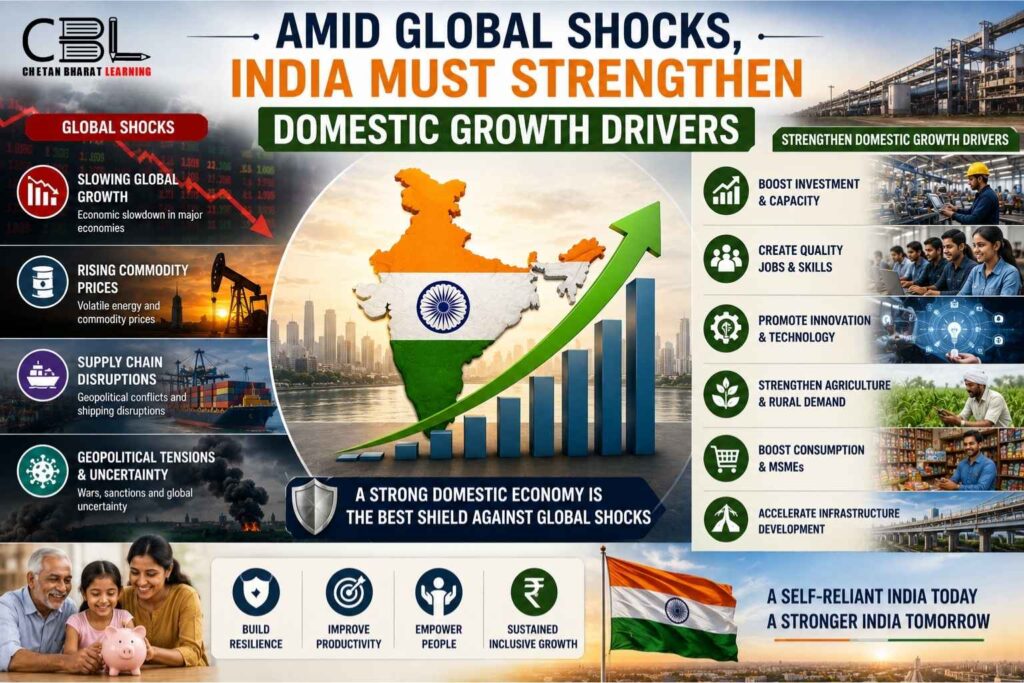
Despite difficult global conditions, India remained one of the fastest-growing major economies in the world.
According to official estimates, GDP growth reached 7.7% during FY 2025-26. Strong domestic demand, healthy investment activity, and a resilient services sector contributed significantly to this performance.
Private consumption remained a major pillar of growth, while public investment in infrastructure continued to support economic activity. The services sector, particularly finance, real estate, communication, and professional services, maintained strong momentum throughout the year.
These factors helped India withstand global disruptions and maintain macroeconomic stability.
Role of Government Policies
Several policy interventions supported economic growth during the year.
The Reserve Bank of India adopted measures that improved financial conditions and supported demand. Fiscal initiatives such as GST rationalisation, tax relief measures, and direct benefit transfers also contributed to strengthening purchasing power and consumer confidence.
Government spending on infrastructure projects generated employment opportunities and stimulated investment activity. Together, fiscal and monetary policies created a supportive environment for economic growth.
Why Growth May Slow in FY 2026-27
Although the previous year was encouraging, growth expectations for the current fiscal year have become more cautious.
The RBI has projected GDP growth at around 6.6%, lower than the previous year’s performance. Several risks are contributing to this slowdown.
Global economic uncertainty continues to affect trade and investment flows. Many of India’s major export destinations, including the United States and Europe, are expected to experience slower growth, reducing demand for Indian exports.
At the same time, geopolitical tensions in West Asia have increased uncertainty in global energy markets, creating inflationary pressures and raising production costs.
Impact of Rising Energy Prices
Energy remains one of India’s biggest economic vulnerabilities.
India imports a large portion of its crude oil requirements, making it highly sensitive to fluctuations in international oil prices. Any prolonged rise in crude prices increases transportation costs, manufacturing expenses, and overall inflation.
Higher energy costs also reduce household purchasing power and can negatively impact business profitability. If global conflicts continue to disrupt energy supplies, India’s growth prospects may face additional pressure.
This issue is particularly relevant when discussing Energy Security and economic stability in UPSC examinations.
Inflation Risks on the Horizon
Inflation remains another major concern.
While consumer inflation has remained relatively moderate, rising fuel prices, imported inflation, and supply-chain disruptions could push prices higher in the coming months.
Food inflation may also become a challenge if weather conditions affect agricultural production. Rising inflation reduces consumer spending and limits the effectiveness of monetary policy in stimulating growth.
For policymakers, balancing inflation control with growth support will remain a difficult task.
Monsoon and Agricultural Concerns
The possibility of a weak monsoon presents another risk to India’s economic outlook.
Weather agencies have indicated the possibility of below-normal rainfall due to climatic factors such as El Niño. A weak monsoon can affect agricultural production, rural incomes, food prices, and overall economic activity.
Since a significant portion of India’s population depends on agriculture for livelihood, any disruption in farm output can have wider economic consequences.
Agriculture continues to play a crucial role in supporting domestic demand and maintaining food security.
Why Domestic Growth Drivers Matter
In an increasingly uncertain global environment, domestic growth drivers become even more important.
India’s large domestic market provides a strong foundation for economic expansion. Private consumption, urbanisation, digitalisation, infrastructure development, and manufacturing growth can help offset external shocks.
Encouraging entrepreneurship, improving ease of doing business, and supporting MSMEs can generate employment and attract investment.
The government’s focus on infrastructure, logistics improvement, and manufacturing initiatives such as Make in India can further strengthen long-term growth potential.
Key Areas Requiring Attention
To sustain growth momentum, policymakers must focus on several priorities.
Strengthening Private Investment
Private sector investment remains essential for long-term economic expansion and job creation.
Supporting MSMEs
Small and medium enterprises generate significant employment and contribute substantially to GDP.
Improving Infrastructure
Better transportation, logistics, and digital infrastructure can improve productivity and competitiveness.
Enhancing Energy Security
Reducing dependence on imported energy can protect the economy from global shocks.
Agricultural Resilience
Investing in climate-resilient agriculture can reduce the impact of weather-related disruptions.
Significance for UPSC Aspirants
This topic is important for multiple sections of the UPSC syllabus.
Prelims
- GDP Growth
- Inflation
- RBI Monetary Policy
- Fiscal Policy
- Energy Security
GS Paper III
- Indian Economy
- Economic Growth and Development
- Inflation Management
- Infrastructure Development
- Energy Security
Essay Topics
- India’s Growth Story
- Economic Resilience in a Changing World
- Domestic Drivers of Economic Growth
- Balancing Growth and Inflation
Students studying through UPSC Coaching in Chandigarh can use current GDP and inflation trends as contemporary examples in Mains answers. Aspirants enrolled in IAS Coaching in Chandigarh can utilise these developments while discussing India’s economic prospects and policy challenges.
FAQs
Why is India’s GDP growth expected to slow?
Global uncertainties, higher energy prices, inflation risks, and weaker export demand are expected to moderate growth.
What are domestic growth drivers?
Domestic growth drivers include consumption, investment, infrastructure development, manufacturing, agriculture, and services.
How do rising oil prices affect India?
Higher oil prices increase inflation, raise production costs, and reduce consumer purchasing power.
Why is inflation a concern for economic growth?
Persistent inflation reduces demand, affects savings, and limits policy flexibility.
Why is this topic important for UPSC?
It covers economic growth, inflation, energy security, monetary policy, and development issues that are frequently asked in UPSC examinations.
Conclusion
India’s strong growth performance in FY 2025-26 demonstrates the resilience of its economy. However, the outlook for the coming year is more uncertain due to global conflicts, inflationary pressures, energy market volatility, and climate-related risks. In such a scenario, relying solely on external demand is unlikely to be sufficient.
The need of the hour is to strengthen domestic growth drivers through investment, infrastructure, innovation, agricultural resilience, and energy security. By addressing structural bottlenecks and supporting economic reforms, India can continue its growth journey despite an increasingly uncertain global environment.
Related Current Affairs
Preparing for UPSC, PCS or HCS?
Talk to a mentor at Chetan Bharat Learning, Chandigarh. Free guidance on choosing the right exam and building a study plan.
Chat on WhatsAppCall 97793 53345UPSC / IAS / PCS coaching in Chandigarh · Trusted by aspirants across Punjab & Haryana
Leave a Reply
You must be logged in to post a comment.