

UPSC Mapping
| Prelims | Science & Technology — Astronomy and Space Weather |
|---|---|
| Mains | General Studies Paper III |
Quick Facts
| Date | 12 August 2026 |
|---|---|
| Type | Total solar eclipse |
| Totality Path | Greenland, Iceland, Russia and Spain |
| Maximum Duration | About 2 minutes 18 seconds |
What is Total solar eclipse?
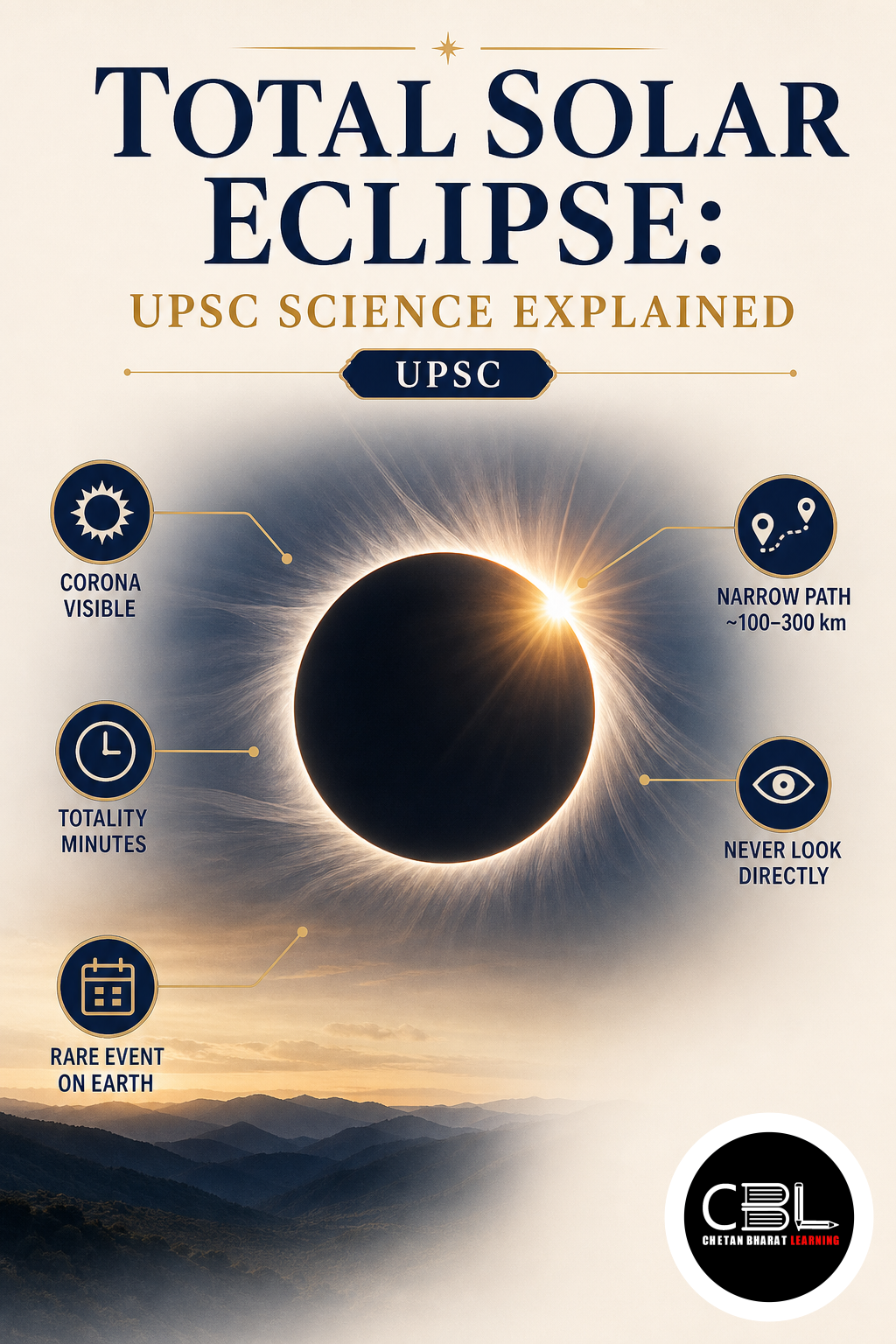
A total solar eclipse occurs when the Moon passes between Earth and the Sun and completely covers the bright solar disk for observers located within the Moon’s umbra. The umbra is the darker central part of the Moon’s shadow, while the wider penumbra produces a partial eclipse. The apparent similarity between the angular sizes of the Sun and Moon allows this alignment to produce totality.
During totality, the bright photosphere disappears behind the Moon and the much fainter corona becomes visible. The corona is the Sun’s outer atmosphere and contains extremely hot, ionised plasma shaped by complex magnetic fields. NASA notes that the corona can reach temperatures above one million degrees Celsius, creating one of solar physics’ major scientific puzzles.
Why is Total solar eclipse in News?
The 12 August 2026 eclipse crossed a path of totality extending through northern Russia, Greenland, Iceland and Spain, with a small part of Portugal also included. Other regions across Europe, North America and northwestern Africa experienced a partial eclipse. For most locations in the path of totality, the period of complete coverage lasted less than two minutes, while the maximum duration was a little over two minutes.
The event also matters because the Sun remains in an active phase of its approximately 11-year solar cycle. Solar activity influences flares, coronal mass ejections and the solar wind, all of which contribute to space weather. Scientists therefore use eclipse observations alongside spacecraft data to understand the corona, solar wind and processes that can influence Earth’s technological environment.
NASA has highlighted eclipses as valuable scientific opportunities because the Moon naturally blocks the bright solar disk without eliminating the corona from view. The agency continues to combine eclipse observations with spacecraft observations to improve understanding of the Sun-Earth system.
Key Features
- Corona becomes observable: The Moon suppresses the overwhelming brightness of the solar disk, allowing the faint outer atmosphere to be studied during totality.
- Solar magnetic fields: Coronal streamers, loops and other structures reflect the influence of the Sun’s complex magnetic field on plasma.
- Solar wind connection: The corona is closely connected with the continuous outward flow of charged particles known as the solar wind.
- Space-weather relevance: Solar flares and coronal mass ejections can disturb the magnetosphere and affect satellites, navigation, radio communication and power infrastructure.
- Scientific observations: Eclipse images and spectroscopic measurements complement spacecraft observations by providing information about the inner corona that is difficult to obtain otherwise.
Challenges
- Short observation window: Totality lasts only a few minutes, leaving scientists with limited time for ground-based measurements.
- Weather dependence: Clouds, atmospheric conditions and poor visibility can prevent observers from collecting useful data from the ground.
- Restricted path: Only observers inside the narrow path of totality experience complete coverage of the solar disk.
- Complex solar behaviour: Magnetic fields, plasma flows and eruptions interact across different scales, making the corona difficult to model precisely.
- Technology dependence: Understanding space weather requires coordinated observations from ground stations, satellites and specialised instruments rather than eclipse observations alone.
For UPSC preparation, these limitations can be linked with the wider theme of space-based observation and the role of scientific infrastructure.
Way Forward
Future total solar eclipse observations should combine ground-based astronomy with data from solar observatories and space missions. Multi-wavelength observations can help scientists connect visible coronal structures with magnetic activity, solar wind generation and energetic eruptions. This approach can improve the scientific understanding of the Sun while strengthening space-weather forecasting.
For India, the broader lesson is the value of space-weather preparedness. Satellite navigation, communication networks, aviation, power systems and space missions can be affected by strong solar activity. Agencies and research institutions can therefore benefit from sustained solar monitoring, modelling and international data-sharing.
Prelims Practice Corner
Q1. Consider the following statements about a total solar eclipse:
1. It occurs when the Moon completely blocks the bright solar disk for observers within the umbra.
2. The corona becomes easier to observe during totality.
3. The entire Earth experiences totality during the event.
Options: (a) 1 and 2 only (b) 2 and 3 only (c) 1 and 3 only (d) 1, 2 and 3
Answer: (a) 1 and 2 only. Totality occurs only within the Moon’s narrow umbral path.
Q2. The corona is best described as which of the following?
Options: (a) The innermost layer of Earth’s atmosphere (b) The outer atmosphere of the Sun (c) The solid surface of the Moon (d) The region between Earth and Moon
Answer: (b) The outer atmosphere of the Sun. It consists of very hot, ionised plasma.
Q3. Which of the following is most directly associated with space weather?
Options: (a) Solar flares and CMEs (b) Ocean tides only (c) Earthquakes only (d) Volcanic ash
Answer: (a) Solar flares and CMEs. They can disturb Earth’s near-space environment and technological systems.
Q4. The approximately 11-year solar cycle is primarily associated with changes in which feature?
Options: (a) Solar magnetic activity (b) Earth’s axial tilt (c) Moon’s orbital plane (d) Earth’s ocean salinity
Answer: (a) Solar magnetic activity. Sunspots, flares and other activity vary across the solar cycle.
Q5. During the partial phases of a solar eclipse, which practice is appropriate?
Options: (a) Use ordinary sunglasses (b) Look briefly with the naked eye (c) Use specialised solar viewing protection (d) Use an uncovered telescope
Answer: (c) Use specialised solar viewing protection. NASA advises eye protection during all partial phases.
Mains Practice Questions
Q1. Explain why observations of the solar corona during eclipses are important for understanding space weather. (10 marks)
- Intro: Define the corona and explain why its faint light becomes observable during totality.
- Body: Cover coronal magnetic fields, solar wind, flares, CMEs, space-weather impacts and the role of satellite observations.
- Conclusion: Link improved solar understanding with stronger forecasting and protection of critical infrastructure.
Q2. Discuss the significance of solar activity for modern technological infrastructure and national preparedness. (15 marks)
- Intro: Introduce space weather as changing conditions in near-Earth space driven by solar activity.
- Body: Discuss effects on satellites, GPS, aviation, communication, power grids and astronauts; add monitoring, forecasting, international cooperation and indigenous space capabilities.
- Conclusion: Emphasise a resilient Sun-Earth monitoring framework combining science, infrastructure planning and early warnings.
FAQs on Total solar eclipse
Why does the corona become visible during totality?
The bright photosphere normally overwhelms the much fainter corona. When the Moon completely covers the photosphere, the corona can be observed more clearly around the dark lunar disk.
What makes total solar eclipse observations scientifically useful?
They provide access to the inner corona, where scientists can study plasma structures and magnetic activity. These observations complement spacecraft data used to understand solar wind and space weather.
Is eye protection needed during a solar eclipse?
Yes, during all partial phases viewers should use proper solar viewing glasses or another safe method. Direct viewing without specialised protection is safe only during the brief period when the Moon completely covers the Sun’s bright face.
Related Current Affairs
Preparing for UPSC, PCS or HCS?
Talk to a mentor at Chetan Bharat Learning, Chandigarh. Free guidance on choosing the right exam and building a study plan.
Chat on WhatsAppCall 97793 53345UPSC / IAS / PCS coaching in Chandigarh · Trusted by aspirants across Punjab & Haryana
Leave a Reply
You must be logged in to post a comment.