

UPSC Mapping
Prelims
- Science & Health
Mains
- GS Paper 3 (Science & Technology)
| Market Position | 4th in Asia |
|---|---|
| Key Framework | SAHI (2026) |
| AI Platform | BODH (IIT Kanpur) |
| Data Platform | AIKosh |
What is AI in MedTech?
AI in MedTech refers to the integration of artificial intelligence tools and algorithms into medical devices, diagnostics, drug discovery, and healthcare delivery systems. India’s medical devices market, a sunrise sector, is projected to reach US$50 billion by 2030, with exports rising 88% to ~$3.64 billion in FY25.
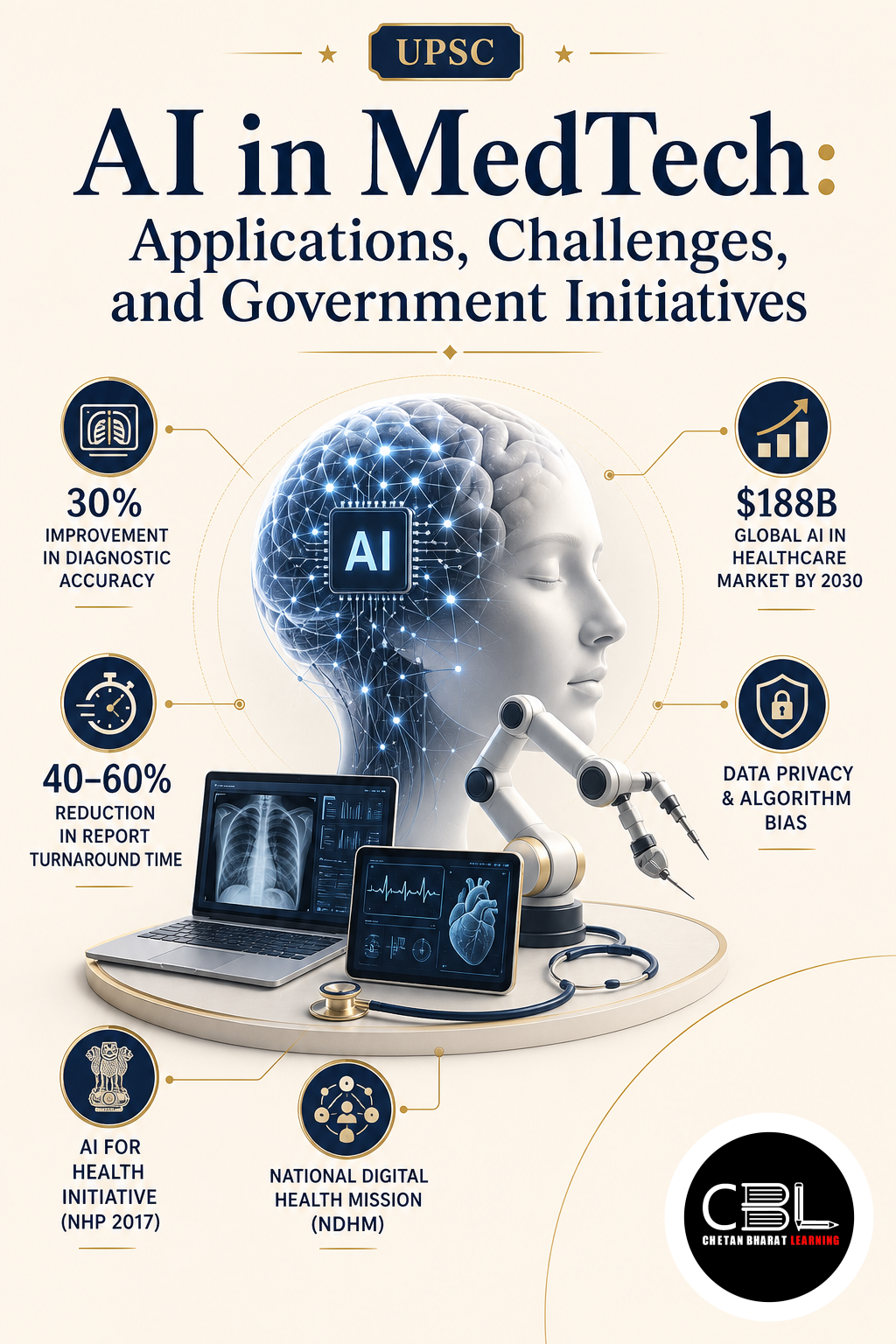
Historically reliant on imports for 75–80% of domestic needs, India has increased its local market share from 10% to 30% in five years. AI is seen as a catalyst to further reduce import dependence and improve diagnostic accuracy, rural access, and precision medicine through tools like AI-powered ECGs and diabetic retinopathy screening.
Why is AI in MedTech in News?
AI in MedTech is currently in the news because the Union Minister for Health released a knowledge paper calling for scaling successful AI pilots to ensure widespread clinical adoption. The paper emphasises equitable healthcare access, especially in rural areas where specialist shortages are acute.
Additionally, the government launched the Strategy for Artificial Intelligence in Healthcare (SAHI) in 2026 as an apex policy framework. The IndiaAI–ICMR partnership launched the AIKosh Dataset Platform, providing startups access to over 3,000 anonymised biomedical datasets and subsidising GPU infrastructure. For more details, refer to the official PIB release.
Key Features of AI in MedTech
- Diagnostic Accuracy: AI tools rapidly and precisely analyse X-rays, MRIs, and CT scans, potentially reducing diagnostic errors by up to 40% globally.
- Rural Access: AI embeds expert skills into portable devices like ECG and diabetic-retinopathy screening tools, expanding diagnostics to Primary Health Centers (PHCs).
- Drug Discovery: AI and machine learning improve clinical trials and molecular simulations, reducing pharmaceutical R&D time and costs.
- Precision Care: AI uses genetic, behavioural, and environmental data to predict disease recurrence and tailor individualised treatment protocols.
- Policy Frameworks: SAHI (2026) provides guidelines for safe, ethical, and equitable clinical AI, while the BODH platform enables secure benchmarking of AI models on Indian health data.
Challenges Associated with AI in MedTech
- Data Bias: Most AI models are trained on urban or Western data, overlooking India’s socio-economic and genetic diversity, leading to skewed diagnostics.
- Regulatory Ambiguity: The Medical Devices Rules, 2017 mainly address static hardware and inadequately cover dynamic, self-learning Software as a Medical Device (SaMD).
- Data Fragmentation: Clinical data remains fragmented across public and private silos, hindering unified, AI-ready datasets despite ABDM.
- Commercialisation Barrier: Lack of public procurement policies and insurance reimbursement for AI interventions limits scale-up.
- Equity Concerns: AI could widen the digital divide if not deployed with a focus on affordability and accessibility.
Way Forward for AI in MedTech
To harness the full potential of AI in MedTech, India must invest in diverse, representative datasets and encourage public-private partnerships for data sharing. Updating the regulatory framework to explicitly cover SaMD will provide clarity and foster innovation.
Creating structured reimbursement pathways and public procurement policies for AI-enabled diagnostics will incentivise adoption. Additionally, training healthcare workers in AI tools and ensuring equitable access through telemedicine can bridge the rural-urban divide. A collaborative approach involving ICMR, CDSCO, and industry is essential.
Prelims Practice Corner
-
Q1. Which apex policy framework for AI in healthcare was launched in 2026?
- (a) National Health Policy 2020
- (b) Strategy for Artificial Intelligence in Healthcare (SAHI)
- (c) Digital Health Mission
- (d) MedTech Policy 2025
Answer: (b) SAHI was launched in 2026 as the apex policy framework.
-
Q2. What is the BODH platform?
- (a) A medical device manufacturing hub
- (b) A drug discovery AI model
- (c) A platform to benchmark AI models on Indian health data
- (d) A telemedicine app
Answer: (c) BODH, developed by IIT Kanpur and NHA, enables secure benchmarking of AI models.
-
Q3. What is the projected size of India’s medical devices market by 2030?
- (a) US$25 billion
- (b) US$50 billion
- (c) US$75 billion
- (d) US$100 billion
Answer: (b) The market is projected to reach US$50 billion by 2030.
-
Q4. Which initiative provides startups access to over 3,000 anonymised biomedical datasets?
- (a) AIKosh Dataset Platform
- (b) MedTech Mitra
- (c) SAHI
- (d) BODH
Answer: (a) The AIKosh Dataset Platform was launched under the IndiaAI–ICMR partnership.
-
Q5. What is a major challenge for AI in MedTech in India?
- (a) High internet connectivity
- (b) Lack of trained radiologists
- (c) Data bias due to Western-trained models
- (d) Abundance of structured health data
Answer: (c) AI models often train on Western data, overlooking India’s genetic diversity.
Mains Practice Questions
-
Q1. Discuss the potential of AI in transforming India’s MedTech landscape. What are the key challenges and policy interventions needed to realise this potential? (250 words, 15 marks)
Answer Structure:
- Intro: Introduce AI in MedTech and its significance for India’s healthcare.
- Body: Discuss applications: diagnostics, drug discovery, rural access. Analyse challenges: data bias, regulatory gaps, commercialisation. Suggest policy interventions: SAHI, data sharing frameworks, reimbursement policies.
- Conclusion: Conclude that AI can revolutionise healthcare if supported by robust governance and infrastructure.
-
Q2. Evaluate the role of government initiatives like SAHI and AIKosh in promoting AI adoption in healthcare. (150 words, 10 marks)
Answer Structure:
- Intro: Mention SAHI and AIKosh as recent policy and data initiatives.
- Body: Explain SAHI as an ethical and governance framework; AIKosh provides data access and GPU support to startups. Also mention MedTech Mitra for regulatory guidance.
- Conclusion: Conclude that these initiatives are foundational but need complementary efforts in training and infrastructure.
FAQs on AI in MedTech
-
What is the role of AI in MedTech?
AI enhances diagnostic accuracy, enables rural access through portable devices, accelerates drug discovery, and enables precision medicine by analysing genetic and lifestyle data.
-
What is SAHI?
SAHI (Strategy for Artificial Intelligence in Healthcare) is India’s apex policy framework launched in 2026 to guide safe, ethical, and equitable clinical AI adoption.
-
What is the AIKosh Dataset Platform?
Launched under the IndiaAI–ICMR partnership, AIKosh provides startups access to over 3,000 anonymised biomedical datasets and subsidised GPU infrastructure for AI model development.
Related Current Affairs
Preparing for UPSC, PCS or HCS?
Talk to a mentor at Chetan Bharat Learning, Chandigarh. Free guidance on choosing the right exam and building a study plan.
Chat on WhatsAppCall 97793 53345UPSC / IAS / PCS coaching in Chandigarh · Trusted by aspirants across Punjab & Haryana
Leave a Reply
You must be logged in to post a comment.