

UPSC Mapping
Important For
| Prelims | Mains |
|---|---|
| Geography & Environment | GS Paper 1 (Geography) & GS Paper 3 (Environment) |
Quick Facts
| Altitude | 21-23 km |
|---|---|
| Campaign | NetRAD-ASMA Phase-I |
| Key Institution | ARIES, Nainital |
Article
What is the Ozone Layer Bay Bengal Discovery?
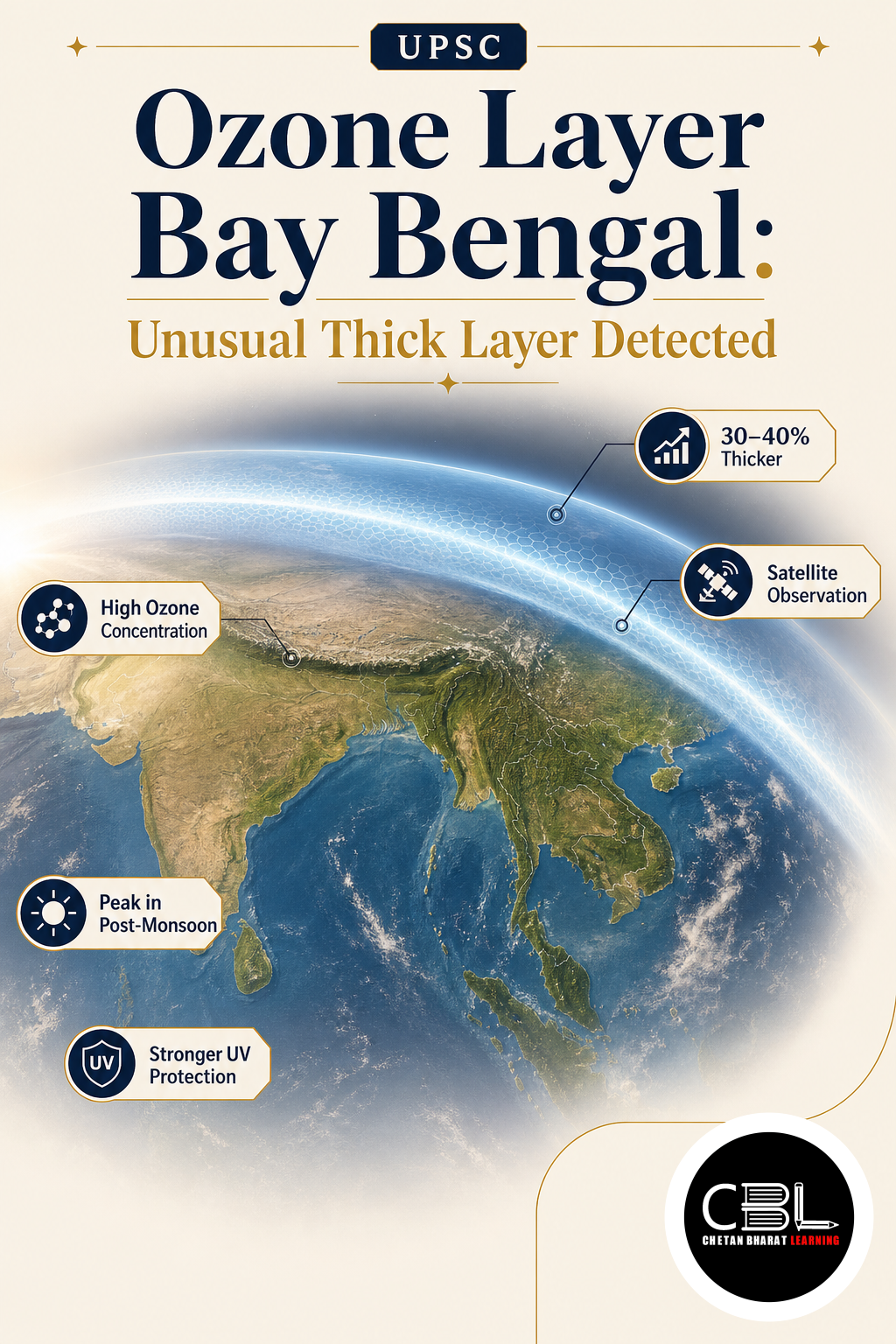
The Ozone Layer Bay Bengal discovery refers to the detection of an unusually thick ozone layer over the North Bay of Bengal, at an altitude of 21-23 kilometres in the lower stratosphere. The concentration was significantly higher than normally observed over eastern India, with the unusual layer persisting for more than a day.
Scientists found that the enhancement was detected during both day and night, ruling out sunlight-driven chemical reactions as the main cause. Instead, analysis showed persistent downward air motion in the lower stratosphere, indicating that the unusual ozone enhancement was primarily caused by the transport of ozone-rich air, followed by downward movement and compression of the air mass.
Why is Ozone Layer Bay Bengal in News?
The Ozone Layer Bay Bengal phenomenon has attracted attention because it provides new quantitative evidence of how atmospheric circulation can redistribute stratospheric ozone over the Indian subtropical region. The findings were made as part of the Phase-I NetRAD-ASMA campaign, a coordinated effort involving atmospheric research institutions across India.
Scientists used an extensive network of instruments, including atmospheric radars, weather balloons, satellites, and advanced atmospheric models. A key role was played by the Aryabhatta Research Institute of Observational Sciences (ARIES), which used its indigenously developed 206.5 MHz Stratosphere-Troposphere (ST) Radar at Nainital alongside similar radars at Haringhata, Gadanki, and Kochi. For official updates, refer to the PIB release.
Key Features of the Ozone Layer Bay Bengal Discovery
- Altitude: The unusual layer was located at 21-23 km in the lower stratosphere, a key region for atmospheric dynamics.
- Persistence: The enhanced ozone layer persisted for more than a day, indicating a stable atmospheric feature.
- Transport Mechanism: Downward air motion and compression of ozone-rich air were the primary causes, not chemical reactions.
- Instrumentation: A network of radars, weather balloons, and satellites was used for the detection.
- Regional Significance: The discovery sheds light on ozone distribution over the Indian subtropical region.
Challenges in Studying Ozone Layer Bay Bengal
- Instrument Limitations: While radars and satellites provide data, their resolution and coverage may not capture finer atmospheric details.
- Data Integration: Combining data from multiple instruments across different locations requires sophisticated modelling.
- Transient Nature: Such ozone enhancements may be short-lived, making them difficult to study in real time.
- Complex Dynamics: Understanding the interplay of convection, wind shear, and horizontal transport is scientifically challenging.
- Climate Change Effects: Changing climate patterns may alter the frequency and intensity of such ozone transport events. For more on atmospheric research, visit the science and technology section.
Way Forward for Ozone Layer Bay Bengal Research
To further understand the Ozone Layer Bay Bengal dynamics, India should invest in a permanent network of advanced atmospheric monitoring stations across the country. Continuous observation using ST radars, ozonesondes, and satellite data will help track such events and their drivers.
Collaborative research with international partners can improve modelling capabilities and predictions. Understanding these ozone transport mechanisms is vital for assessing their impact on regional climate and UV radiation levels. Such research also contributes to global atmospheric science and climate change studies. For international guidelines, refer to the WMO.
Prelims Practice Corner
Q1. At what altitude was the unusual ozone layer detected over the North Bay of Bengal?
- (a) 10-12 km
- (b) 21-23 km
- (c) 30-35 km
- (d) 40-45 km
Answer: (b) The layer was found at 21-23 kilometres in the lower stratosphere.
Q2. Which campaign led to the discovery of the unusual ozone layer?
- (a) Phase-I NetRAD-ASMA
- (b) Ozone Monitoring Campaign
- (c) Stratospheric Research Project
- (d) Climate Change Initiative
Answer: (a) The discovery was made during the Phase-I NetRAD-ASMA campaign.
Q3. What was the primary cause of the ozone enhancement?
- (a) Chemical reactions
- (b) Sunlight-driven processes
- (c) Downward transport and compression of ozone-rich air
- (d) Ozone depletion
Answer: (c) Downward air motion and compression of ozone-rich air were the primary causes.
Q4. Which Indian institution played a key role in the discovery using its ST Radar?
- (a) IIT Delhi
- (b) ARIES Nainital
- (c) ISRO Bengaluru
- (d) IMD Pune
Answer: (b) ARIES, Nainital, used its indigenously developed ST Radar.
Q5. What is the normal altitude of the highest ozone concentration in the stratosphere?
- (a) 10-15 km
- (b) 25-30 km
- (c) 35-40 km
- (d) 45-50 km
Answer: (b) The ozone layer normally reaches its highest concentration around 25-30 kilometres.
Mains Practice Questions
Q1. Discuss the significance of the unusual ozone layer detection over the North Bay of Bengal for understanding atmospheric dynamics and regional climate. (250 words, 15 marks)
Answer Structure:
- Intro: Introduce the discovery of the thick ozone layer and its location.
- Body: Discuss the transport mechanism, instrumentation used, and implications for understanding stratospheric circulation and ozone distribution over India.
- Conclusion: Emphasise the need for continued monitoring and research.
Q2. What is the role of atmospheric radars and satellites in studying atmospheric phenomena like the ozone layer? (150 words, 10 marks)
Answer Structure:
- Intro: Highlight the importance of remote sensing and in-situ measurements.
- Body: Discuss ST radars for wind and turbulence, weather balloons for in-situ data, and satellites for wide-area coverage.
- Conclusion: Conclude that integrated observations are essential for atmospheric science.
FAQs on Ozone Layer Bay Bengal
What was the unusual ozone layer discovery over the Bay of Bengal?
Scientists detected an unusually thick ozone layer at 21-23 km altitude over the North Bay of Bengal, caused by downward transport and compression of ozone-rich air, not chemical reactions.
What instruments were used in the discovery?
An extensive network of atmospheric radars (ST radars), weather balloons, satellites (Aura MLS and INSAT-3DR), and atmospheric models were used.
Why is this discovery significant?
It provides quantitative evidence of how atmospheric circulation redistributes stratospheric ozone over the Indian subtropical region, aiding climate and weather modelling.
Related Current Affairs
Preparing for UPSC, PCS or HCS?
Talk to a mentor at Chetan Bharat Learning, Chandigarh. Free guidance on choosing the right exam and building a study plan.
Chat on WhatsAppCall 97793 53345UPSC / IAS / PCS coaching in Chandigarh · Trusted by aspirants across Punjab & Haryana
Leave a Reply
You must be logged in to post a comment.