
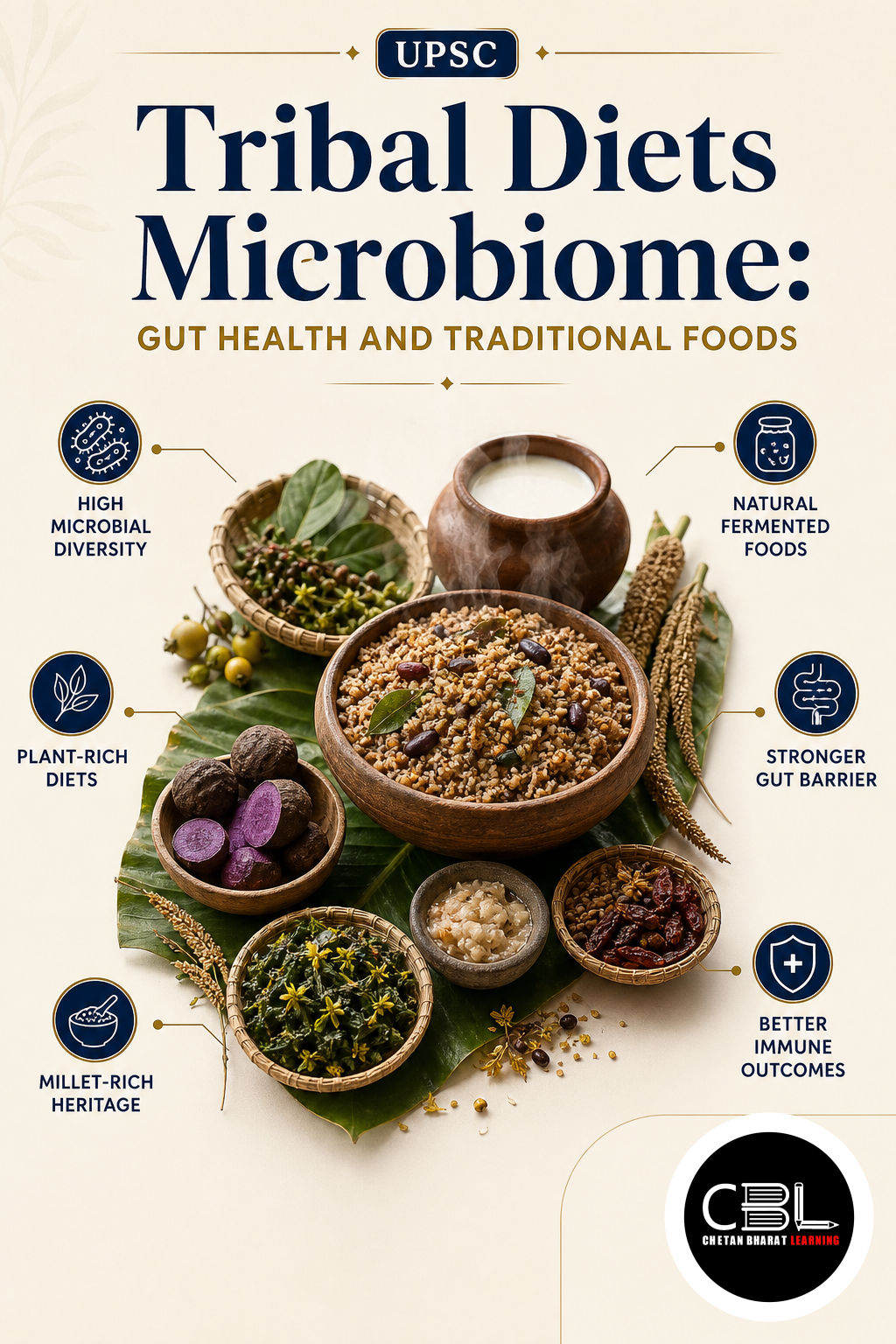

UPSC Mapping
Important for
| Prelims | Science & Health | Mains | GS Paper 3 (Science & Technology) |
|---|
Quick Facts
| Study Led By | NCCS & Stanford |
|---|---|
| Communities Studied | 8 tribal groups |
| Key Bacteria | Bifidobacterium adolescentis |
Article
Tribal Diets Microbiome research has revealed that traditional diets rich in dairy and grains in trans-Himalayan populations are associated with distinct gut bacteria and locally adapted microbial strains. The study, led by researchers from BRIC-National Centre for Cell Science (NCCS), Pune, and Stanford University, stresses the need for India-specific microbiome research. For more such health-related updates, visit the health current affairs archive.
What is the Tribal Diets Microbiome Study?
Tribal Diets Microbiome research focuses on how traditional dietary patterns influence the composition and function of gut microbes in indigenous communities. The study analysed healthy adults from the Warli, Gond, Madia, Kabui, Boto, Balti, Brokpa and Purigpa communities across four geographically diverse regions of India.
Researchers examined stool samples alongside dietary habits using advanced DNA sequencing. The four trans-Himalayan groups regularly consumed milk, homemade butter, wheat and barley, as also rice, turmeric and chilli. The study revealed that these communities had more diverse gut microbiomes and significantly higher levels of Bifidobacterium compared to people who didn’t widely consume these foods.
Why is Tribal Diets Microbiome in News?
Tribal Diets Microbiome findings have generated significant attention because they highlight the need for India-specific microbiome research and probiotics. The most striking finding was that strains of Bifidobacterium adolescentis isolated from trans-Himalayan participants were genetically distinct from strains commonly found in industrialised countries.
Although belonging to the same bacterial species, the Indian bacterial strains carried unique combinations of carbohydrate-processing genes, indicating adaptation to local diets. The study raises an important question: whether probiotics developed in Western countries are equally effective for Indian populations. For more details, refer to this PIB release.
Key Features of Tribal Diets Microbiome
The Tribal Diets Microbiome study reveals several key features:
- Diverse Gut Microbiomes: Trans-Himalayan communities have more diverse gut bacteria than populations with Westernised diets.
- High Bifidobacterium Levels: Regular consumption of dairy and grains is associated with significantly higher Bifidobacterium levels.
- Genetic Adaptation: Gut microbes carry distinct genes for digesting lactose and grain-derived carbohydrates, showing adaptation to local diets.
- Strain Specificity: Indian strains of Bifidobacterium adolescentis are genetically distinct from those in industrialised countries.
- Regional Variation: Geography, altitude, and lifestyle also influence gut microbial composition.
Challenges in Tribal Diets Microbiome Research
The study also highlights several challenges in Tribal Diets Microbiome research:
- Lack of India-Specific Probiotics: Most commercial probiotics are developed from Western strains, which may not be optimal for Indian populations.
- Dietary Transition: Modernisation and dietary changes among tribal communities may alter their gut microbiomes, reducing diversity.
- Limited Sampling: The study covered only eight communities; many more remain unstudied.
- Data Gaps: More research is needed to understand the functional implications of these microbial adaptations.
- Commercialisation Risks: Without proper validation, probiotic products may not deliver expected benefits in Indian contexts. For more on such issues, visit the science and technology section.
Way Forward for Tribal Diets Microbiome
To leverage Tribal Diets Microbiome insights, India should invest in indigenous probiotic research and develop strains derived from healthy Indian populations. Large-scale surveys across diverse communities can build a comprehensive microbial database for the country.
Regulatory frameworks should evaluate imported probiotics for efficacy in Indian populations rather than assuming universal effectiveness. Public health messaging can promote traditional dietary patterns that support gut health. Collaborative research with international partners can accelerate the development of India-specific microbiome-based therapies. For global standards, refer to the WHO.
Prelims Practice Corner
-
Q1. Which bacteria group was found at significantly higher levels in trans-Himalayan communities?
(a) Escherichia coli (b) Bifidobacterium (c) Streptococcus (d) Lactobacillus
Answer: (b) Bifidobacterium levels were significantly higher in trans-Himalayan communities. -
Q2. Which institutions led the Tribal Diets Microbiome study?
(a) AIIMS and ICMR (b) NCCS and Stanford University (c) IIT Delhi and WHO (d) CSIR and Harvard
Answer: (b) The study was led by BRIC-NCCS and Stanford University. -
Q3. How many tribal communities were analysed in the study?
(a) 4 (b) 6 (c) 8 (d) 10
Answer: (c) The study analysed 8 Indian tribal communities. -
Q4. What makes the Indian Bifidobacterium adolescentis strains distinct?
(a) They are identical to Western strains (b) They lack carbohydrate-processing genes (c) They carry unique carbohydrate-processing genes (d) They are antibiotic-resistant
Answer: (c) Indian strains carry unique combinations of carbohydrate-processing genes adapted to local diets. -
Q5. What is a key implication of the study’s findings?
(a) All probiotics are equally effective (b) Western probiotics are superior (c) India needs its own probiotic research (d) Gut microbiomes are unaffected by diet
Answer: (c) The study highlights the need for India-specific probiotic research.
Mains Practice Questions
-
Q1. Discuss the significance of traditional diets in shaping the gut microbiome, with reference to the recent study on Indian tribal communities. (250 words, 15 marks)
Answer Structure:
- Intro: Introduce the Tribal Diets Microbiome study and its findings.
- Body: Discuss the link between dairy/grain consumption and Bifidobacterium levels; the genetic adaptation of Indian strains; the need for India-specific probiotics.
- Conclusion: Emphasise the importance of preserving traditional dietary practices for gut health.
-
Q2. Evaluate the challenges and opportunities in developing India-specific probiotic strains based on indigenous gut microbiomes. (150 words, 10 marks)
Answer Structure:
- Intro: Frame the need for indigenous probiotics.
- Body: Discuss opportunities: genetic diversity, adaptation to local diets. Challenges: limited research, commercialisation, regulatory approval.
- Conclusion: Conclude that collaborative research and public investment are key.
FAQs on Tribal Diets Microbiome
What is the Tribal Diets Microbiome study about?
It is a study on how traditional diets of Indian tribal communities, especially dairy and grains in trans-Himalayan groups, shape gut bacteria, with implications for probiotic development.
Why are Indian Bifidobacterium strains different?
They carry unique genes for digesting lactose and grain-derived carbohydrates, reflecting adaptation to traditional Indian diets, unlike Western strains.
What is the implication for probiotics?
The findings suggest that probiotics developed from Western strains may not be equally effective in Indian populations, highlighting the need for India-specific probiotics.
Related Current Affairs
Preparing for UPSC, PCS or HCS?
Talk to a mentor at Chetan Bharat Learning, Chandigarh. Free guidance on choosing the right exam and building a study plan.
Chat on WhatsAppCall 97793 53345UPSC / IAS / PCS coaching in Chandigarh · Trusted by aspirants across Punjab & Haryana
Leave a Reply
You must be logged in to post a comment.