

UPSC Mapping
| Prelims | Economy & Banking |
|---|---|
| Mains | GS Paper 3 (Economic Development) |
| Target Sector | Urban Cooperative Banks |
| Features | Core Banking + Cloud + Compliance |
| Highest UCBs | Maharashtra (449) |
Article
What is Bank in a Box?
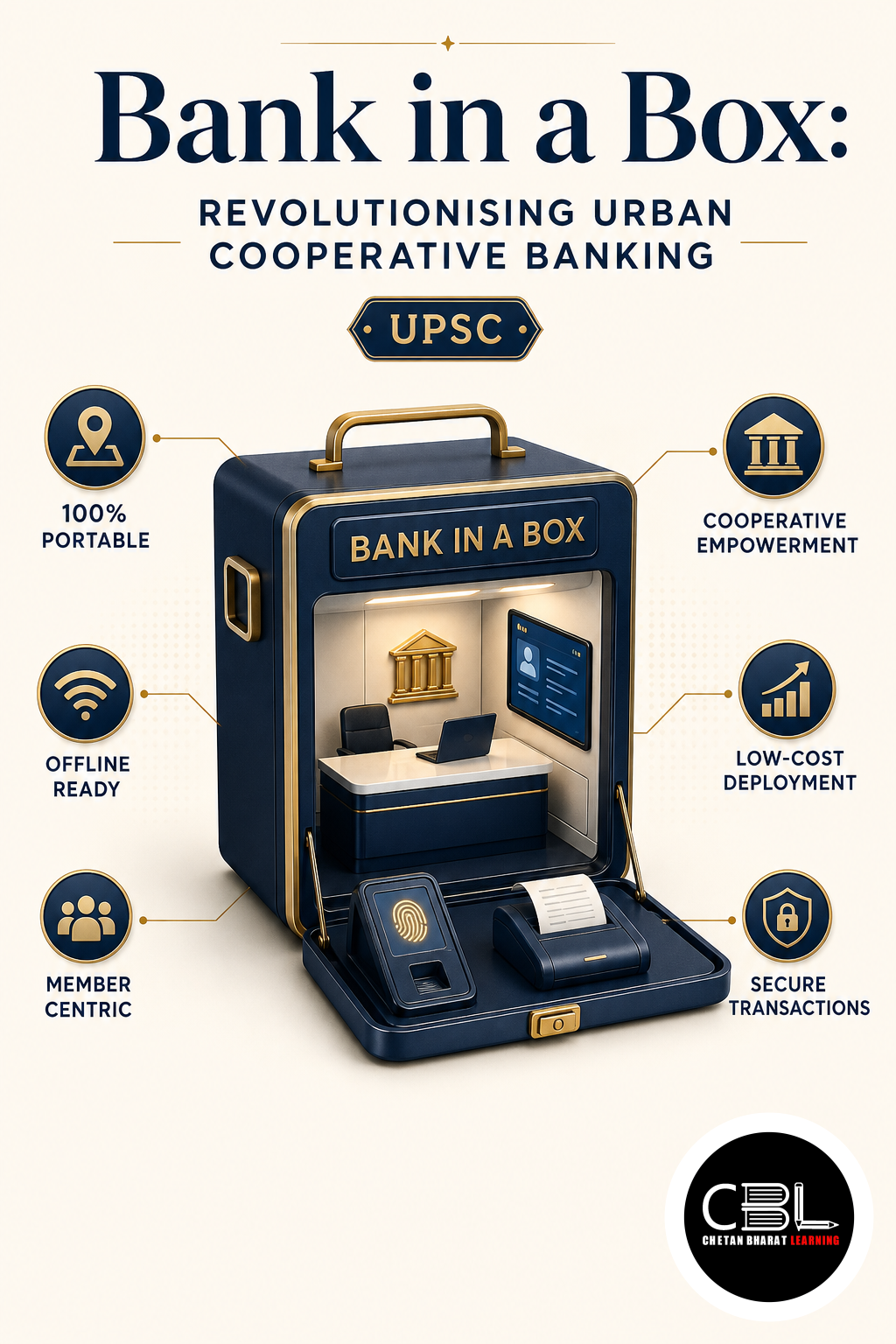
Bank in a Box is an integrated service platform that offers core banking, digital payments, cloud infrastructure, and regulatory compliance solutions to urban cooperative banks. The initiative allows even a small, single-branch UCB to provide world-class banking services without making heavy investments in technology infrastructure.
It was launched by the Union Home Minister as part of broader reforms to strengthen the cooperative banking sector. The platform simplifies technology adoption, reduces operational costs, and enables UCBs to compete effectively with larger commercial banks while ensuring regulatory compliance.
Why is Bank in a Box in News?
Bank in a Box has been in the news following its formal launch by the Union Home Minister, highlighting the government’s commitment to strengthening urban cooperative banks. The initiative is part of a series of reforms, including allowing UCBs to open up to 15% additional branches without separate permission and extending doorstep banking services.
Other reforms include simplifying the process for eligible Tier-3 cooperative banks to obtain scheduled-bank status and appointing an RBI nodal officer for regular sector interaction. The Priority Sector Lending target for UCBs has been reduced from 75% to 60%, while housing-loan limits have been enhanced. For official details, refer to the PIB release.
Key Features of Bank in a Box
- Integrated Platform: Combines core banking services, digital payments, cloud infrastructure, and compliance solutions in a single bundle.
- Low Cost: Enables small UCBs to access advanced technology without heavy capital expenditure.
- Regulatory Compliance: Simplifies adherence to RBI and other regulatory requirements through built-in compliance tools.
- Scalability: Allows banks to expand services and branches seamlessly as they grow.
- Digital Payments: Facilitates integration with UPI, NEFT, RTGS, and other digital payment systems.
Challenges in Implementing Bank in a Box
- Digital Literacy: Many UCBs, especially in rural and semi-urban areas, lack the digital skills to fully utilise the platform.
- Cybersecurity Risks: Increased digitalisation exposes smaller banks to cyber threats that they may not have the resources to counter.
- Infrastructure Gaps: Reliable internet and power connectivity are prerequisites, which may be lacking in some regions.
- Adoption Hesitation: Traditional UCBs may be reluctant to move from legacy systems to cloud-based platforms.
- Data Privacy: Handling customer data on shared cloud infrastructure raises privacy and ownership concerns.
Way Forward for Bank in a Box
To maximise the impact of Bank in a Box, the government and RBI should invest in training programmes for UCB staff to enhance digital literacy. Providing financial incentives or subsidised access for smaller banks can accelerate adoption.
Strengthening cybersecurity frameworks and offering affordable insurance products against cyber risks will build confidence among bankers. Regular monitoring and feedback mechanisms will help refine the platform to meet evolving needs. Ultimately, this initiative can significantly boost financial inclusion by enabling cooperative banks to serve underserved segments.
Prelims Practice Corner
- Q1. What is ‘Bank in a Box’?
- (a) A physical banking kit
- (b) An integrated digital banking platform for UCBs
- (c) A new type of ATM
- (d) A loan product for MSMEs
Answer: (b) It is an integrated service bundle offering core banking, digital payments, cloud services, and compliance.
- Q2. Which ministry or authority launched ‘Bank in a Box’?
- (a) Ministry of Finance
- (b) Reserve Bank of India
- (c) Union Home Minister
- (d) Ministry of Electronics & IT
Answer: (c) The Union Home Minister launched the initiative.
- Q3. What is the Priority Sector Lending target for UCBs after the recent reforms?
- (a) 75%
- (b) 60%
- (c) 50%
- (d) 40%
Answer: (b) The target has been reduced from 75% to 60%.
- Q4. Which state has the highest number of Urban Cooperative Banks?
- (a) Gujarat
- (b) Tamil Nadu
- (c) Maharashtra
- (d) Karnataka
Answer: (c) Maharashtra has 449 UCBs, the highest in the country.
- Q5. The origins of Urban Cooperative Banks trace back to which Act?
- (a) Banking Regulation Act, 1949
- (b) Cooperative Credit Societies Act, 1904
- (c) RBI Act, 1934
- (d) Companies Act, 1956
Answer: (b) The origins trace to the 1904 Cooperative Credit Societies Act.
Mains Practice Questions
-
Q1. Discuss the significance of the ‘Bank in a Box’ initiative in the context of digital financial inclusion and the cooperative banking sector. (250 words, 15 marks)
Answer Structure:
- Intro: Introduce Bank in a Box as a transformative digital banking platform for UCBs.
- Body: Discuss its features – core banking, cloud, compliance. Analyse its role in financial inclusion, especially for underserved areas. Mention associated reforms.
- Conclusion: Emphasise the need for digital literacy and cybersecurity to maximise benefits.
-
Q2. Evaluate the role of Urban Cooperative Banks in India’s financial system and the challenges they face in the digital era. (150 words, 10 marks)
Answer Structure:
- Intro: Highlight the importance of UCBs in local credit delivery.
- Body: Discuss their strengths: community-based, local focus. Challenges: technology gaps, compliance burden, competition. Suggest Bank in a Box as a solution.
- Conclusion: Conclude that digital transformation is key to UCB relevance.
FAQs on Bank in a Box
- What is Bank in a Box?
- It is an integrated service bundle offering core banking, digital payments, cloud services, and regulatory compliance, designed to empower urban cooperative banks.
- Who launched Bank in a Box?
- The Union Home Minister formally launched the initiative as part of reforms for the cooperative banking sector.
- What are the benefits of Bank in a Box?
- It reduces technology costs, enables digital payments, simplifies regulatory compliance, and allows small UCBs to provide modern banking services.
Related Current Affairs
Preparing for UPSC, PCS or HCS?
Talk to a mentor at Chetan Bharat Learning, Chandigarh. Free guidance on choosing the right exam and building a study plan.
Chat on WhatsAppCall 97793 53345UPSC / IAS / PCS coaching in Chandigarh · Trusted by aspirants across Punjab & Haryana
Leave a Reply
You must be logged in to post a comment.