

UPSC Mapping
| Prelims |
|
|---|---|
| Mains |
|
Quick Facts
| Location | Hanle, Ladakh |
|---|---|
| Telescope Type | 2-m Optical-Infrared Telescope |
| Elevation | 4,500 metres |
| First Light | 26 September 2000 |
What is Himalayan Chandra Telescope?
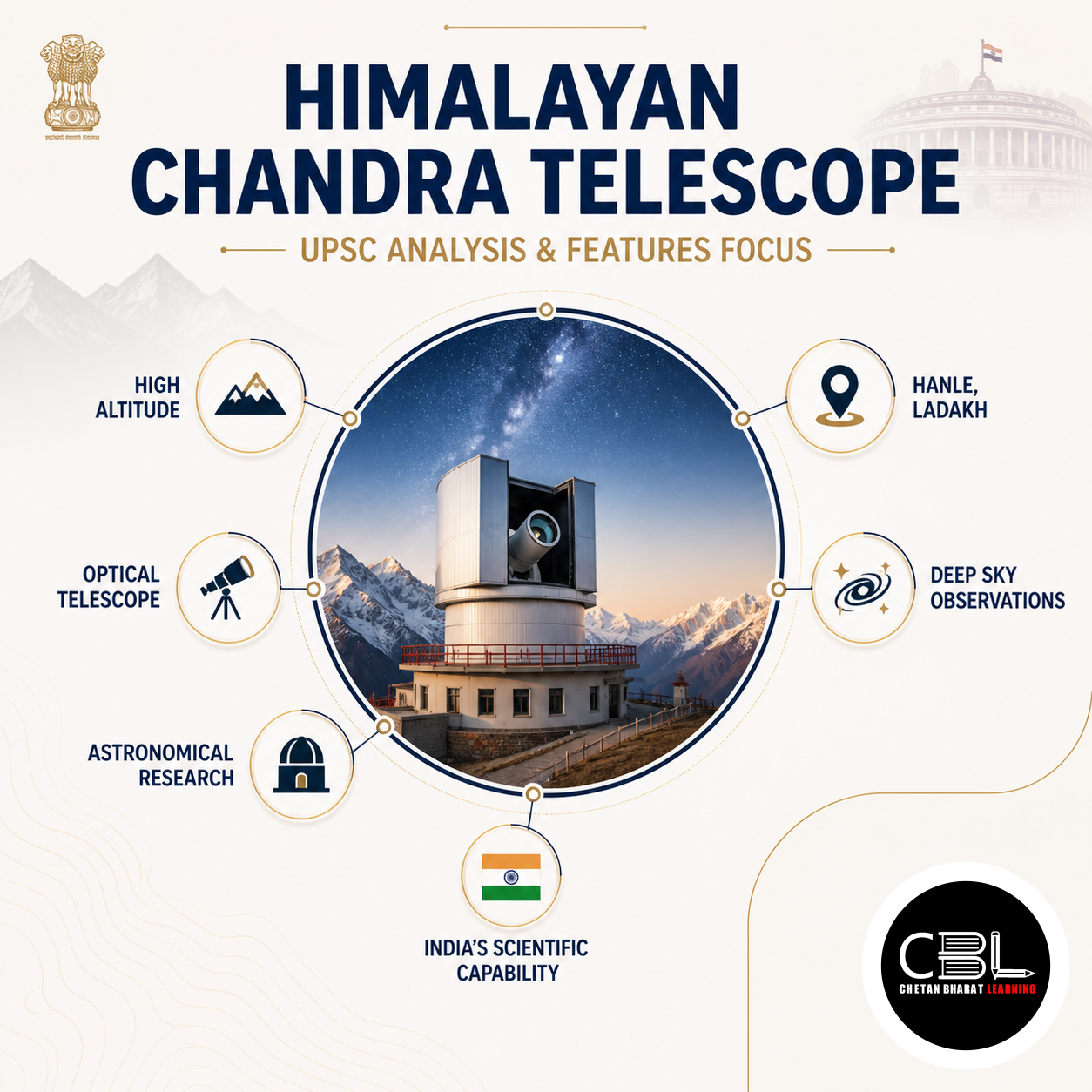
Himalayan Chandra Telescope is a 2-metre optical-infrared telescope located at the Indian Astronomical Observatory (IAO) in Hanle, Ladakh. Named after Nobel Prize-winning astrophysicist Subrahmanyan Chandrasekhar, it is one of India’s premier ground-based astronomical research facilities.
Situated at an altitude of about 4,500 metres, it is currently among the world’s highest optical telescopes. Hanle’s cloudless skies, low atmospheric water vapour and minimal light pollution make it one of the finest locations globally for observations in optical, infrared, sub-millimetre and millimetre wavelengths.
Why is Himalayan Chandra Telescope in News?
The Himalayan Chandra Telescope recently completed 25 years of scientific operations. A commemorative conference highlighted its engineering milestones, scientific contributions and future research directions in astronomy and astrophysics.
Since becoming operational, the telescope has played a major role in observational astronomy and has strengthened India’s position in global astronomical research. Official details are available through the PIB.
Key Features of Himalayan Chandra Telescope
- Strategic location: Installed at the Indian Astronomical Observatory in Hanle, one of the world’s best high-altitude observing sites.
- Remote operation: Operated remotely via satellite link from CREST (Centre for Research & Education in Science & Technology), Indian Institute of Astrophysics, Hosakote.
- Advanced instruments: Hosts HFOSC (optical spectrograph & camera), uTIRSPEC (near-infrared spectrometer & imager) and HESP (high-resolution Echelle spectrograph).
- Excellent observing conditions: Low atmospheric moisture and stable skies allow high-quality observations across multiple wavelengths.
- National facility: Accessible to astronomers from institutions across India for cutting-edge research.
Scientific Contributions
- Planetary science: Detailed spectroscopy of comets and asteroids.
- Exoplanet research: Studies of exoplanet atmospheres, including TRAPPIST-1b.
- Stellar astronomy: Investigations of stellar evolution, variable stars and star-forming regions.
- Galactic research: Observations of galaxies and large-scale cosmic structure.
- Capacity building: Enhanced India’s indigenous capability in observational astronomy and instrumentation.
Significance
- Promotes frontier science: Supports world-class research in astronomy and astrophysics.
- Enhances infrastructure: Demonstrates India’s capability in advanced observational facilities.
- Supports innovation: Encourages indigenous instrument development and collaborations.
- Human resource development: Provides research opportunities for students and scientists.
- Global visibility: Strengthens India’s contribution to international discoveries.
Challenges
- Extreme environment: Harsh weather and high altitude increase maintenance complexity.
- Infrastructure: Transporting sophisticated equipment to remote terrain is challenging.
- Technology upgrades: Continuous modernisation is required to stay competitive.
- Operational costs: Sustained funding is necessary for advanced facilities.
- Skilled manpower: Specialized instrumentation demands highly trained personnel.
Way Forward
Continued investment in astronomical infrastructure, advanced instrumentation and international collaborations will enhance India’s leadership in observational astronomy. Expanding outreach and supporting young researchers will further strengthen the research ecosystem.
Future upgrades to the Himalayan Chandra Telescope and complementary facilities can enable more precise observations of exoplanets, galaxies and transient events. Additional details are available through the Indian Institute of Astrophysics.
Prelims Practice Corner
-
Q1. Himalayan Chandra Telescope is located in:
- (a) Kodaikanal
- (b) Hanle, Ladakh
- (c) Ooty
- (d) Shillong
Answer: (b) Hanle, Ladakh.
-
Q2. Himalayan Chandra Telescope is named after:
- (a) Vikram Sarabhai
- (b) C.V. Raman
- (c) Subrahmanyan Chandrasekhar
- (d) Homi Bhabha
Answer: (c) Subrahmanyan Chandrasekhar.
-
Q3. The Himalayan Chandra Telescope is primarily a:
- (a) Radio telescope
- (b) Optical-infrared telescope
- (c) Gamma-ray telescope
- (d) Solar telescope
Answer: (b) Optical-infrared telescope.
-
Q4. The telescope is remotely operated from:
- (a) ISRO Headquarters
- (b) CREST, Hosakote
- (c) IISc Bengaluru
- (d) PRL Ahmedabad
Answer: (b) CREST, Hosakote.
-
Q5. Which of the following is an instrument hosted on the Himalayan Chandra Telescope?
- (a) HFOSC
- (b) NAVIC
- (c) RISAT
- (d) SARAL
Answer: (a) HFOSC.
Mains Practice Questions
Q1. Discuss the role of the Himalayan Chandra Telescope in strengthening India’s astronomical research capabilities. (10 marks)
Intro: Introduce the Himalayan Chandra Telescope.
Body: Explain location advantages, scientific instruments, research contributions and national significance.
Conclusion: Highlight the importance of investment in scientific infrastructure.
Q2. Evaluate the importance of high-altitude astronomical observatories for scientific research and technological development. (15 marks)
Intro: Explain the importance of astronomical observatories.
Body: Discuss site selection, research potential, technological innovation, challenges and future prospects.
Conclusion: Emphasise the role of scientific infrastructure in national development.
FAQs on Himalayan Chandra Telescope
- What is the Himalayan Chandra Telescope?
- The Himalayan Chandra Telescope is a 2-metre optical-infrared telescope located at the Indian Astronomical Observatory in Hanle, Ladakh.
- Why is Hanle considered an ideal location for the Himalayan Chandra Telescope?
- Hanle offers cloudless skies, low atmospheric water vapour, minimal light pollution and high altitude, making it one of the world’s best sites for optical and infrared astronomy.
- Why is the Himalayan Chandra Telescope important for UPSC?
- The telescope represents India’s advances in astronomical research, scientific infrastructure, indigenous capability and international collaboration, making it relevant for both Prelims and GS Paper III.
Related Current Affairs
Preparing for UPSC, PCS or HCS?
Talk to a mentor at Chetan Bharat Learning, Chandigarh. Free guidance on choosing the right exam and building a study plan.
Chat on WhatsAppCall 97793 53345UPSC / IAS / PCS coaching in Chandigarh · Trusted by aspirants across Punjab & Haryana
Leave a Reply
You must be logged in to post a comment.