
What did the High Court halt?
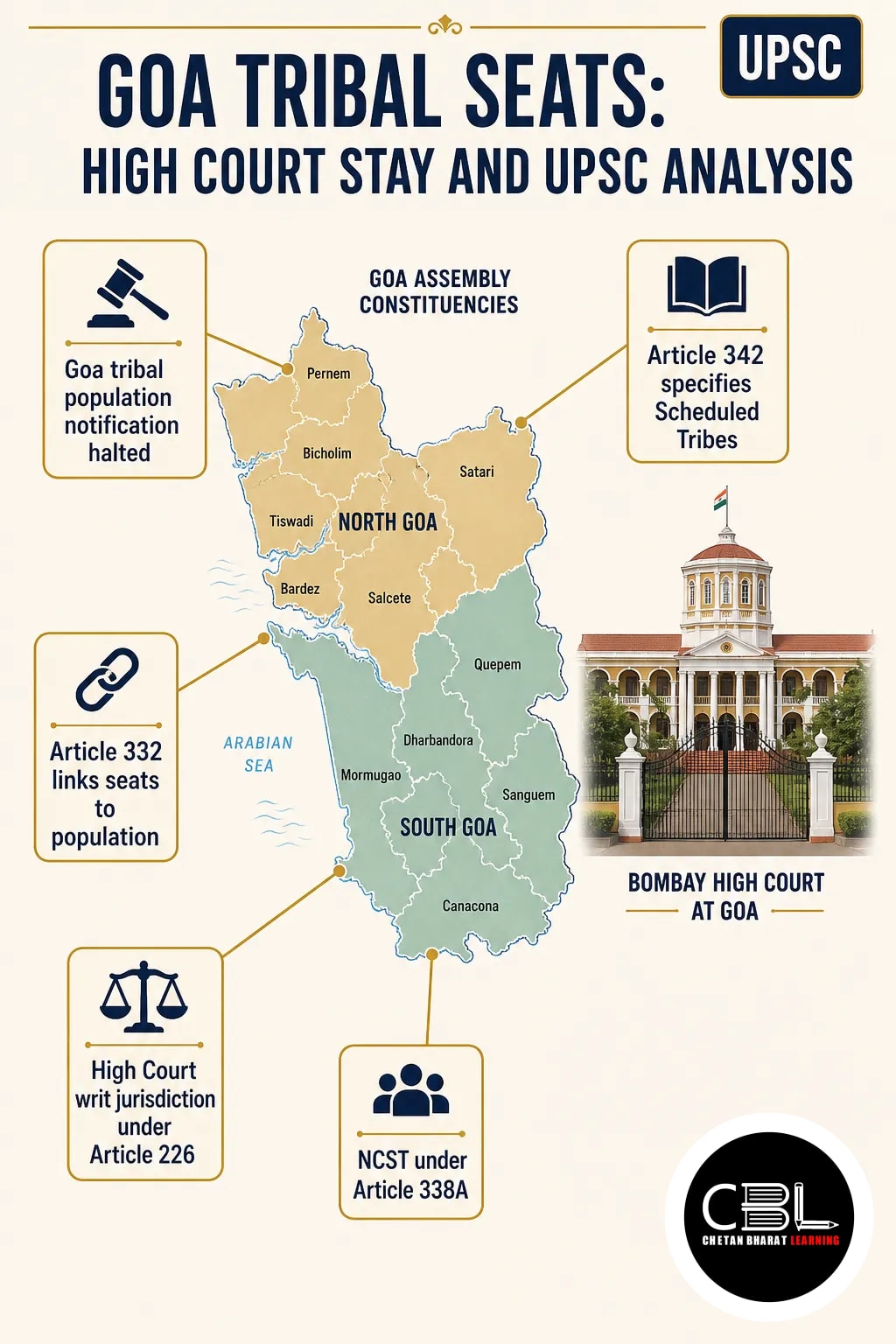
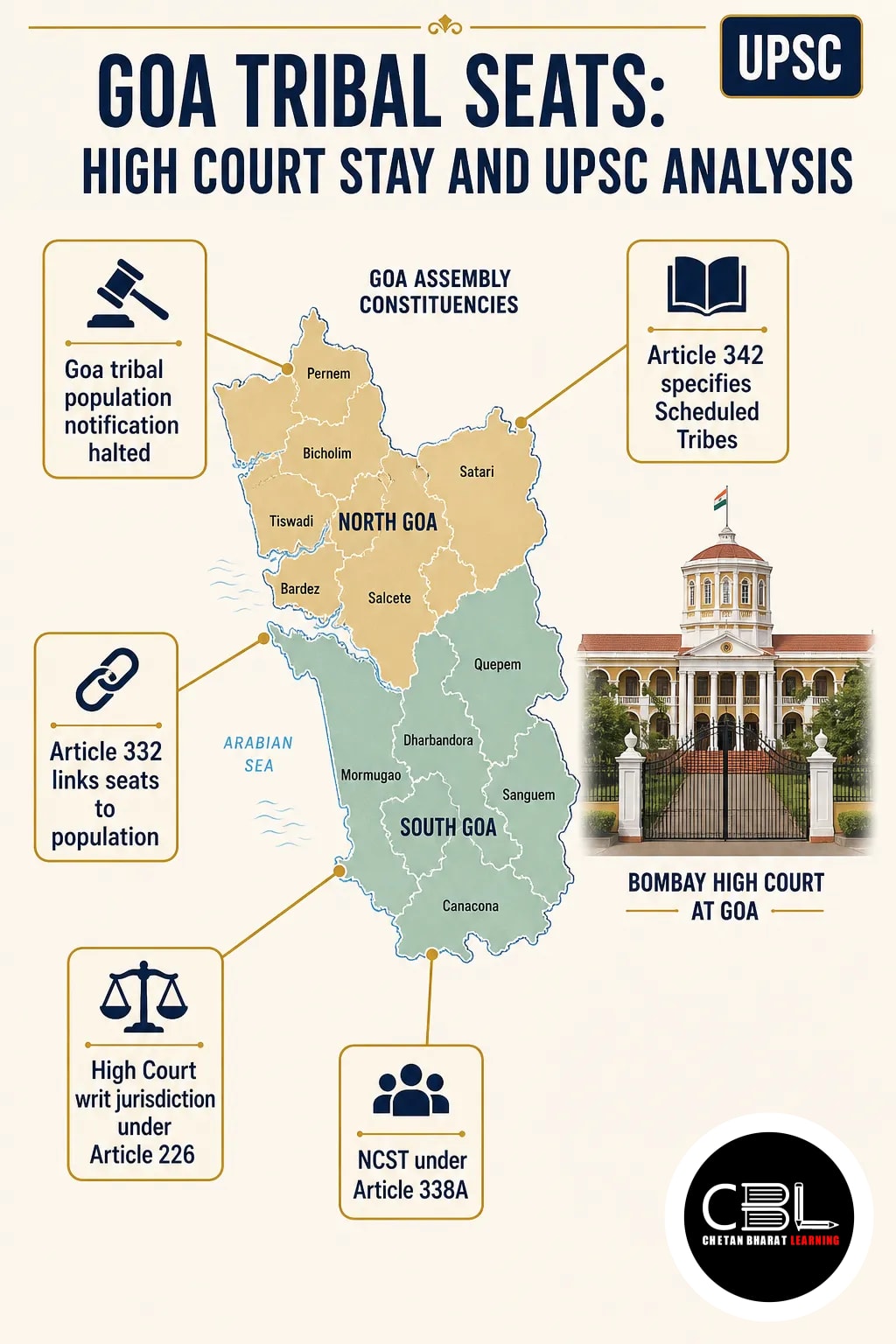
The Bombay High Court halted a notification concerning Goa’s tribal population. The available report links the matter to reserved seats, but does not provide the notification’s contents or the court’s reasons.
Consequently, the stay should not be described as a final decision against reservation. Nor do the available facts establish how many constituencies, if any, immediately change status.
For exam purposes, distinguish the interim halt from the constitutional question of political representation. The latter concerns how population data and legal procedures translate a guarantee into reserved constituencies.
How does the Constitution protect tribal representation?
The Constitution provides for reserved legislative seats and identifies institutions responsible for Scheduled Tribe safeguards. In particular, Article 332 links state assembly reservation to the Scheduled Tribe share of the state’s population.
| Provision | What it provides |
|---|---|
| Article 332 | Reservation of seats for Scheduled Castes and Scheduled Tribes in state legislative assemblies, subject to constitutional provisions. |
| Article 342 | Specification of Scheduled Tribes for a state or Union territory; Parliament may include or exclude communities by law. |
| Article 338A | Establishes the National Commission for Scheduled Tribes to investigate and monitor constitutional and legal safeguards. |
| Article 226 | Empowers High Courts to issue writs for fundamental rights and other purposes. |
| Article 46 | Directs the state to promote the educational and economic interests of weaker sections, particularly Scheduled Castes and Scheduled Tribes. |
Under Article 332, the number of reserved seats must bear, as nearly as possible, the same proportion to assembly seats as the relevant population bears to the state’s population. Therefore, the constitutional principle is proportional representation, not a uniform quota for every state.
Article 342 addresses a different question: which communities qualify as Scheduled Tribes in a particular state or Union territory. For a state, the President issues the initial specification after consulting its Governor; Parliament can subsequently amend the list by law.
Meanwhile, Article 46 belongs to the Directive Principles of State Policy. CBL’s guide to Directive Principles and welfare governance explains their wider constitutional context.
Why does the population notification matter for Goa tribal seats?
Population figures matter because Article 332 connects reserved assembly seats to the relevant population proportion. However, the available source does not explain the precise legal role of this particular notification.
Three questions are useful for analysing the case. First, which population figure does the notification establish? Second, what legal authority supports it? Finally, how does the applicable process use that figure to determine reserved constituencies? The source material does not answer these questions.
A population notification and the Article 342 list also serve different functions. One concerns a population figure; the other specifies eligible communities. Therefore, a halt to the former cannot, by itself, be treated as a change to the Scheduled Tribe list.
Population data can have consequences beyond this case. For background on data collection, see CBL’s analysis of census questions and privacy. That discussion does not establish which data the Goa notification uses.
What are the implications and concerns?
The halt highlights the need to reconcile timely representation with lawful and verifiable decision-making. Its precise consequences, however, depend on the order and the governing legal procedure.
- Representation: A delay in a population-related step can affect the timing of a reservation exercise if that step is legally necessary.
- Data integrity: Population figures need a transparent legal and statistical basis because they can influence seat allocation.
- Judicial scrutiny: Courts can examine challenged action; however, an interim order does not settle the final merits.
- Public clarity: Voters and affected communities need clear information about existing arrangements and any subsequent changes.
These are analytical concerns, not findings attributed to the court. In particular, the available material does not establish a final seat count, an election delay or a defect in the data.
What is the way forward?
A legally sound process should clarify the notification, the court’s directions and their relationship to seat reservation. First, authorities should explain the applicable population basis and procedure without prejudging the pending matter.
Second, official communication should distinguish community specification, population enumeration and constituency reservation. In addition, affected communities should receive accessible information about the process and opportunities to raise concerns.
Finally, future action must follow judicial directions and the relevant law. This approach can protect both procedural legitimacy and the constitutional objective of political representation.
Source: Indian Express, 30 October 2026
- Directive Principles: Rights, Welfare and Governance (16 Sep 2026)
Asked in UPSC: Previous Year Questions
- UPSC CSE Mains 2016 (GS Paper I): Why are tribals in India referred to as Scheduled Tribes? Indicate the major constitutional provisions for their upliftment.
UPSC links Scheduled Tribe status to constitutional safeguards, so revise both identification and representation.
Punjab PCS and Haryana HCS may test Articles 332, 342 and 338A under Indian polity. Also, compare constitutional principles with the applicable state-specific lists rather than assuming identical community status across states.
Prelims Practice Corner
Mains Practice Questions
Frequently Asked Questions
What did the Bombay High Court halt in Goa?
It halted a tribal population notification. However, the available source does not state the order’s reasons or date.
Which Article provides for Scheduled Tribe reservation in state assemblies?
Article 332 provides for it. The provision also connects the number of reserved seats to the relevant population proportion, as nearly as possible.
Does the notification halt change the Scheduled Tribe list?
The available facts do not establish any change to the list. Moreover, Article 342 governs Scheduled Tribe specification and changes to that list.
Did the court decide the final number of reserved seats?
The available source does not identify any final seat count. Therefore, the impact on individual constituencies cannot be determined from the supplied material.
Related Current Affairs
Preparing for UPSC, PCS or HCS?
Talk to a mentor at Chetan Bharat Learning, Chandigarh. Free guidance on choosing the right exam and building a study plan.
Chat on WhatsAppCall 97793 53345UPSC / IAS / PCS coaching in Chandigarh · Trusted by aspirants across Punjab & Haryana
Leave a Reply
You must be logged in to post a comment.