
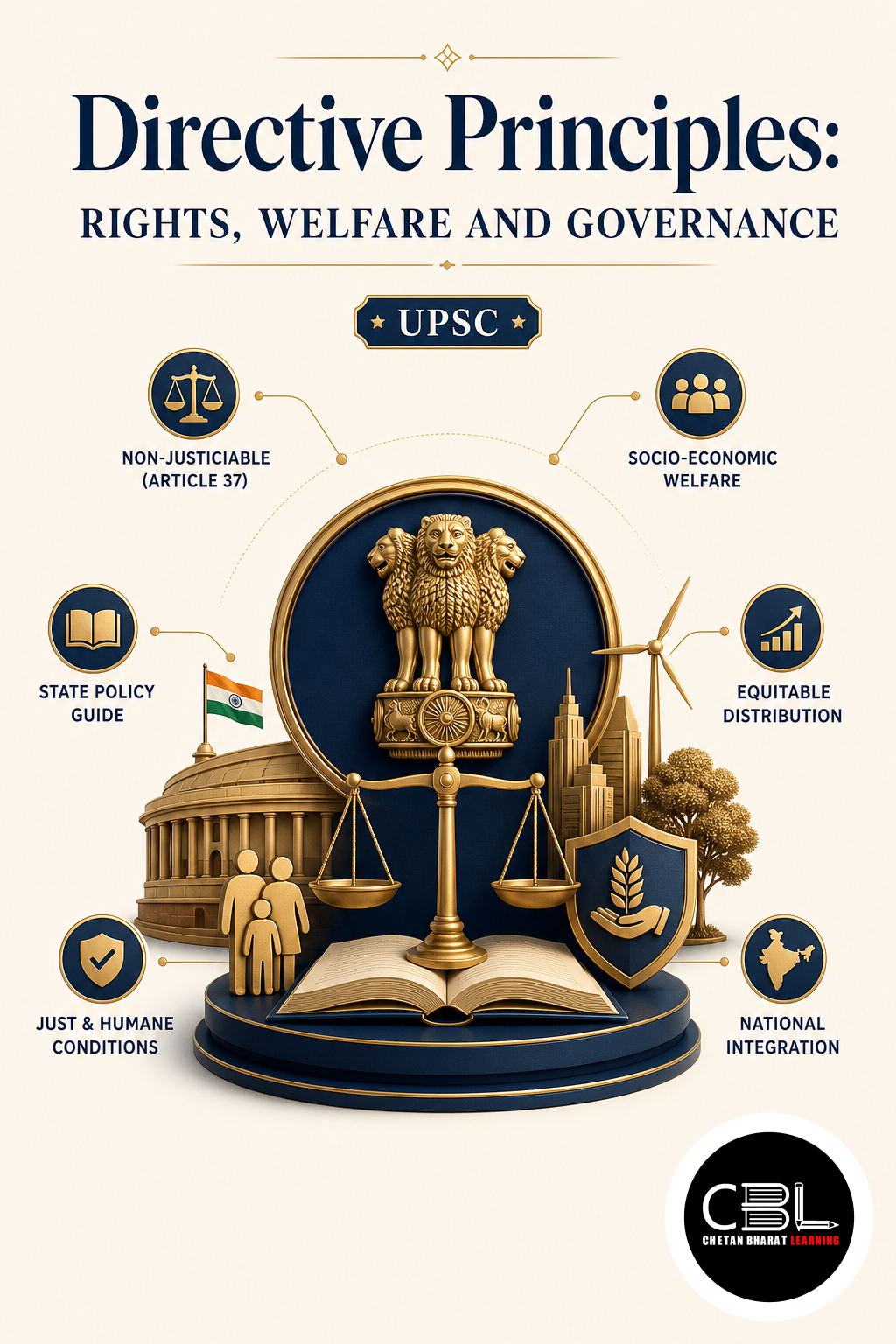

UPSC Mapping
| Prelims | Part IV, Articles 36–51 and Article 37 |
|---|---|
| Mains | GS Paper II: Constitution, Welfare and Governance |
| Constitutional Part | Part IV |
| Article Range | Articles 36–51 |
| Legal Status | Non-justiciable |
| Implementation Duty | Article 37 |
What are Directive Principles?
The Directive Principles are constitutional instructions that guide the State in building a just social and economic order. Articles 36 to 51 address livelihood, equal pay, public health, education, legal aid, village governance, environmental protection and international peace. Article 37 declares these provisions non-enforceable by courts, yet calls them fundamental in governing the country and places a duty upon the State to apply them while making laws; they therefore establish standards for public action without directly granting a judicial remedy for every policy failure, budgetary shortfall or disputed legislative choice.
The framers placed these goals beside Fundamental Rights because political freedom required social and economic foundations. Rights protect individuals against unconstitutional state action, while Part IV asks governments to reduce material disadvantage and unequal opportunity. This distinction does not make welfare commitments optional or legally irrelevant; legislatures must debate implementation, executives must design workable programmes and courts may use these values when interpreting ambiguous law; the constitutional scheme thus combines individual liberty with social justice instead of treating either objective as complete by itself.
Why are Directive Principles in News?
The Directive Principles are in focus because renewed debate over Article 44 has linked personal-law reform with a constitutional policy objective. State-level civil-code initiatives have raised questions about legislative competence, equality, religious freedom and the limits of administrative uniformity. The issue demonstrates why a directive cannot implement itself through political announcement alone; governments must enact valid legislation, respect Fundamental Rights and provide fair procedures before changing deeply personal legal relationships involving marriage, maintenance, succession or inheritance.
The debate also illustrates that different provisions of Part IV require distinct policy choices rather than one uniform method. Articles dealing with nutrition, legal aid, local government or environmental protection demand specialised institutions and financial commitments. The official Constitution text places these goals within an integrated constitutional structure; any measure pursuing them must still satisfy equality, liberty and due process; public policy therefore gains legitimacy through constitutional compliance, evidence and democratic deliberation, not through reliance on Part IV alone.
Key Features
Part IV provides a governance framework that connects constitutional values with long-term public policy.
- Non-justiciable character: Citizens cannot ordinarily demand direct enforcement of these provisions, but courts may consider their underlying values while reviewing legislation, interpreting rights or resolving uncertainty within a constitutional framework, supporting legal coherence without converting broad policy aspirations into standalone individual claims.
- Positive state obligations: The provisions encourage governments to create institutions, regulate markets, distribute public resources and expand access to education, healthcare, legal assistance, livelihood opportunities and social security, particularly where historical exclusion prevents formal liberty from becoming a meaningful opportunity.
- Broad social vision: Their objectives cover economic democracy, distributive justice, humane working conditions, child welfare, public health, local self-government, environmental protection, cultural preservation and peaceful international relations, giving lawmakers a connected vision of human development rather than isolated programme-specific commands.
- Legislative flexibility: Parliament and state legislatures may choose different laws, timelines and delivery systems according to constitutional competence, available resources, local conditions and evidence about policy effectiveness, while remaining answerable for unreasonable delay, discrimination, arbitrary classification or exclusion.
- Constitutional interpretation: Courts have treated harmony between Fundamental Rights and Part IV as essential, rejecting approaches that destroy liberty in the name of welfare or obstruct legitimate social reform, preserving democratic space while preventing welfare objectives from justifying disproportionate state power.
Challenges
Implementation often exposes a gap between constitutional aspiration and administrative capacity.
- Resource constraints: Universal services require stable revenue, trained personnel, reliable infrastructure and sustained intergovernmental coordination, making gradual fulfilment necessary without allowing indefinite neglect or arbitrary exclusion, especially when preventable administrative failures repeatedly burden the same vulnerable communities.
- Competing priorities: Governments must balance several legitimate goals when welfare spending, environmental protection, industrial growth, employment creation and fiscal stability place conflicting demands upon limited public resources, making transparent prioritisation and reasoned budget choices essential for public trust.
- Rights conflicts: A law framed as social reform may still burden speech, privacy, religious freedom, property interests or equality, requiring proportional safeguards and meaningful judicial scrutiny, narrowly tailored restrictions and effective remedies against unlawful administrative action.
- Uneven federal delivery: Differences in state finances and institutional capacity can produce unequal public services, even where citizens share comparable needs and the Constitution identifies a common national objective, thereby requiring fiscal transfers, shared standards and cooperative monitoring across levels of government.
- Weak accountability: Broad promises can become symbolic when governments omit measurable targets, transparent budgets, outcome audits and accessible grievance systems.
Way Forward
Governments should translate constitutional objectives into clear statutes, funded programmes and measurable public outcomes; each proposal needs a rights-impact assessment, fiscal estimate, implementation timetable and transparent allocation of responsibility among Union, state and local institutions. Legislatures should examine evidence through committees and invite affected communities to participate before adopting major reforms; independent audits, disaggregated data and accessible grievance mechanisms can show whether benefits reach women, children, workers, persons with disabilities and disadvantaged communities. This approach strengthens democratic accountability and policy continuity beyond electoral announcements, while published reasons for changing targets can separate genuine constraints from avoidable delay.
Courts should preserve the constitutional balance by protecting enforceable rights while recognising legitimate welfare legislation; judicial interpretation, legislative deliberation and executive delivery must therefore operate as complementary processes; a mature framework will pursue social justice through lawful, proportionate and evidence-based measures while protecting the dignity and freedom of every person. Such coordination can convert constitutional commitments into durable institutions without weakening the rule of law, parliamentary oversight or the institutional independence needed to enforce constitutional limits.
Prelims Practice Corner
- Q1. Which Part of the Constitution contains the DPSP? (a) Part III (b) Part IV (c) Part IVA (d) Part V
Answer: (b) Part IV contains Articles 36 to 51 concerning the DPSP. - Q2. What does Article 37 establish? (a) Direct judicial enforcement (b) Parliamentary supremacy (c) Non-justiciability with a duty to apply (d) Emergency suspension
Answer: (c) Article 37 makes these provisions non-enforceable yet fundamental in governance. - Q3. Which constitutional provision concerns equal justice and free legal aid? (a) Article 39A (b) Article 44 (c) Article 48A (d) Article 50
Answer: (a) Article 39A promotes equal justice and free legal aid. - Q4. Article 44 addresses which objective? (a) Village panchayats (b) Uniform civil code (c) Environmental protection (d) Separation of judiciary
Answer: (b) Article 44 asks the State to endeavour to secure a common civil code. - Q5. Which statement best describes the relationship between Fundamental Rights and Part IV? (a) They are unrelated (b) Part IV always overrides rights (c) Harmony between them is constitutionally important (d) Rights are only advisory
Answer: (c) Constitutional interpretation seeks balance between individual rights and social goals.
Mains Practice Questions
- Q1. Examine how Part IV supports welfare governance while remaining non-justiciable. (250 words, 15 marks)
- Intro: Explain the constitutional status established by Article 37.
- Body: Discuss welfare goals, legislative duty, interpretive value, resource limits and democratic accountability.
- Conclusion: Link measurable implementation with rights-compliant governance.
- Q2. Harmony between Fundamental Rights and social-policy goals forms part of India’s constitutional balance. Discuss. (150 words, 10 marks)
- Intro: Present liberty and social justice as complementary constitutional aims.
- Body: Analyse judicial review, proportionality, welfare legislation and protection against state excess.
- Conclusion: Emphasise reform that advances welfare without weakening enforceable rights.
FAQs on Directive Principles
- Can courts directly enforce every provision in Part IV?
No. Article 37 makes these provisions non-justiciable, although their values can influence constitutional interpretation and review of legislation. - Why are these principles fundamental in governance?
They establish social, economic and institutional goals for the State. They also guide lawmakers when designing welfare legislation and public policy. - Can a welfare law violate Fundamental Rights?
A welfare objective does not automatically protect a law from review. The measure must remain within legislative competence and comply with applicable constitutional rights.
Related Current Affairs
Preparing for UPSC, PCS or HCS?
Talk to a mentor at Chetan Bharat Learning, Chandigarh. Free guidance on choosing the right exam and building a study plan.
Chat on WhatsAppCall 97793 53345UPSC / IAS / PCS coaching in Chandigarh · Trusted by aspirants across Punjab & Haryana
Leave a Reply
You must be logged in to post a comment.