
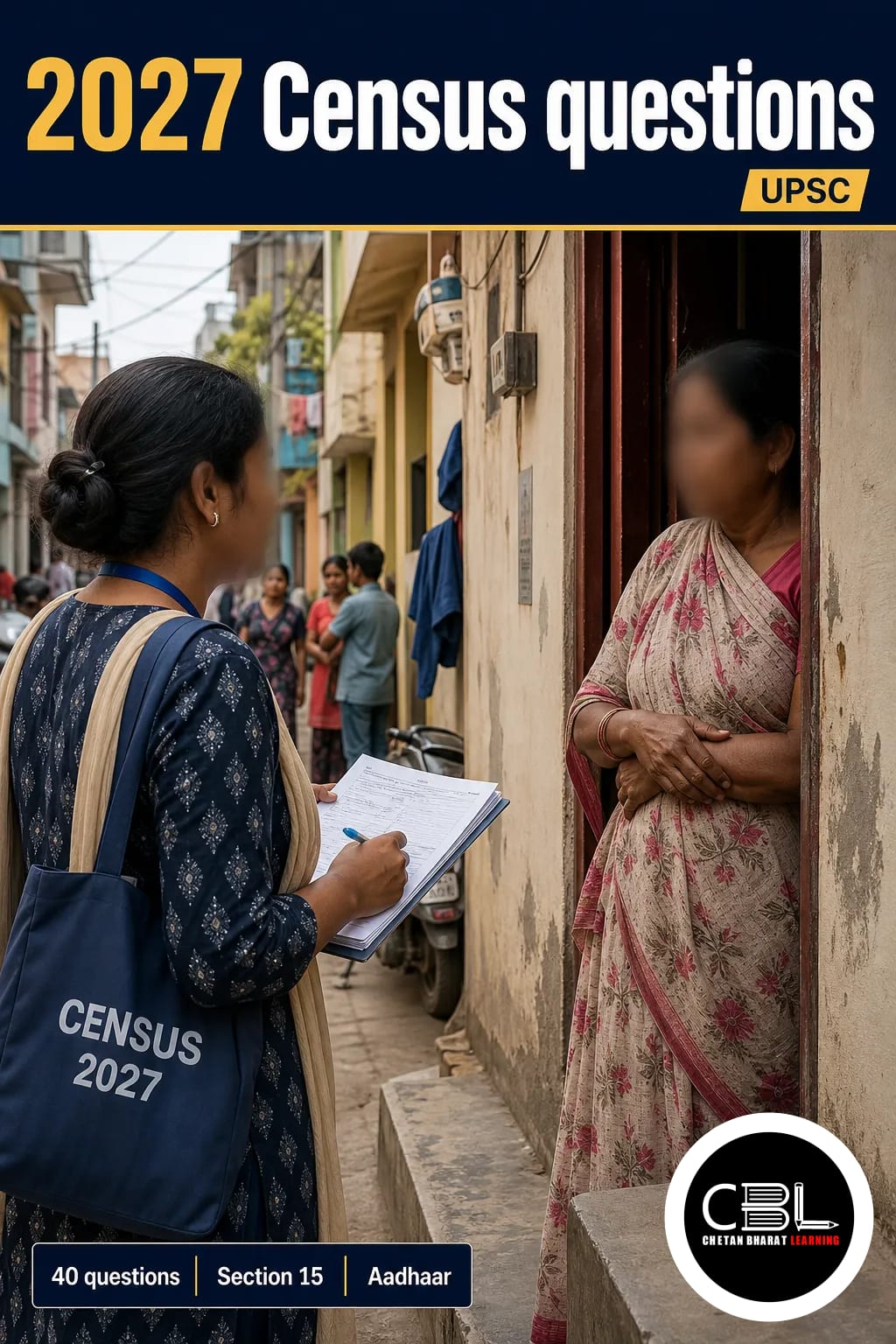

The 2027 Census questions have sparked debate over the collection of personal identifiers during population enumeration. The newly notified questions raise issues distinct from, but relevant to, electoral roll revision and identity records.
Quick answer: The 2027 Census questions reportedly include 40 items for India’s population enumeration phase. The Union government has notified questions on declared nationality, bank accounts and personal identifiers, among other details. Their inclusion raises questions about statistical purpose, privacy and safeguards for information collected from individuals.
What are the 2027 Census questions?
They are questions notified for collecting individual information during the population enumeration phase of the Census. Besides demographic details, they seek information on family relationships, declared nationality, residence, vaccination and selected identifiers.
A census produces population statistics that help governments understand demographic patterns and plan public services. However, the inclusion of identifying details requires a separate assessment of why each detail is needed and how it will be protected.
Why are the questions in the news?
The Union government has notified individual questions for the 2027 population enumeration phase, prompting scrutiny of their statistical purpose. The reported questionnaire contains 40 questions, including several concerning personal details.
For example, it asks for the number of bank accounts and for mobile, Aadhaar and voter identity (ID) numbers, if available. The source also identifies questions about an Indian passport number for holders and driving licence availability.
Which details does the enumeration seek?
The notified items cover relationships, residence and identifiers alongside declared nationality and selected service-related details.
| Category | Details identified in the source |
|---|---|
| Family relationships | Parents of every individual and spouses of married household members |
| Nationality and residence | Nationality as declared and permanent residential address |
| Services and accounts | Place of COVID-19 vaccination and total number of bank accounts |
| Identifiers and documents | Mobile, Aadhaar and voter ID numbers if available; Indian passport number for holders; driving licence availability |
These items do not all serve the same statistical function. For instance, a count of accounts can support an aggregate measure, whereas an individual identifier requires a distinct justification.
What legal principles govern census information?
The Census Act, 1948 provides a statutory framework for census operations and protects the confidentiality of individual census records.
Under Section 15, individual census records are not open to inspection and census entries are inadmissible as evidence in civil or criminal proceedings. This protection matters because enumeration depends on people providing information to the state.
In addition, the Supreme Court recognised privacy as a fundamental right in Justice K.S. Puttaswamy v. Union of India in 2017. The privacy framework makes legality, legitimate purpose and proportionality relevant to assessing state collection of personal information.
However, a question about declared nationality is not itself a determination of citizenship. Similarly, an Aadhaar number is not proof of citizenship; the presence of both items in a questionnaire should not blur that distinction.
What are the main concerns?
The central concern is whether each personal detail is necessary for the Census’s statistical objectives.
- Purpose limitation: A question should have a clear statistical use; otherwise, collection may exceed the exercise’s needs.
- Identification risk: Identifiers can make records easier to associate with individuals; therefore, their collection increases the importance of access controls.
- Public confidence: Uncertainty about how information will be used can discourage candid answers and, consequently, affect data quality.
- Function creep: Information collected for statistics could face pressure for unrelated uses; hence, clear restrictions matter.
- Exclusion and misunderstanding: Respondents may lack a requested identifier or misunderstand its role; therefore, enumerators need clear instructions.
These are risks requiring scrutiny, not evidence that census data have been misused. Moreover, the reported availability condition for certain identifiers should not be confused with a general requirement to possess them.
How can statistical needs and privacy be balanced?
A proportionate approach would collect only information needed for clearly stated statistical purposes and protect it throughout its use.
- Explain each item: The government should publish the statistical purpose of sensitive questions and explain why alternatives are insufficient.
- Minimise collection: Where aggregate answers suffice, authorities should consider whether individual identifiers are necessary.
- Protect records: Strict access controls, secure storage and clear retention rules can reduce unauthorised disclosure risks.
- Communicate safeguards: Enumerators should explain confidentiality and availability conditions; consequently, respondents can answer with greater clarity.
- Enable accountability: Independent scrutiny and a clear process for addressing complaints can strengthen trust.
For Mains, the key balance is not statistics versus privacy. Rather, effective governance requires reliable population data collected through a lawful, necessary and proportionate process.
Source: The Hindu, 28 October 2026
- Electoral Roll Revision and Supreme Court Review (28 Oct 2026)
Asked in UPSC: Previous Year Questions
- UPSC CSE Prelims 2018 (GS Paper I): Can Aadhaar prove citizenship or domicile, and can the issuing authority deactivate or omit an Aadhaar number once issued?
UPSC tests the legal significance of identifiers; therefore, distinguish identity documentation from proof of citizenship.
State PCS General Studies can test census concepts, confidentiality and the use of demographic data in planning. In addition, candidates should distinguish census enumeration from electoral roll administration.
Prelims Practice Corner
Mains Practice Questions
Frequently Asked Questions
How many questions are in the 2027 population enumeration schedule?
The schedule reportedly contains 40 questions. These include questions on nationality, bank accounts and selected identifiers.
Does the Census ask for Aadhaar and voter ID numbers?
Yes, it asks for those numbers if available. The questions also seek a mobile number, subject to the same availability condition.
Are individual census records open to public inspection?
No, because Section 15 of the Census Act, 1948 protects them from inspection. It also makes census entries inadmissible as evidence in civil or criminal proceedings.
Does an Aadhaar number prove Indian citizenship?
No, an Aadhaar number is not proof of citizenship. Therefore, it must be distinguished from a question about declared nationality.
Related Current Affairs
Preparing for UPSC, PCS or HCS?
Talk to a mentor at Chetan Bharat Learning, Chandigarh. Free guidance on choosing the right exam and building a study plan.
Chat on WhatsAppCall 97793 53345UPSC / IAS / PCS coaching in Chandigarh · Trusted by aspirants across Punjab & Haryana
Leave a Reply
You must be logged in to post a comment.