
UPSC Syllabus Mapping
- GS Paper: GS-II and GS-III
- Subject: International Relations — West Asia; Science and Technology — Nuclear Energy and Nuclear Non-Proliferation
What is 123 Agreement?
In the United States, a civil nuclear cooperation arrangement with another country is governed by Section 123 of the US Atomic Energy Act of 1954. Such an agreement establishes the legal framework under which significant peaceful nuclear cooperation can occur. It can cover areas such as nuclear material, equipment, technology and associated cooperation, subject to safeguards and non-proliferation requirements.
Civil nuclear cooperation is distinct from the transfer of nuclear weapons technology. It may facilitate electricity generation, research, medical applications, agriculture and other peaceful uses of nuclear science. Because some stages of the nuclear fuel cycle have dual-use implications, however, international nuclear cooperation requires safeguards, monitoring and controls intended to ensure that civilian programmes remain peaceful.
Why is 123 Agreement in News?
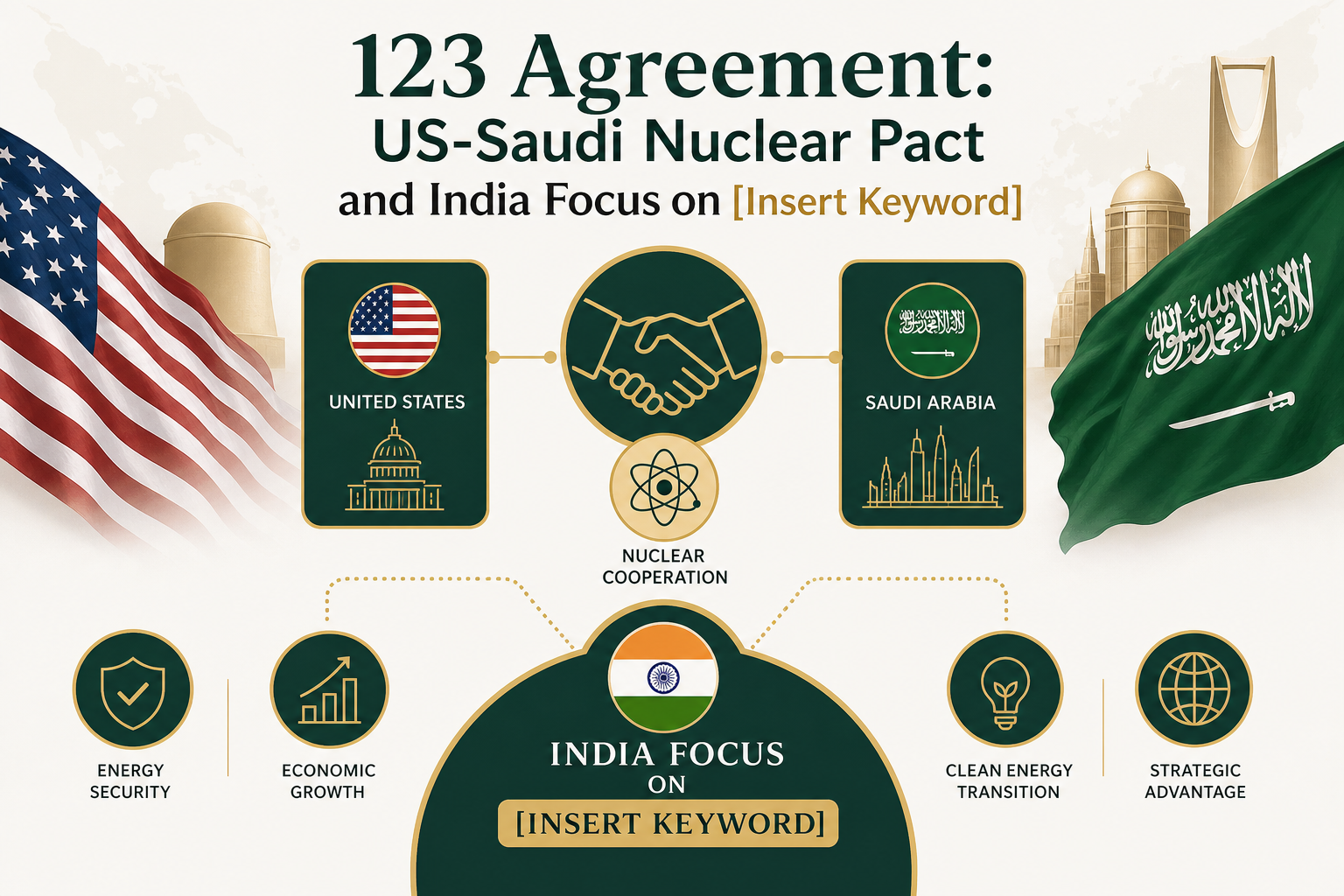
The issue is in focus following a US–Saudi civil nuclear cooperation agreement intended to facilitate Saudi Arabia’s development of a civilian nuclear energy programme. The development comes as Riyadh seeks to diversify its energy mix, develop new technological capabilities and pursue the broader economic transformation associated with its Vision 2030 agenda. For Washington, nuclear cooperation also forms part of a wider strategic relationship with an important West Asian partner.
The sensitive question concerns the conditions attached to nuclear fuel-cycle activities, particularly uranium enrichment. Enrichment has legitimate civilian applications, but the underlying technological capability can become proliferation-sensitive when enrichment levels and associated infrastructure move beyond civilian requirements. This makes safeguards and verification central to the debate. Official Indian perspectives on major international developments can be followed through the Ministry of External Affairs.
Key Features of Civil Nuclear Cooperation
Understanding the nuclear fuel cycle is essential for analysing such agreements. Uranium is mined and processed before it can be prepared for use as nuclear fuel. Enrichment increases the proportion of the fissile isotope uranium-235. Low-enriched uranium is commonly associated with civilian reactor fuel, while much higher enrichment can have weapons relevance. The existence of legitimate civilian enrichment therefore creates a classic dual-use challenge for the international non-proliferation regime.
- Peaceful purpose: cooperation concerns civilian nuclear applications rather than the transfer of nuclear weapons.
- Legal framework: US cooperation is governed by requirements under its Atomic Energy Act.
- Safeguards: nuclear material and facilities can be subject to international verification arrangements.
- Technology dimension: cooperation may involve equipment, material, expertise and nuclear-energy infrastructure.
- Non-proliferation conditions: controls seek to reduce the risk that peaceful capabilities are diverted towards military purposes.
The International Atomic Energy Agency plays a central role in the global safeguards system by verifying that nuclear material under applicable safeguards is not diverted from peaceful uses. The wider architecture also includes the Nuclear Non-Proliferation Treaty (NPT), which recognises five nuclear-weapon states while seeking to prevent the further spread of nuclear weapons and promote peaceful nuclear cooperation.
Challenges Related to the 123 Agreement
The central challenge is balancing a state’s legitimate right to peaceful nuclear energy with international concerns about proliferation-sensitive technologies. Domestic enrichment capacity can provide greater control over the nuclear fuel cycle, but it can also shorten the technological distance between peaceful capability and potential weapons capability. This does not mean that civilian enrichment automatically produces a weapons programme; rather, it explains why verification, transparency and safeguards receive exceptional attention.
West Asia makes this debate particularly consequential. Regional rivalries, security dilemmas and perceptions of unequal strategic treatment can influence nuclear choices. Any expansion of sensitive capabilities may therefore be assessed not only in technical terms but also through its effect on relations among Saudi Arabia, Iran, Israel and external powers.
Way Forward for Nuclear Cooperation and Non-Proliferation
Civil nuclear expansion and non-proliferation need not be opposing objectives if cooperation is accompanied by credible safeguards, transparency and verification. Clear arrangements governing nuclear material, sensitive technology and fuel-cycle activities can help build confidence. Strong international monitoring is especially important where regional security competition could magnify suspicions about the long-term purpose of civilian capabilities.
India has a particular interest in a stable West Asia because the region is important for energy security, trade, connectivity and the welfare of a large Indian diaspora. New nuclear partnerships can create opportunities for clean-energy cooperation and business while also requiring close attention to proliferation risks and geopolitical competition.
Prelims Practice Corner
-
In the context of international relations, a US Section 123 arrangement primarily concerns:
- (a) Ballistic missile defence
- (b) Civil nuclear cooperation
- (c) Free trade agreements
- (d) Mutual military defence
Answer: (b) Civil nuclear cooperation. Section 123 of the US Atomic Energy Act provides the framework for significant peaceful nuclear cooperation with other countries.
-
Consider the following statements about uranium enrichment:
- 1. It increases the proportion of uranium-235 in uranium.
- 2. Enrichment technology can have both civilian and proliferation-sensitive applications.
Answer: (c) Both 1 and 2. Enrichment has legitimate civilian uses but is considered dual-use because higher enrichment can have military relevance.
-
Which organisation is principally associated with international nuclear safeguards?
- (a) OPCW
- (b) IAEA
- (c) WTO
- (d) ILO
Answer: (b) IAEA. The International Atomic Energy Agency administers safeguards designed to verify peaceful use of nuclear material under applicable agreements.
-
Which of the following is NOT one of the five nuclear-weapon states recognised under the NPT?
- (a) China
- (b) France
- (c) India
- (d) United Kingdom
Answer: (c) India. The five NPT-recognised nuclear-weapon states are China, France, Russia, the United Kingdom and the United States.
-
India is:
- (a) A nuclear-weapon state recognised under the NPT
- (b) A non-nuclear-weapon state party to the NPT
- (c) Not a party to the NPT
- (d) The depositary of the NPT
Answer: (c) Not a party to the NPT. India has not joined the Nuclear Non-Proliferation Treaty.
Mains Practice Questions
-
Civil nuclear cooperation must balance energy requirements with the objectives of nuclear non-proliferation. Discuss in the context of recent developments in West Asia. (10 marks)
Outline: Civil nuclear cooperation → peaceful applications → uranium enrichment and dual-use dilemma → safeguards and IAEA → regional security competition → energy diversification → transparency and verification → balanced conclusion.
-
Examine how expanding civil nuclear cooperation in West Asia could affect India’s strategic and economic interests. (15 marks)
Outline: Changing West Asian geopolitics → Saudi energy diversification → US strategic role → regional proliferation concerns → Iran and Israel dimension → India’s energy security → trade and diaspora → clean-energy opportunities → need for regional stability and non-proliferation.
FAQs on Civil Nuclear Cooperation
- What does Section 123 of the US Atomic Energy Act do?
- It establishes statutory requirements for agreements that provide a legal basis for significant US peaceful nuclear cooperation with another country.
- Why is uranium enrichment politically sensitive?
- Enrichment is used for civilian nuclear fuel, but the same broad technological capability can become proliferation-sensitive at higher enrichment levels. This dual-use character makes safeguards and verification important.
- Why is the US–Saudi nuclear development relevant to India?
- India has major energy, economic, connectivity and diaspora interests in West Asia. Changes in the region’s strategic balance, energy sector and nuclear non-proliferation environment can therefore affect India’s wider interests.
Related Current Affairs
Preparing for UPSC, PCS or HCS?
Talk to a mentor at Chetan Bharat Learning, Chandigarh. Free guidance on choosing the right exam and building a study plan.
Chat on WhatsAppCall 97793 53345UPSC / IAS / PCS coaching in Chandigarh · Trusted by aspirants across Punjab & Haryana
Leave a Reply
You must be logged in to post a comment.