
UPSC Mapping
Prelims
Economy & Banking
Mains
GS Paper 3 (Economic Development)
| Indicator | Value |
|---|---|
| FI Index (2017) | 43.4 |
| FI Index (2026) | 70.0 |
| Bank Branches | 1.81 lakh |
What is Financial Inclusion India?
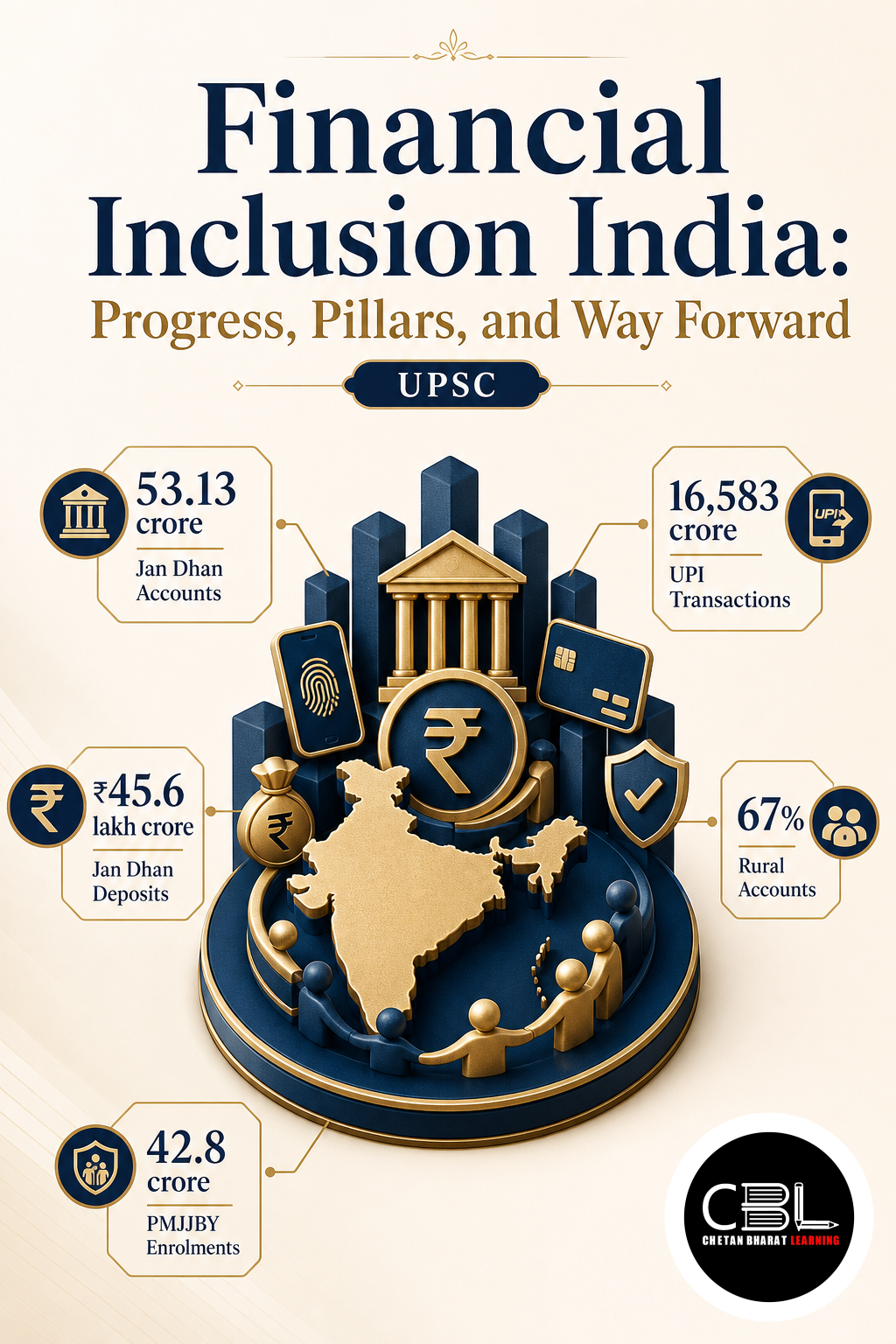
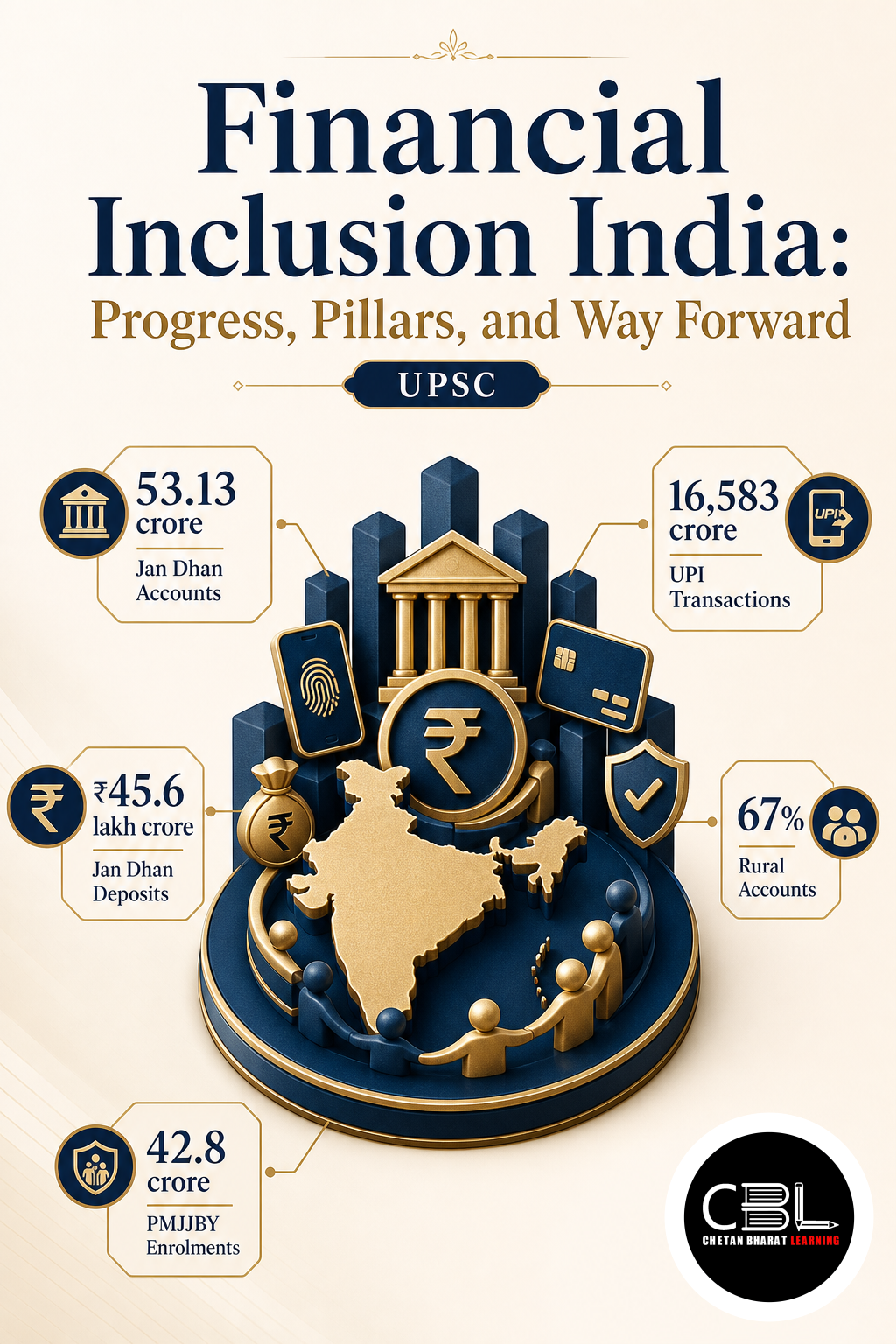
Financial Inclusion India refers to the process of ensuring access to appropriate financial products and services for all sections of society at an affordable cost. India’s progress is measured by the RBI’s Financial Inclusion (FI) Index, which captures access, usage, and quality of financial services. The World Bank Global Findex also tracks account ownership, which reached 89% in India.
The banking infrastructure has expanded significantly, with 1.81 lakh bank branches, 1.65 lakh post offices, and 17.36 lakh Banking Correspondents. Village banking coverage stands at 99.92%, and the India Post Payments Bank serves over 11 crore customers across 5.57 lakh villages and towns.
Why is Financial Inclusion India in News?
Financial Inclusion India is in the news because the government has highlighted the significant progress made, with the FI Index rising to 70.0. The PMJDY has covered 58.90 crore beneficiaries, of which 32.83 crore are women. The JAM Trinity—Jan Dhan accounts, Aadhaar, and mobile connectivity—has enabled Direct Benefit Transfer (DBT) and reduced leakages.
Digital payments have surged, with UPI transaction volume increasing nearly 12,000-fold between FY 2016–17 and FY 2025–26, recognised by the IMF as the world’s largest real-time payment system.
Key Features of Financial Inclusion India
Financial Inclusion India rests on several pillars:
- Universal Banking: PMJDY provides basic savings accounts; the JAM Trinity enables DBT.
- Social Security: PMJJBY (life insurance), PMSBY (accident insurance), and APY (pension) cover millions.
- Inclusive Credit: PM Mudra Yojana offers collateral-free loans up to ₹20 lakh; PM SVANidhi supports street vendors; the Kisan Credit Card provides agricultural credit.
- Digital Financial Inclusion: UPI revolutionised payments; the Jan Samarth platform integrates 16 credit schemes.
- Financial Literacy: NCFE promotes education; FEPA targets farmers, SHGs, and ASHA workers.
Challenges in Financial Inclusion India
Despite progress, Financial Inclusion India faces several challenges:
- Usage Gap: Many accounts remain dormant; active usage of financial products needs improvement.
- Digital Divide: Lack of digital literacy and smartphone access hinders adoption, especially in rural areas.
- Credit Access: MSMEs and informal sector workers still struggle to access formal credit.
- Financial Literacy: Awareness of available schemes and products is low among marginalised communities.
- Fraud and Security: Rising digital payments increase the risk of cyber fraud and phishing.
Way Forward for Financial Inclusion India
To deepen Financial Inclusion India, the government should focus on usage, not just account ownership. Regular financial literacy campaigns, especially through community-based organisations, can empower people to use formal financial services.
Expanding digital infrastructure and promoting affordable smartphones and internet access can bridge the digital divide. Strengthening credit guarantee schemes and easing loan access for MSMEs and street vendors can boost economic activity. The nationwide Financial Inclusion Saturation Campaign covering 2.70 lakh Gram Panchayats and ULBs is a positive step.
Prelims Practice Corner
Q1. What is the current value of RBI’s Financial Inclusion Index (2026)?
(a) 43.4 (b) 55.5 (c) 70.0 (d) 85.0
Answer
The FI Index is 70.0 as of March 2026.
Q2. Which scheme provides collateral-free loans up to ₹20 lakh?
(a) PMJDY (b) PM Mudra Yojana (c) PMSVANidhi (d) APY
Answer
PM Mudra Yojana provides loans up to ₹20 lakh.
Q3. What is the JAM Trinity?
(a) Jan Dhan, Aadhaar, Mobile (b) Banking, Insurance, Pension (c) Loans, Savings, Payments (d) Government, RBI, Banks
Answer
JAM integrates Jan Dhan accounts, Aadhaar, and mobile connectivity for DBT.
Q4. How many beneficiaries are covered under PMJDY as of July 2026?
(a) 30 crore (b) 58.90 crore (c) 80 crore (d) 100 crore
Answer
PMJDY has covered 58.90 crore beneficiaries.
Q5. UPI is recognised by which international body as the world’s largest real-time payment system?
(a) IMF (b) World Bank (c) BIS (d) WTO
Answer
The IMF has recognised UPI as the world’s largest real-time payment system.
Mains Practice Questions
Q1. Discuss the role of financial inclusion in achieving inclusive growth in India. Highlight the progress made and the challenges that remain. (250 words, 15 marks)
Answer Structure:
- Intro: Define financial inclusion and its importance.
- Body: Discuss progress through PMJDY, JAM Trinity, UPI, and social security schemes. Analyse challenges: usage gap, digital divide, credit access.
- Conclusion: Suggest a focus on usage, digital literacy, and strengthening credit mechanisms.
Q2. What is the significance of the JAM Trinity in enhancing financial inclusion and welfare delivery in India? (150 words, 10 marks)
Answer Structure:
- Intro: Explain JAM Trinity.
- Body: Discuss how Jan Dhan accounts, Aadhaar, and mobile connectivity enable DBT, reduce leakages, and improve targeting of subsidies and welfare payments.
- Conclusion: Conclude that JAM is a game-changer for inclusive growth.
FAQs on Financial Inclusion India
What is financial inclusion?
It is the process of ensuring access to appropriate financial products and services for all sections of society at an affordable cost, enabling them to participate in the formal financial system.
What are the key pillars of financial inclusion in India?
Universal banking (PMJDY), social security (PMJJBY, PMSBY, APY), inclusive credit (PM Mudra, PMSVANidhi, KCC), digital payments (UPI), and financial literacy (NCFE).
What is the FI Index?
The RBI’s Financial Inclusion Index measures the extent of financial inclusion across access, usage, and quality of financial services.
Related Current Affairs
Preparing for UPSC, PCS or HCS?
Talk to a mentor at Chetan Bharat Learning, Chandigarh. Free guidance on choosing the right exam and building a study plan.
Chat on WhatsAppCall 97793 53345UPSC / IAS / PCS coaching in Chandigarh · Trusted by aspirants across Punjab & Haryana
Leave a Reply
You must be logged in to post a comment.