

UPSC Mapping
| Prelims | Mains |
|---|---|
| Science & Technology | GS Paper 3 (Science & Technology & Defence) |
Quick Facts
| Combustion Type | Detonation (Supersonic) |
|---|---|
| Efficiency Gain | 10-25% higher |
| Temperature | >2,000°C |
What is a Rotating Detonation Engine?
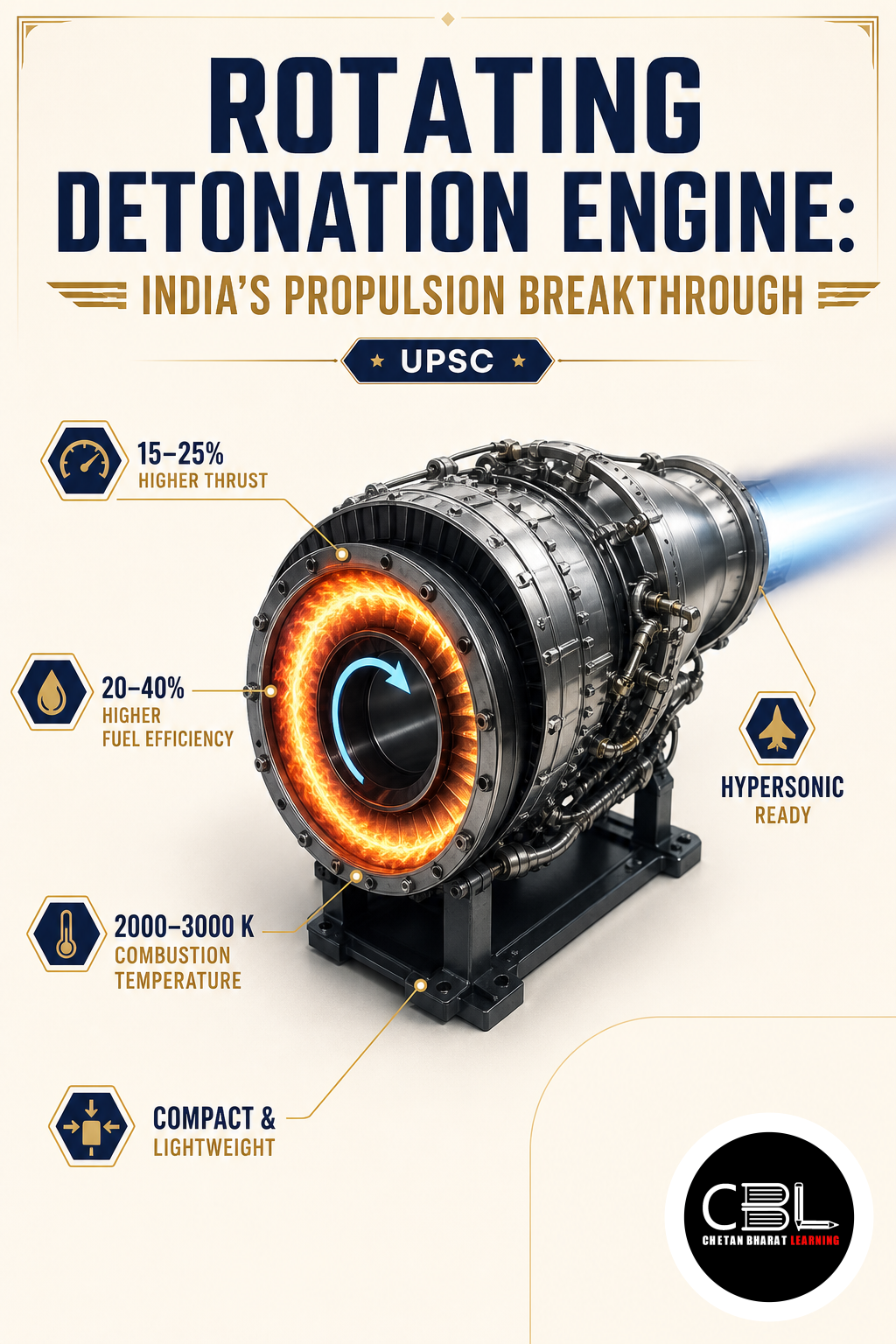
A Rotating Detonation Engine (RDE) is a type of propulsion system that uses a continuous supersonic detonation wave around a ring-shaped combustion chamber to burn fuel. Unlike conventional engines that use deflagration—a subsonic, steady flame—RDEs achieve near-instantaneous combustion through a shock wave that compresses and ignites the fuel-air mixture.
The detonation wave races continuously around the annulus, consuming fresh fuel-air mixture and expelling high-pressure exhaust through the nozzle. This pressure-gain combustion enables approximately 10–25% higher thermodynamic efficiency than conventional engines, potentially reducing fuel requirements and increasing payload capacity in aerospace applications.
Why is the Rotating Detonation Engine in News?
The Rotating Detonation Engine is in the news because D-Propulse successfully demonstrated the technology at a DRDO facility in Hyderabad, marking a significant milestone for India’s defence and aerospace sectors. The demonstration showcases India’s growing capability in advanced propulsion technologies.
The RDE offers potential advantages over conventional gas turbines and ramjets, including greater range, higher speed, and improved affordability. Its mechanically simple design has no moving parts, making it less complex and potentially lower-cost to manufacture. For more details, refer to this PIB release.
Key Features of the Rotating Detonation Engine
- Supersonic Combustion: Uses detonation driven by a shock wave, unlike subsonic deflagration in conventional engines.
- Pressure Gain: Near-instantaneous combustion traps heat at constant volume, causing a sharp pressure spike.
- Continuous Cycle: A detonation wave races continuously around the annular chamber, consuming fresh fuel-air mixture.
- No Moving Parts: Mechanically simpler than gas turbine engines, potentially reducing manufacturing costs.
- Higher Efficiency: Provides 10–25% higher thermodynamic efficiency than conventional combustion.
Challenges in Rotating Detonation Engine Development
- Material Durability: Requires chamber materials capable of withstanding temperatures exceeding 2,000°C and extreme pressure oscillations.
- Precise Fuel Injection: Requires precise timing and control of fuel and oxidizer injection to sustain the detonation wave.
- Thermal Management: Managing extreme heat and preventing component degradation is a significant engineering challenge.
- Scaling: Scaling the technology for practical aerospace applications while maintaining efficiency.
- Testing Infrastructure: Requires advanced testing facilities to validate performance and durability.
Way Forward for Rotating Detonation Engine
To harness the potential of the Rotating Detonation Engine, India should continue investing in R&D for advanced materials and fuel injection systems. Collaborations between defence start-ups, DRDO, and academic institutions can accelerate technology maturation.
Developing ground-testing facilities and flight-demonstration programmes will help validate performance. The technology’s potential applications include missiles, hypersonic vehicles, and satellite launch systems. A focused, long-term roadmap with clear milestones and funding is essential. For international best practices, refer to the NASA.
Prelims Practice Corner
Q1. What type of combustion does a Rotating Detonation Engine use?
- a) Deflagration
- b) Detonation
- c) Subsonic flame
- d) Diffusion flame
Answer: (b) RDE uses supersonic detonation.
Q2. What is the approximate efficiency gain of an RDE over conventional engines?
- a) 5-10%
- b) 10-25%
- c) 25-50%
- d) 50-75%
Answer: (b) RDE offers 10–25% higher thermodynamic efficiency.
Q3. Which Indian organisation facilitated the RDE demonstration?
- a) ISRO
- b) DRDO
- c) BARC
- d) CSIR
Answer: (b) The demonstration was held at a DRDO facility in Hyderabad.
Q4. What is deflagration?
- a) Supersonic combustion
- b) Subsonic combustion through a spreading flame
- c) No combustion
- d) Explosive combustion
Answer: (b) Deflagration is subsonic combustion through a spreading flame.
Q5. What is a key challenge in RDE development?
- a) Low efficiency
- b) Material durability at >2,000°C
- c) High moving parts
- d) High fuel consumption
Answer: (b) RDE requires materials that can withstand extreme temperatures and pressure oscillations.
Mains Practice Questions
Q1. Discuss the significance of the Rotating Detonation Engine for India’s defence and aerospace sectors, and the challenges in its development. (250 words, 15 marks)
Answer Structure:
- Intro: Introduce the RDE and its recent demonstration.
- Body: Explain the technology: detonation vs deflagration, efficiency gains, no moving parts. Analyse its significance: propulsion for missiles, hypersonic vehicles, satellites. Address challenges: materials, fuel injection, scaling.
- Conclusion: Suggest a long-term R&D roadmap and collaboration.
Q2. What is the difference between detonation and deflagration in propulsion systems? (150 words, 10 marks)
Answer Structure:
- Intro: Define both terms.
- Body: Explain that deflagration is subsonic combustion through a flame, while detonation is supersonic combustion driven by a shock wave. Detonation offers higher thermodynamic efficiency but requires more robust materials.
- Conclusion: Conclude that detonation engines represent a significant advancement in propulsion technology.
FAQs on Rotating Detonation Engine
What is a Rotating Detonation Engine?
It is a propulsion system that uses continuous supersonic detonation waves in a ring-shaped combustion chamber to burn fuel and generate thrust.
How does an RDE differ from a conventional gas turbine?
RDE uses detonation instead of deflagration, has no moving parts, and offers 10-25% higher thermodynamic efficiency.
What are the potential applications of RDE?
Potential applications include missiles, hypersonic vehicles, satellite launch systems, and advanced aircraft propulsion.
Related Current Affairs
Preparing for UPSC, PCS or HCS?
Talk to a mentor at Chetan Bharat Learning, Chandigarh. Free guidance on choosing the right exam and building a study plan.
Chat on WhatsAppCall 97793 53345UPSC / IAS / PCS coaching in Chandigarh · Trusted by aspirants across Punjab & Haryana
Leave a Reply
You must be logged in to post a comment.