

UPSC Mapping
Important for
| Prelims | Digital Public Infrastructure, IndiaAI Mission, DEPA, UPI, Aadhaar |
|---|---|
| Mains | GS Paper II – Governance, Digital Governance and Emerging Technologies |
Quick Facts
| Existing DPI | Aadhaar, UPI, DEPA |
|---|---|
| Proposed Utility | Artificial Intelligence |
| Mission | IndiaAI Mission |
| Policy Theme | Digital Governance |
What is AI Digital Public Infrastructure?
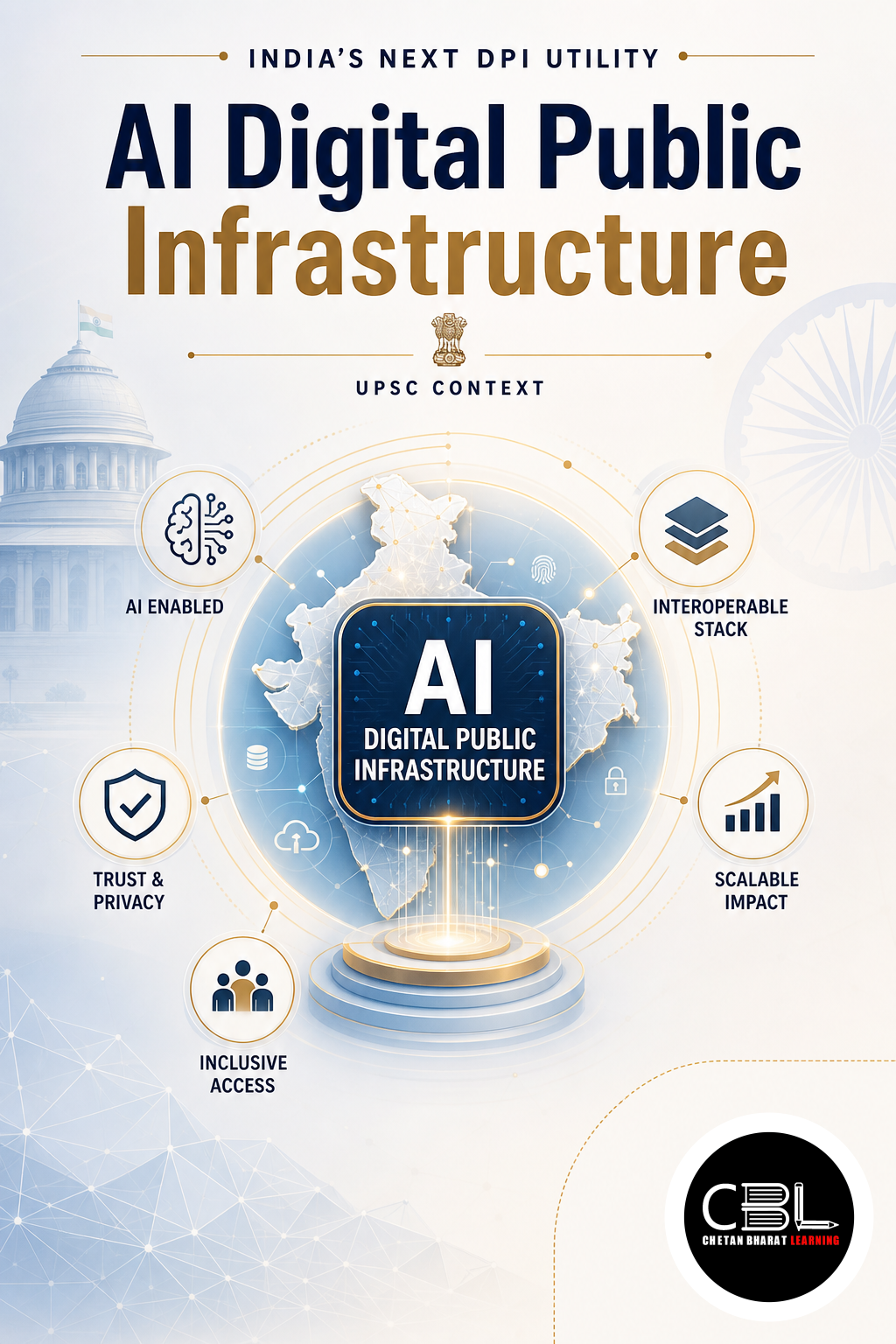
AI Digital Public Infrastructure refers to the proposal of establishing Artificial Intelligence as the fourth foundational layer of India’s Digital Public Infrastructure ecosystem. It builds upon existing public digital utilities such as Aadhaar (identity), Unified Payments Interface (UPI) (payments) and the Data Empowerment and Protection Architecture (DEPA) (data sharing).
Digital Public Infrastructure (DPI) is an open, interoperable network that delivers population-scale public services through digital platforms. Integrating AI into this ecosystem can enable intelligent, secure and inclusive delivery of governance and citizen-centric services.
Why is AI Digital Public Infrastructure in News?
Policy experts have argued that India can achieve another population-scale digital transformation if Artificial Intelligence becomes the country’s next Digital Public Infrastructure utility. The proposal highlights India’s existing strengths in digital identity, payments, multilingual datasets and public digital networks.
The discussion has gained momentum alongside the implementation of the IndiaAI Mission and India’s efforts to build sovereign AI capabilities. Official information is available through the IndiaAI Mission.
Significance of AI Digital Public Infrastructure
- Inclusive public services: AI-powered multilingual platforms such as Bhashini can improve access to government services for citizens speaking diverse Indian languages and dialects.
- Lower innovation costs: Open-source sovereign AI models can reduce dependence on expensive proprietary foreign APIs, making advanced AI more affordable for startups.
- Financial inclusion: AI-enabled assessment of alternative data through the Open Credit Enablement Network (OCEN) can improve access to credit for underserved MSMEs.
- Efficient welfare delivery: Predictive analytics integrated with Aadhaar and DigiLocker can improve targeting of subsidies and reduce leakages.
- Healthcare transformation: AI integrated with Ayushman Bharat networks can assist early disease screening and strengthen preventive healthcare.
- Agricultural productivity: Computer vision and regional AI models can support early crop disease detection and precision farming for small farmers.
India’s Structural Advantages
- Massive digital datasets: Billions of monthly UPI transactions provide structured datasets for training AI models.
- Multilingual diversity: India’s 22 official languages and thousands of dialects create valuable linguistic resources for Indic large language models.
- Universal digital identity: Aadhaar offers a trusted authentication layer for AI-enabled public services.
- Interoperable digital platforms: Open networks such as ONDC and OCEN facilitate seamless AI integration.
- Privacy architecture: DEPA supports consent-based data sharing while protecting user privacy.
- Government investment: The IndiaAI Mission provides dedicated funding for compute infrastructure, innovation and regulatory sandboxes.
Challenges in Building AI Digital Public Infrastructure
- Limited computing capacity: India’s current GPU availability remains insufficient for training globally competitive sovereign AI models.
- Energy demand: Rapid expansion of AI data centres will increase pressure on electricity generation and transmission infrastructure.
- Dependence on foreign technology: Excessive reliance on proprietary AI models leads to capital outflow and technological dependence.
- Regulatory uncertainty: Clear accountability frameworks are required for autonomous AI agents performing financial or administrative functions.
- Data security concerns: Expanding interoperable public databases increases cyber risks and potential misuse of sensitive information.
- Privacy risks: Large-scale AI deployment must balance innovation with safeguards against surveillance and data breaches.
Way Forward
India should accelerate implementation of the IndiaAI Compute Portal to provide affordable GPU access for domestic innovators. Public investment in compute infrastructure, transmission networks and sovereign AI models will strengthen national technological capabilities.
Developing open-weight AI models, expanding anonymised public datasets, standardising AI interfaces and creating robust governance frameworks can establish Artificial Intelligence as a trusted Digital Public Infrastructure utility. Greater regulatory clarity and privacy protection will ensure responsible deployment.
Prelims Practice Corner
-
Q1. Which of the following is proposed as the fourth foundational Digital Public Infrastructure utility in India?
- (a) Blockchain
- (b) Artificial Intelligence
- (c) Quantum Computing
- (d) Internet of Things
Answer: (b) Artificial Intelligence.
-
Q2. DEPA stands for:
- (a) Digital Empowerment and Privacy Act
- (b) Data Empowerment and Protection Architecture
- (c) Digital Electronic Payment Authority
- (d) Data Exchange Protection Authority
Answer: (b) Data Empowerment and Protection Architecture.
-
Q3. Which mission supports India’s public investment in Artificial Intelligence?
- (a) Digital India Mission
- (b) IndiaAI Mission
- (c) Startup India
- (d) PM Gati Shakti
Answer: (b) IndiaAI Mission.
-
Q4. Which DPI component primarily supports digital payments in India?
- (a) Aadhaar
- (b) DigiLocker
- (c) UPI
- (d) DEPA
Answer: (c) UPI.
-
Q5. Which network enables consent-based data sharing in India’s Digital Public Infrastructure?
- (a) ONDC
- (b) Aadhaar
- (c) DEPA
- (d) OCEN
Answer: (c) DEPA.
Mains Practice Questions
-
Q1. Discuss the potential of Artificial Intelligence as the next Digital Public Infrastructure utility in India. (10 marks)
Answer Structure
Intro: Explain Digital Public Infrastructure and the proposal to integrate AI.
Body: Benefits for governance, healthcare, finance, agriculture, challenges and safeguards.
Conclusion: Emphasise inclusive and responsible AI-led governance.
-
Q2. Evaluate the opportunities and challenges associated with building sovereign Artificial Intelligence infrastructure in India. (15 marks)
Answer Structure
Intro: Define sovereign AI infrastructure.
Body: Structural strengths, compute infrastructure, privacy, regulation, funding and innovation.
Conclusion: Highlight India’s pathway towards trusted public AI.
FAQs on AI Digital Public Infrastructure
What is AI Digital Public Infrastructure?
It refers to integrating Artificial Intelligence as a foundational Digital Public Infrastructure utility alongside Aadhaar, UPI and DEPA to deliver population-scale public services.
Why is AI important for India’s Digital Public Infrastructure?
AI can improve service delivery, financial inclusion, healthcare, agriculture and multilingual access while making governance more efficient and citizen-centric.
Why is AI Digital Public Infrastructure relevant for UPSC?
The topic is important for GS Paper II covering governance, Digital India, Artificial Intelligence, public policy and emerging technologies.
Related Current Affairs
Preparing for UPSC, PCS or HCS?
Talk to a mentor at Chetan Bharat Learning, Chandigarh. Free guidance on choosing the right exam and building a study plan.
Chat on WhatsAppCall 97793 53345UPSC / IAS / PCS coaching in Chandigarh · Trusted by aspirants across Punjab & Haryana
Leave a Reply
You must be logged in to post a comment.