
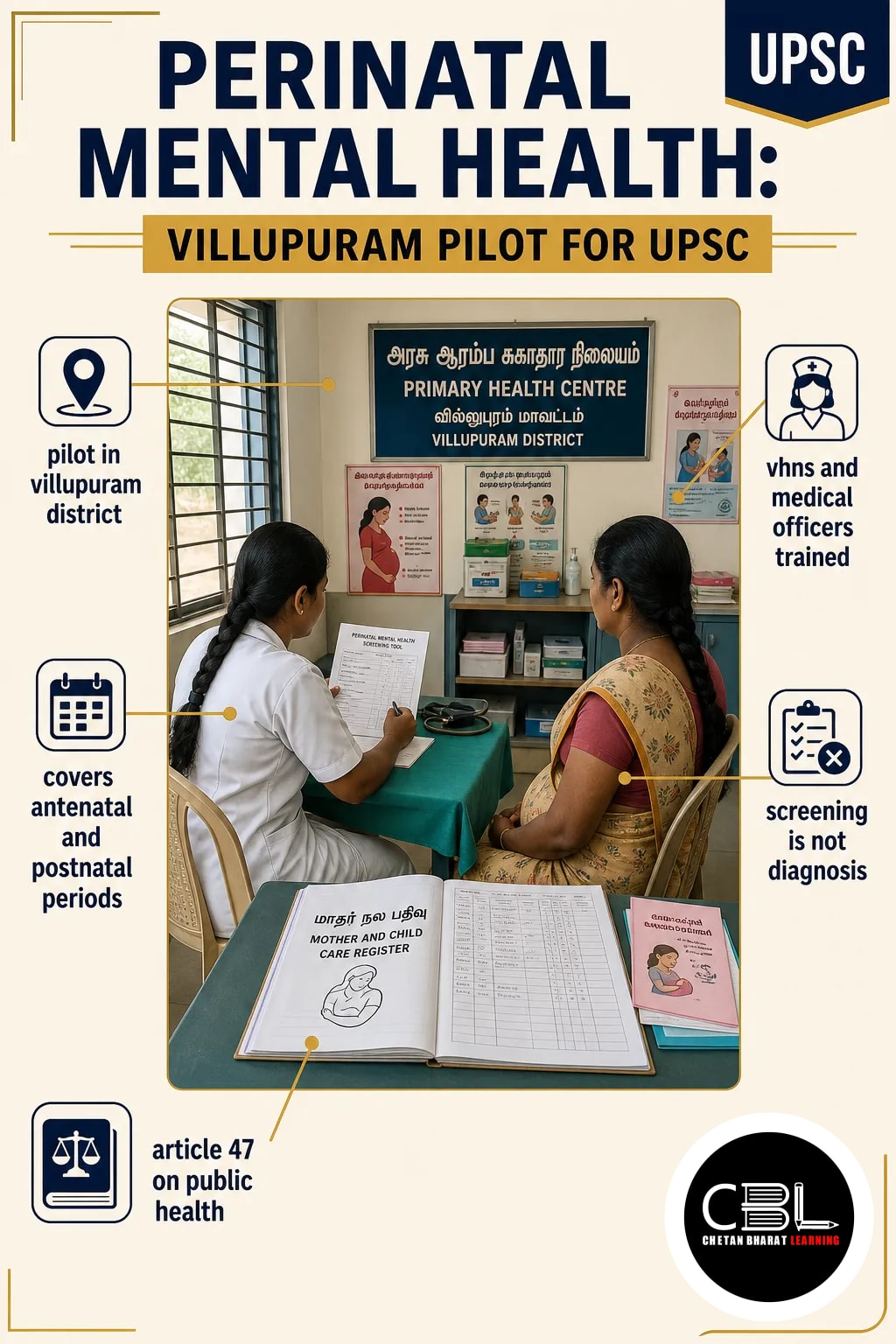
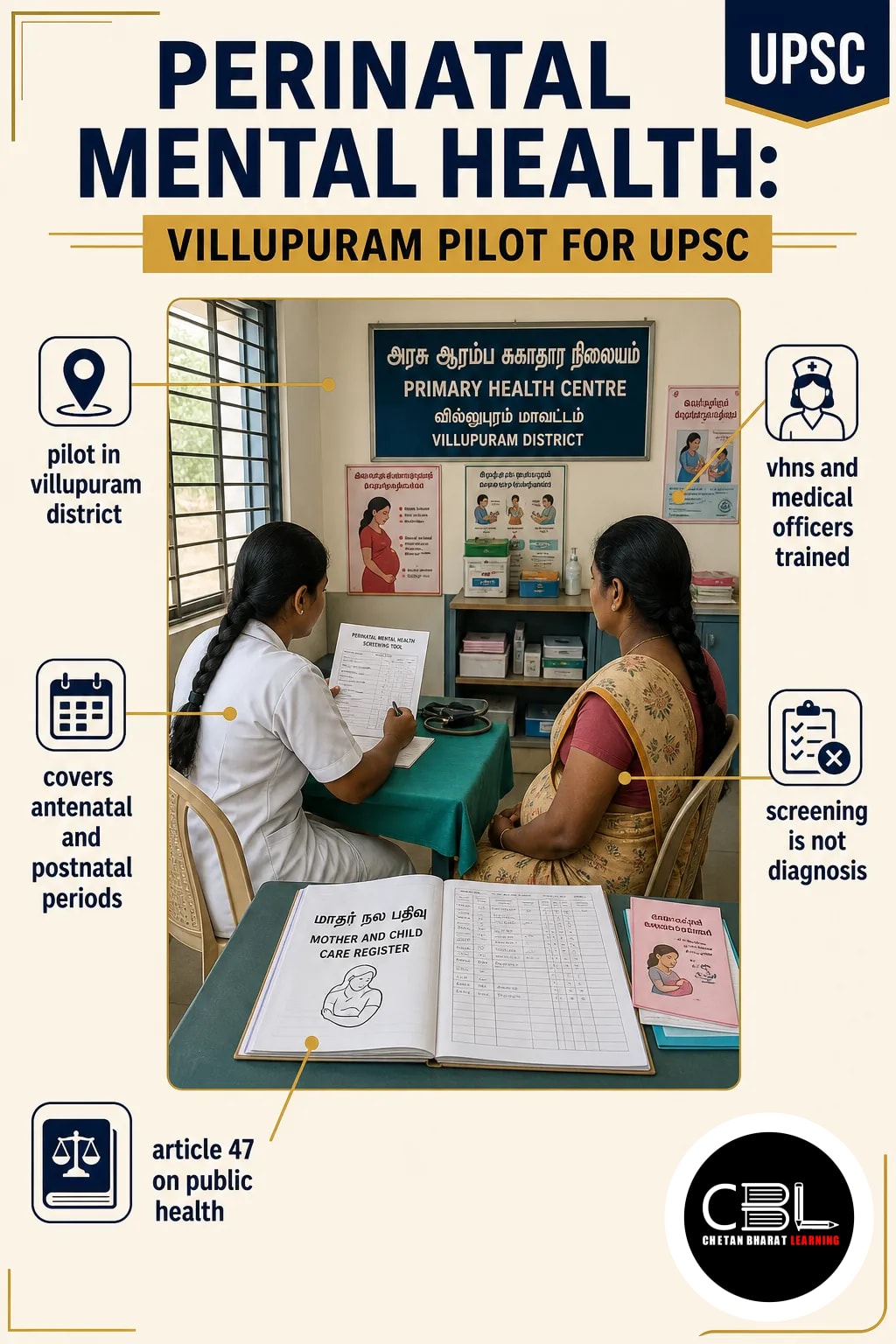
Perinatal mental health is the focus of Tamil Nadu’s proposed Thai Manam pilot in Villupuram district. The initiative offers a case study in integrating mental healthcare with maternal services for national current affairs.
Quick answer: Tamil Nadu plans to pilot Thai Manam in four Villupuram blocks to strengthen perinatal mental health care. Village Health Nurses and medical officers are being trained to screen for problems, particularly depression, before and after childbirth. The initiative aims to connect women with timely, appropriate care through primary healthcare.
What is perinatal mental health?
Perinatal mental health concerns psychological well-being during pregnancy and after childbirth. Antenatal refers to the period before birth; postnatal refers to the period after birth.
Depression is one mental health concern during these periods. Screening can identify women who may need further assessment; however, a screening result alone is not a diagnosis. Appropriate care also requires clinical evaluation, support and follow-up.
Doctors from the Institute of Mental Health (IMH) cited global studies indicating antenatal depression prevalence of 10% to 20%. This is a global range from studies, not an estimate for Villupuram or Tamil Nadu. Therefore, local findings from the pilot should not be assumed in advance.
Why is Thai Manam in the news?
Tamil Nadu is preparing to pilot Thai Manam at the primary healthcare level in Villupuram. Village Health Nurses (VHNs) and medical officers in four blocks are undergoing training to screen women and facilitate care.
The project involves IMH, the Indian Council of Medical Research–National Institute of Epidemiology and the Directorate of Public Health and Preventive Medicine. Thus, it brings mental health expertise, epidemiological capacity and public health administration together.
| Feature | Details |
|---|---|
| Pilot blocks | Kanai, Koliyanur, Vallam and Mugaiyur |
| Personnel | VHNs and medical officers |
| Period covered | Antenatal and postnatal periods |
| Immediate purpose | Screen for mental health problems, especially depression, and facilitate appropriate care |
The source does not specify a screening instrument, budget or pilot start date. Therefore, these details should not be assumed when discussing implementation.
Why integrate mental health with maternal care?
Integration can bring mental health concerns into routine contact with the health system during pregnancy and after childbirth. It also gives primary care personnel an opportunity to identify women who may otherwise not seek separate mental health support.
- Earlier identification: Screening during maternal care can prompt assessment instead of waiting for a crisis.
- Continuity: Antenatal and postnatal contact can support follow-up across both periods, rather than treating birth as the end of care.
- Accessible entry point: Primary healthcare can provide a familiar first point of contact; however, it must connect women with further services when needed.
- Whole-person care: Maternal health policy can address psychological needs alongside physical health, rather than treating them as separate responsibilities.
Screening is consequently a first step, not the full service. Its value depends on whether women can obtain assessment and appropriate support afterwards.
What policy and rights principles apply?
The Constitution and mental health law provide a wider framework for examining access to care. Article 47 directs the state to regard the improvement of public health as a primary duty.
In addition, the Mental Healthcare Act, 2017 recognises a right to access mental healthcare and treatment from services run or funded by the appropriate government. It also protects confidentiality of information concerning a person’s mental health, subject to the Act’s provisions.
For a maternal health pilot, these principles make access and confidentiality central design considerations. They do not, however, establish that a particular referral or privacy procedure has already been adopted for Thai Manam.
What implementation challenges require attention?
The main challenge is to turn screening into a dependable pathway to care. The following are implementation risks to assess, not findings established by the source about the pilot.
- Workforce capacity: Training must help personnel recognise concerns and respond sensitively; moreover, staff need support when cases are complex.
- Referral and follow-up: A positive screen needs a clear route to assessment and care; otherwise, identification may not translate into help.
- Privacy and trust: Women may hesitate to discuss symptoms without confidential conversations and respectful handling of information.
- Service coordination: Primary care and mental health providers need communication arrangements; in addition, patients need clarity about where to seek further care.
- Workload: Adding screening to maternal services requires adequate time and supervision, rather than relying on training alone.
How can the pilot inform wider policy?
The pilot can guide expansion if its assessment examines both access to screening and access to subsequent care. First, authorities could map referral options and assign responsibility for follow-up at each stage.
Second, training could include non-judgemental communication, privacy safeguards and recognition of situations requiring urgent clinical attention. Supportive supervision would also help VHNs and medical officers apply their training consistently.
Finally, evaluation could track screening coverage, completed referrals and follow-up, while protecting personal information. Feedback from women and frontline personnel would add context; together, these measures could show whether the model works beyond initial identification.
Source: The Hindu, 3 November 2026
Asked in UPSC: Previous Year Questions
- UPSC CSE Mains 2020 (GS Paper II): Discuss why sound and adequate healthcare policies, particularly for geriatric and maternal health, are needed to enhance social development.
UPSC connects maternal healthcare policy with broader social development; therefore, link service delivery to access and equity.
State PCS General Studies can test this pilot as an example of integrating mental health with maternal care. In addition, candidates can examine how state health departments coordinate frontline training, referrals and follow-up.
Prelims Practice Corner
Mains Practice Questions
Frequently Asked Questions
What is the Thai Manam project?
Thai Manam is a proposed Tamil Nadu pilot to strengthen mental healthcare around pregnancy and childbirth. It trains primary healthcare personnel to screen for concerns and facilitate care.
Where will the pilot be conducted?
The pilot is planned in four blocks of Villupuram district. These are Kanai, Koliyanur, Vallam and Mugaiyur.
Does a positive mental health screen establish a diagnosis?
No, because screening identifies a possible concern rather than providing a definitive diagnosis. Therefore, further clinical assessment is needed to determine appropriate care.
Related Current Affairs
Preparing for UPSC, PCS or HCS?
Talk to a mentor at Chetan Bharat Learning, Chandigarh. Free guidance on choosing the right exam and building a study plan.
Chat on WhatsAppCall 97793 53345UPSC / IAS / PCS coaching in Chandigarh · Trusted by aspirants across Punjab & Haryana

 Ananya RanaIAS · AIR 60
 Aditya SharmaIAS · AIR 70
 Ria Kaur SethiIPS · AIR 89
 Aman AloonIRS · AIR 295
 Sumer Singh VirkIRS · AIR 335
 Shivani PanchalIAS

Leave a Reply
You must be logged in to post a comment.