
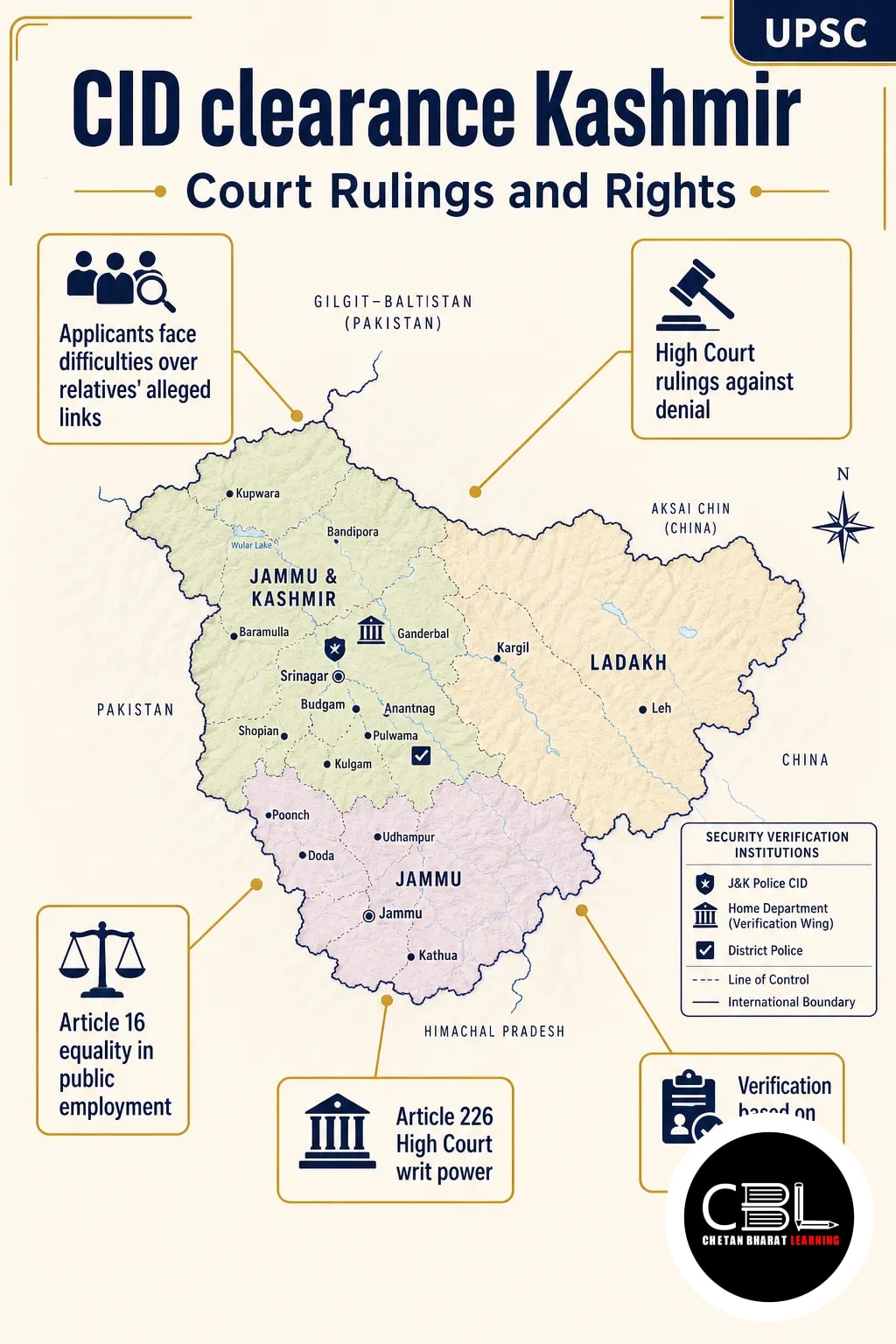
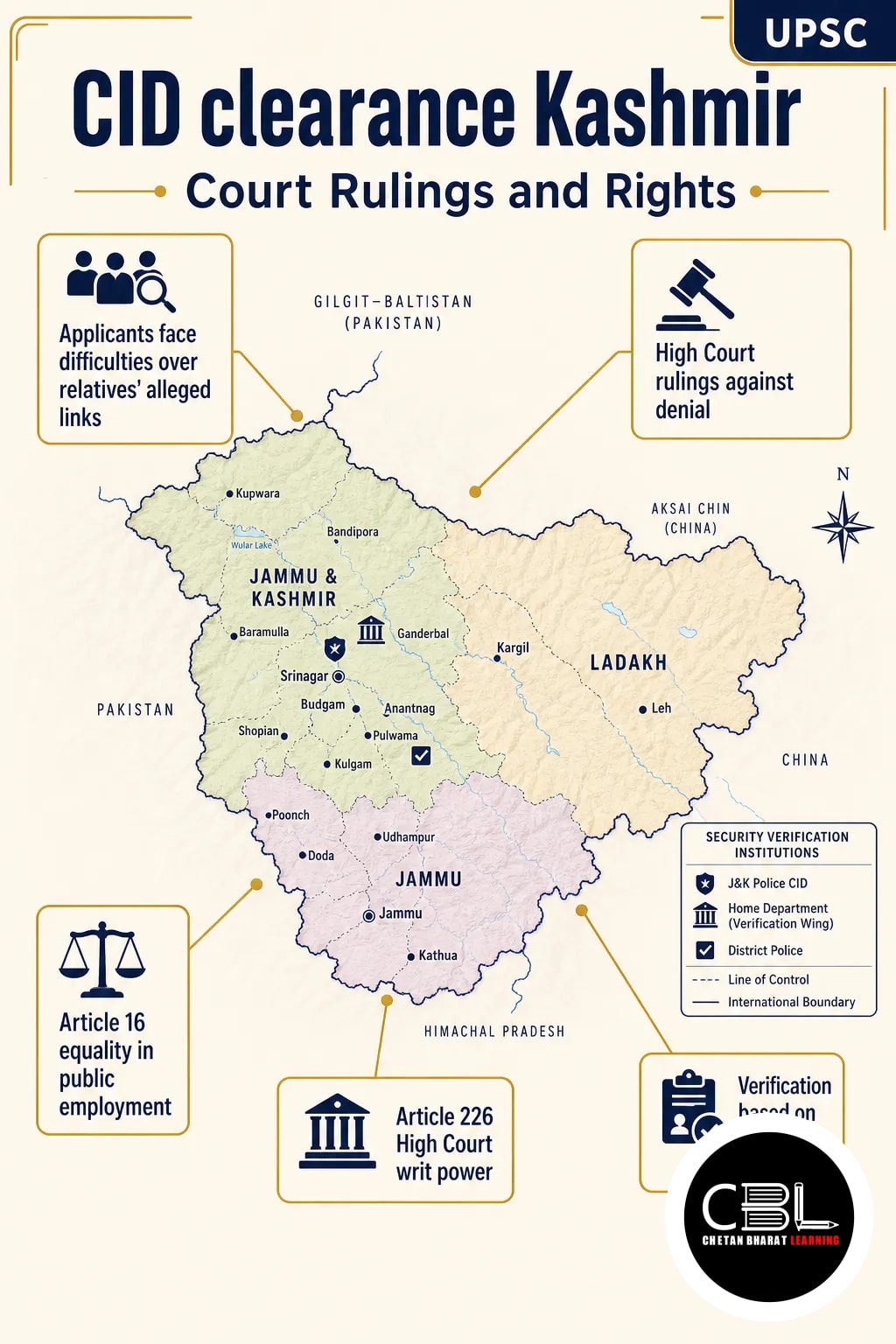
CID clearance Kashmir concerns have resurfaced after lawmaker M.Y. Tarigami said applicants still face difficulties because of relatives’ alleged links to militancy. The issue connects security verification with constitutional rights and administrative accountability.
Quick answer: CID clearance Kashmir is under scrutiny after Tarigami said on 2 November 2026 that applicants face difficulties over relatives’ alleged militancy links. He cited High Court rulings against denial solely on that basis. He also said allegations concerning people who died years ago continue to affect younger family members.
What have the courts held?
According to Tarigami, the High Court has held in several cases that a relative’s alleged militancy involvement alone cannot justify denying security clearance. The source does not identify the cases, dates or precise wording of the orders. Therefore, this account should not be treated as a substitute for reading the judgments.
The distinction is between an applicant’s own conduct and an allegation about someone related to that person. It does not mean that authorities must ignore a substantiated security concern about the applicant. Rather, the reported principle challenges denial based simply on family association.
Why is CID clearance in Kashmir in the news?
Communist Party of India (Marxist) leader and lawmaker Mohammad Yousuf Tarigami said difficulties persist despite the court rulings. On 2 November, he pointed to alleged links involving even distant relatives. He also said that, in some cases, accused persons had died years earlier, yet the allegations still affected their families.
Tarigami argued that this can deny opportunities to younger generations through no fault of their own. He called for a review of verification based on individual conduct, while acknowledging that security concerns matter. However, the source provides no case count, applicant details or official response.
Criminal Investigation Department (CID) clearance here refers to the security verification discussed in the report. The source does not set out the complete procedure, all purposes requiring clearance or the authority deciding every application. Consequently, the precise administrative rules should not be assumed from this report alone.
Which constitutional provisions are relevant?
Equality, public employment and judicial remedies provide the constitutional framework for examining a clearance decision.
| Provision | Relevance |
|---|---|
| Article 14 | Guarantees equality before the law and equal protection of the laws to persons. |
| Article 16 | Guarantees citizens equality of opportunity in public employment, subject to constitutional provisions. |
| Article 21 | Protects life and personal liberty except according to procedure established by law. |
| Article 226 | Empowers High Courts to issue writs for fundamental rights and other purposes. |
For example, Article 16 becomes directly relevant when a clearance decision affects public employment. Article 14 also offers a basis to question arbitrary state action. However, whether a particular decision violates a right depends on its facts, applicable rules and judicial assessment.
High Courts can examine administrative action under Article 226. Therefore, an affected applicant may seek judicial review where appropriate; the Constitution does not make every security assessment automatically unlawful.
What are the governance implications?
The issue tests whether verification can protect security without attributing responsibility by association.
- Individual assessment: A person’s own conduct and relevant evidence should be distinguished from allegations against relatives.
- Equal opportunity: If a decision affects public employment, Article 16 makes the basis of that decision especially important.
- Implementation: Tarigami’s statement raises a gap between reported judicial principles and applicants’ continuing difficulties.
- Public trust: Perceptions of unfair treatment can weaken confidence in institutions; therefore, fair procedures matter alongside security objectives.
These are analytical implications, not findings about the outcome of every application. Similarly, the constitutional discussion of equality illustrates why the reasons for differential treatment matter.
What concerns and safeguards deserve attention?
The central concern is that family association may substitute for an assessment of the individual. Equally, authorities need a workable means of considering genuine security risks.
- Relevant evidence: Verification should focus on information connected to the applicant rather than treat kinship itself as proof.
- Reasons and review: Authorities could communicate reasons as far as security permits and provide a route to challenge errors.
- Correcting records: A review mechanism could allow applicants to contest outdated or inaccurate information.
- Compliance: Supervisory checks could help officials apply relevant court directions consistently.
These are proposed safeguards, not procedures established by the source. Moreover, any disclosure process must account for legitimate confidentiality needs. A useful comparison is the separate discussion of grievance redressal in public administration.
Ultimately, CID clearance in Kashmir presents a question of administrative design: how to assess security risks fairly while allowing meaningful correction and review. An individualised process can address both concerns without assuming that every relative shares an accused person’s conduct.
Source: The Hindu, 3 November 2026
Asked in UPSC: Previous Year Questions
- UPSC CSE Mains 2023 (GS Paper III): Discuss government measures to win hearts and minds and restore public trust as part of conflict resolution in Jammu and Kashmir.
UPSC also examines how security policy and public trust interact in conflict-affected areas.
State PCS General Studies can test equality, public employment and High Court writ jurisdiction through this issue. In addition, Mains answers can examine fair verification and grievance redressal in state administration.
Prelims Practice Corner
Mains Practice Questions
Frequently Asked Questions
Why is CID clearance an issue in Kashmir?
Because Tarigami says applicants still face difficulties over relatives’ alleged militancy links. He also says these difficulties persist despite High Court rulings.
Can clearance be denied solely because of a relative’s alleged militancy involvement?
No, according to Tarigami’s account of several High Court rulings. However, the source does not provide the case names or full orders.
Which constitutional article empowers High Courts to issue writs?
Article 226 empowers High Courts to issue writs. It covers fundamental rights and, in addition, other purposes.
What review did Tarigami propose?
He sought verification based on the individual’s own conduct. He also acknowledged security concerns while arguing that innocent people’s rights should not suffer.
Related Current Affairs
Preparing for UPSC, PCS or HCS?
Talk to a mentor at Chetan Bharat Learning, Chandigarh. Free guidance on choosing the right exam and building a study plan.
Chat on WhatsAppCall 97793 53345UPSC / IAS / PCS coaching in Chandigarh · Trusted by aspirants across Punjab & Haryana

 Ananya RanaIAS · AIR 60
 Aditya SharmaIAS · AIR 70
 Ria Kaur SethiIPS · AIR 89
 Aman AloonIRS · AIR 295
 Sumer Singh VirkIRS · AIR 335
 Shivani PanchalIAS

Leave a Reply
You must be logged in to post a comment.