
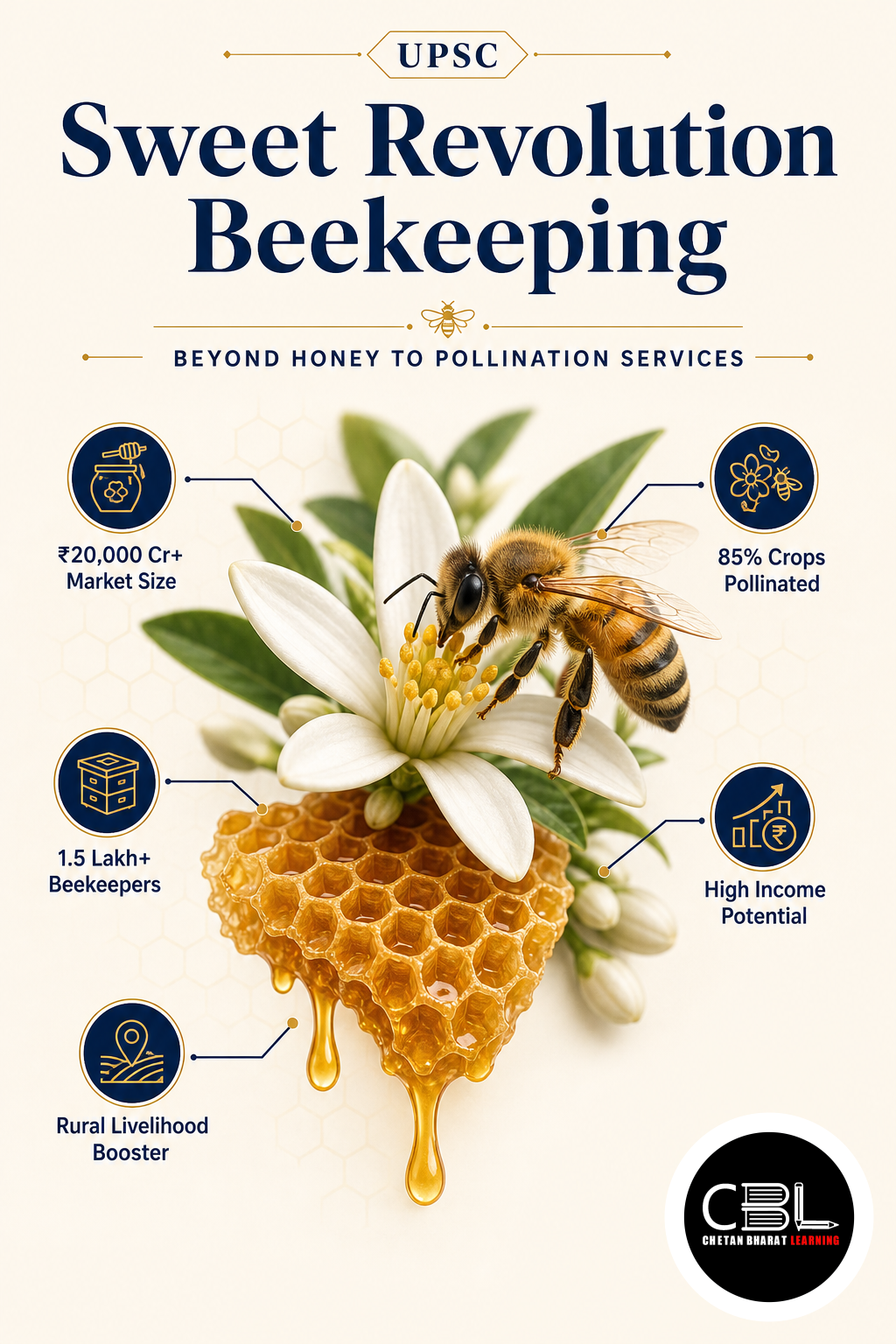

Sweet Revolution Beekeeping is a broader effort to promote scientific beekeeping, honey production, and pollination services as a source of rural income and agricultural sustainability. The government’s National Beekeeping & Honey Mission (NBHM), implemented through the National Bee Board, aims to enhance beekeeping infrastructure and quality. For more such environment and agriculture updates, explore the environment archive.
What is Sweet Revolution Beekeeping?
Sweet Revolution Beekeeping refers to India’s national effort to promote apiculture—the scientific rearing and management of honey bees—as a source of sustainable rural income, improved agricultural productivity through pollination, and biodiversity conservation. The initiative goes beyond honey production to include pollination services, beeswax, royal jelly, and other hive products.
The economic value of bees extends far beyond honey—they are essential pollinators for many food crops, including fruits, vegetables, and oilseeds. Pollinator decline can reduce agricultural productivity and farmer incomes. Beekeeping thus serves as a bridge between agriculture, biodiversity, and rural livelihoods.
Why is Sweet Revolution Beekeeping in News?
Sweet Revolution Beekeeping is in the news as the government continues to promote beekeeping under the NBHM, with a focus on scientific beekeeping, quality improvement, and processing infrastructure. The initiative is part of a broader push to diversify farmer incomes and promote sustainable agriculture.
However, experts caution that a successful honey industry does not automatically mean a healthy pollinator ecosystem. Policy must protect pollinator diversity—including wild bees, butterflies, birds, and bats—not just commercial honey bees. Conservation must consider both managed and wild/native pollinators. For more details, refer to this PIB release.
Key Features of Sweet Revolution Beekeeping
Sweet Revolution Beekeeping has several distinctive features:
- Scientific Beekeeping: Promotes modern techniques for maintaining bee colonies and managing hives.
- Pollination Services: Bees provide vital pollination for crops like fruits, vegetables, and oilseeds, enhancing yields and quality.
- Diverse Products: Honey, beeswax, royal jelly, and other hive products generate multiple income streams.
- Rural Employment: Beekeeping provides supplementary income for farmers, especially landless and marginal households.
- Biodiversity Conservation: Healthy pollinator populations support ecosystem services and biodiversity.
Challenges in Sweet Revolution Beekeeping
Sweet Revolution Beekeeping faces several challenges:
- Pollinator Diversity: Overemphasis on commercial honey bees may neglect wild/native pollinators, affecting ecosystem resilience.
- Pesticide Use: Widespread pesticide use in agriculture harms bee populations and reduces pollination services.
- Habitat Loss: Deforestation and land-use change reduce floral resources and nesting sites for pollinators.
- Disease and Pests: Bee diseases and pests (e.g., Varroa mites) threaten commercial and wild bee populations.
- Market Access: Small beekeepers lack access to processing and marketing infrastructure. For more on biodiversity, visit the biodiversity section.
Way Forward for Sweet Revolution Beekeeping
To make Sweet Revolution Beekeeping sustainable, policy should integrate beekeeping with ecosystem conservation, promoting integrated pest management (IPM) to reduce pesticide harm. Creating pollinator-friendly habitats—including hedgerows, native flowering plants, and protected areas—can support wild pollinators.
Strengthening value chains for honey and other bee products, with quality certification and market linkages, can improve incomes. Research on native bee species and their role in pollination can guide conservation efforts. The goal is a balanced approach that boosts honey production while protecting pollinator diversity and ecosystem services. For international best practices, refer to the FAO.
FAQs on Sweet Revolution Beekeeping
What is the Sweet Revolution?
It is a national effort to promote scientific beekeeping, honey production, and pollination services for rural income and agricultural sustainability.
Why are bees important for agriculture?
Bees are effective pollinators for many food crops, including fruits, vegetables, and oilseeds, directly impacting yields and farmer incomes.
What are the threats to pollinators?
Pesticide use, habitat loss, climate change, and diseases threaten both commercial and wild pollinator populations.
Related Current Affairs
Preparing for UPSC, PCS or HCS?
Talk to a mentor at Chetan Bharat Learning, Chandigarh. Free guidance on choosing the right exam and building a study plan.
Chat on WhatsAppCall 97793 53345UPSC / IAS / PCS coaching in Chandigarh · Trusted by aspirants across Punjab & Haryana
Leave a Reply
You must be logged in to post a comment.