
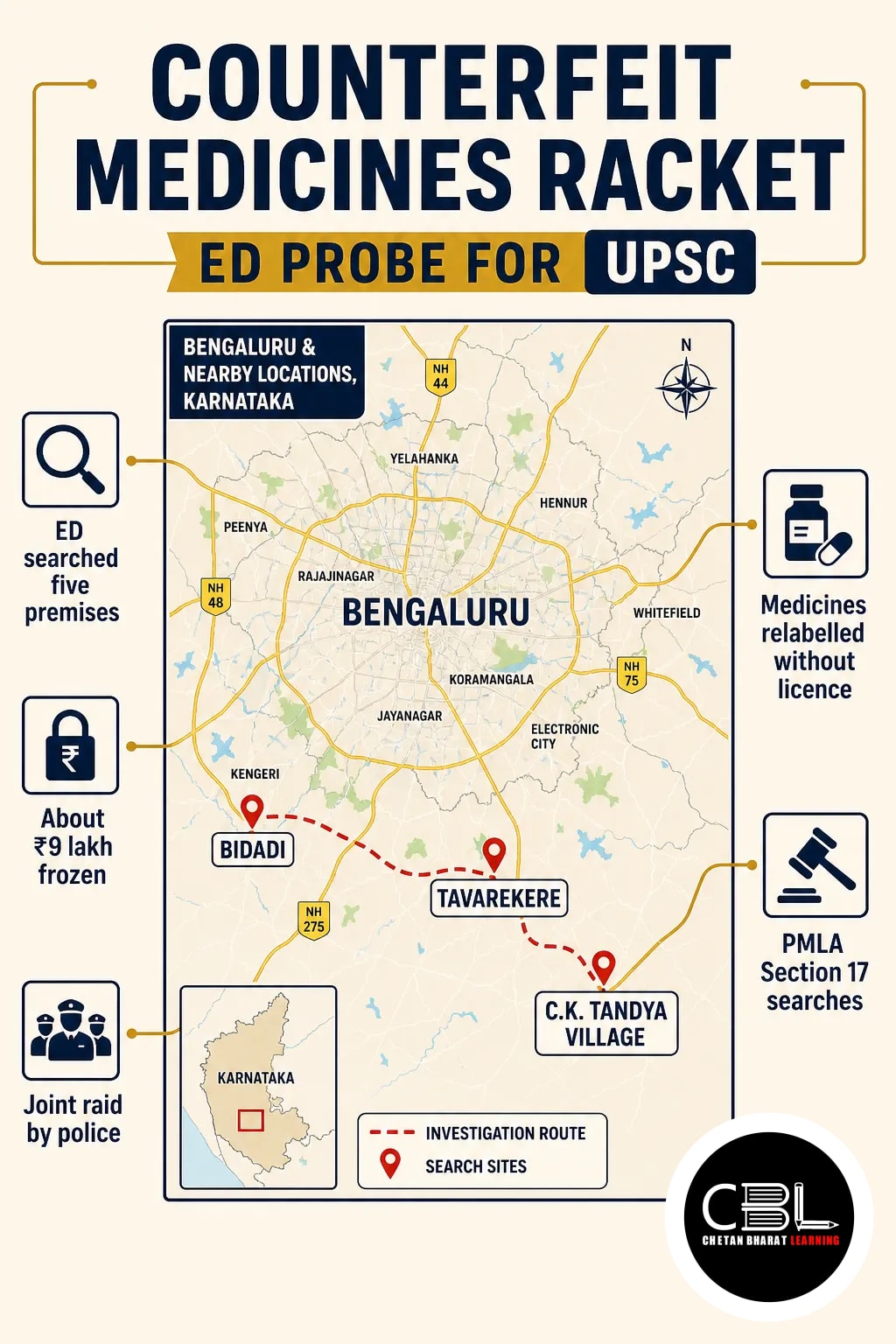

The counterfeit medicines racket in Karnataka has drawn a money-laundering investigation by the Directorate of Enforcement (ED). The case links alleged unauthorised drug storage and relabelling to wider questions of public health and regulatory enforcement.
Quick answer: In the counterfeit medicines racket, the ED searched five Bengaluru premises and froze approximately ₹9 lakh in an accused person’s bank account. Its investigation follows an 18 August 2026 raid in Karnataka, where officials allegedly found unlicensed medicines being relabelled. The agency is tracing suspected proceeds of crime.
What happened in the counterfeit medicines racket?
The ED searched five premises linked to persons and entities allegedly involved in the Karnataka operation. It also froze funds in an accused person’s account and seized digital devices, records and other documents. The source notes also report an asset attachment, but do not specify its value.
The investigation began with a joint raid by the Drug Controlling Authority and police at a residence in C.K. Tandya village on 18 August 2026. Officials allegedly found medicines stored without valid licences, permits or authorisations, along with relabelling activity.
Police registered a First Information Report (FIR) at Tavarekere police station. A Special Investigation Team (SIT), led by Bengaluru Joint Commissioner (West) Vamsi Krishna, is investigating the case. Separately, the ED opened a money-laundering investigation.
How did the alleged supply chain operate?
According to the ED, the operation involved procurement, repackaging and distribution through pharmaceutical entities. These are allegations under investigation, not findings of guilt.
| Stage | What investigators allege |
|---|---|
| Premises | R. Prashanth allegedly arranged a farmhouse near Bidadi for manufacture, repackaging and relabelling without the required drug licence or permit. |
| Inputs and labels | Cheap bulk formulations allegedly sourced from manufacturing centres in several states were repackaged into vials bearing Pfizer labels. |
| Products | The vials allegedly contained generic medicines but carried labels for expensive antibiotics, including Zavicefta and Emblaveo. |
| Distribution | M/s DM Pharmaceuticals allegedly supplied M/s Krupa Healthcare, which supplied other pharmaceutical entities and hospitals. |
The ED says counterfeit and genuine medicines were mixed to avoid detection. However, a generic medicine is not counterfeit simply because it is generic; the alleged deception here concerns false branding and unauthorised handling.
Which laws are relevant to the investigation?
The case combines alleged underlying offences with a separate inquiry into suspected money laundering. The FIR cites two offences that the ED identified as scheduled offences under the Prevention of Money Laundering Act (PMLA), 2002.
| Provision | Relevance |
|---|---|
| Bharatiya Nyaya Sanhita (BNS), 2023, Section 318(4) | The FIR invokes the provision concerning cheating and dishonest inducement to deliver property. |
| Copyright Act, 1957, Section 63 | The FIR also cites this provision concerning knowing infringement of copyright or related rights. |
| PMLA, 2002, Section 17 | The ED conducted searches under this provision, which provides for search and seizure subject to statutory conditions. |
| Drugs and Cosmetics Act, 1940 | This law provides the broader framework for regulating drug quality, manufacture and sale. |
Following the FIR, the ED registered an Enforcement Case Information Report (ECIR). A scheduled offence can trigger a PMLA inquiry, but establishing money laundering also requires examination of the alleged proceeds of crime and the statutory offence. An investigation or freezing order alone does not establish guilt.
Why does the case matter for public health?
False labels can undermine treatment decisions because patients and healthcare providers rely on accurate product information. The case also illustrates how a suspect product can move across multiple points before reaching a hospital.
- Patient safety: A falsely labelled medicine may not contain the expected formulation or strength, potentially compromising treatment.
- Antibiotic stewardship: Inappropriate exposure to antibiotics can contribute to antimicrobial resistance; however, the source does not establish a resistance outcome in this case.
- Supply-chain integrity: Mixing suspect products with genuine stock can make verification and targeted recalls harder.
- Public trust: Moreover, uncertainty about medicine authenticity can weaken confidence in pharmacies and healthcare facilities.
These are general risks, not proof that every vial in this investigation harmed a patient. Laboratory testing and the investigation must establish the contents, distribution and consequences.
What enforcement challenges and responses emerge?
The central challenge is to verify a product’s identity and movement across a fragmented supply chain. In this case, alleged procurement across states and distribution through intermediaries make coordination especially important.
Enforcement challenges
- Source tracing: Investigators must connect bulk formulations, repackaging sites, invoices and recipients without assuming that every transaction was unlawful.
- Evidence preservation: Digital records, physical stock and financial trails require careful documentation; otherwise, links between actors may be difficult to establish.
- Regulatory coordination: Drug authorities, police and financial investigators have distinct functions, so timely information-sharing matters.
- Proportionate action: Authorities must protect patients while respecting statutory safeguards and the rights of those investigated.
Way forward
First, drug authorities can verify licences and inspect suspect storage and repackaging sites. Hospitals and distributors can also check purchase records, supplier credentials and batch details, while retaining records for investigation.
Second, regulators should use laboratory testing and coordinated alerts to identify affected stock and guide any necessary recall. Finally, financial investigators should follow transactions alongside the product trail; courts must determine liability on evidence, not suspicion alone.
Source: The Hindu, 3 November 2026
State PCS General Studies may test state drug-control functions, medicine supply chains and coordination between police and regulators. Candidates should also distinguish drug-quality enforcement from a separate money-laundering inquiry.
Prelims Practice Corner
Mains Practice Questions
Frequently Asked Questions
What triggered the ED investigation in Karnataka?
A police FIR following the 18 August 2026 joint raid triggered the investigation. The ED then registered an ECIR because the cited offences were scheduled offences under the PMLA.
How much money did the ED freeze?
Approximately ₹9 lakh was frozen in an accused person’s bank account. In addition, the ED searched five premises and seized records and digital devices.
Are generic medicines necessarily counterfeit?
No, because generic status alone does not make a medicine counterfeit. The allegation in this case concerns generic medicines presented under another company’s brand labels.
Which PMLA provision did the ED use for the searches?
Section 17 of the PMLA provides for search and seizure subject to statutory conditions. The ED used it for the five searches in this investigation.
Related Current Affairs
Preparing for UPSC, PCS or HCS?
Talk to a mentor at Chetan Bharat Learning, Chandigarh. Free guidance on choosing the right exam and building a study plan.
Chat on WhatsAppCall 97793 53345UPSC / IAS / PCS coaching in Chandigarh · Trusted by aspirants across Punjab & Haryana

 Ananya RanaIAS · AIR 60
 Aditya SharmaIAS · AIR 70
 Ria Kaur SethiIPS · AIR 89
 Aman AloonIRS · AIR 295
 Sumer Singh VirkIRS · AIR 335
 Shivani PanchalIAS

Leave a Reply
You must be logged in to post a comment.