
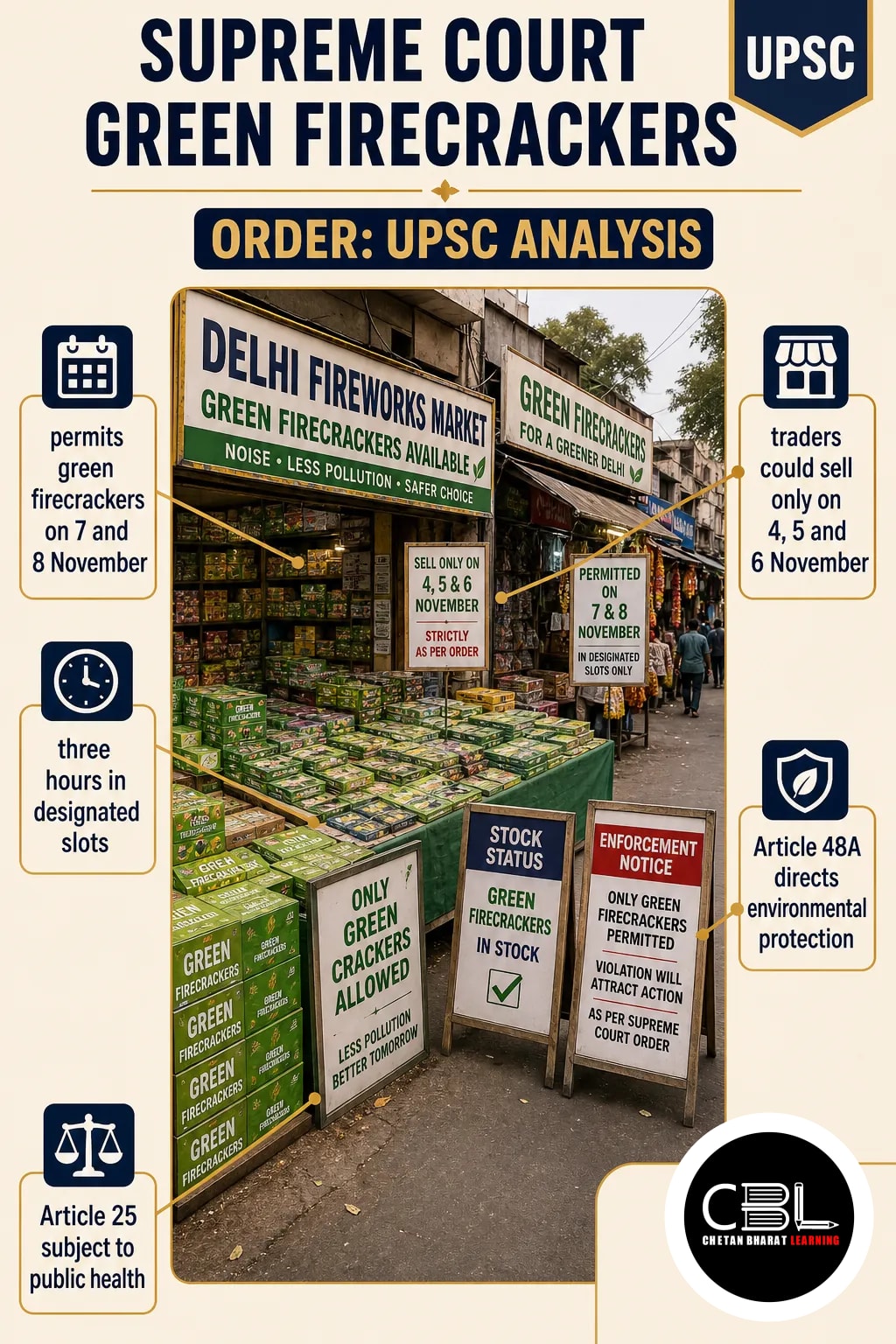
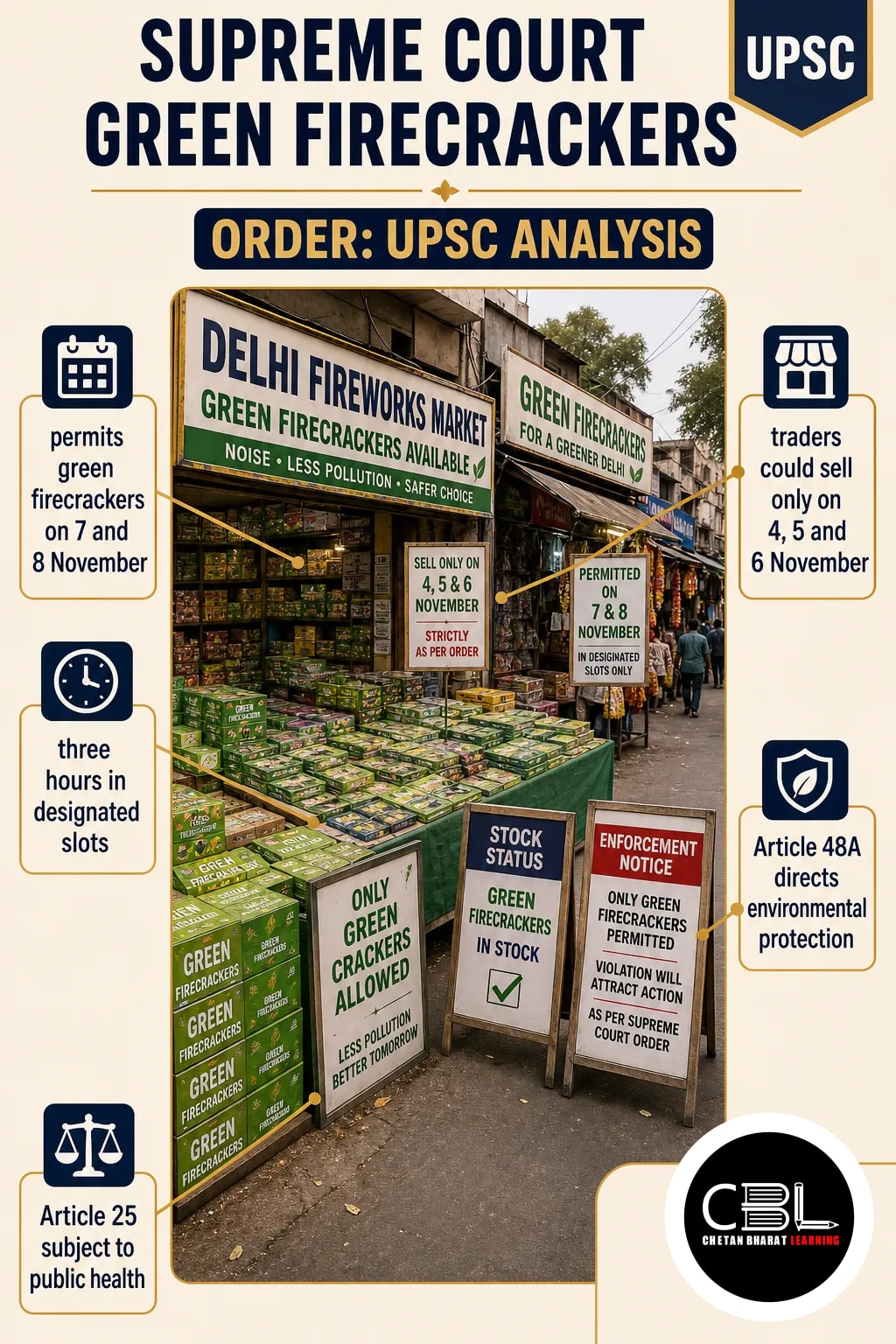
Supreme Court green firecrackers restrictions have reopened the debate on festival pollution and enforcement in Delhi. The decision also raises questions relevant to constitutional and governance issues.
Quick answer: The Supreme Court green firecrackers order of 2 November 2026 permits their use on 7 and 8 November in Delhi and the National Capital Region (NCR), within designated slots totalling three hours. However, activists question enforcement, while traders say short notice and limited stocks make compliance difficult.
What did the Court allow?
On 2 November 2026, the Supreme Court allowed green firecrackers for designated periods on 7 and 8 November. The reported limit is three hours across those slots in Delhi-NCR.
However, the source does not specify the individual slot timings or reproduce the full order. Therefore, the permission should not be read as unrestricted use throughout either day.
The Supreme Court green firecrackers decision distinguishes permitted products and periods from a blanket ban. Yet, the distinction matters only if authorities can identify products and enforce the time limits.
Why is the order contested?
Activists fear weak enforcement, while traders worry about obtaining sufficient stock before the sale window closes.
Environmental activist Bhavreen Kandhari questioned who would check the type of firecrackers being used. She also argued that past restrictions had not prevented people from bursting other firecrackers.
Meanwhile, Rajiv Kumar Jain of the Delhi Fireworks Traders Association welcomed the order but highlighted supply constraints. According to him, traders could sell only on 4, 5 and 6 November, and their suspended permanent licences needed reinstatement.
Jain said this left traders only one day to obtain stocks from manufacturers. His account describes the traders’ difficulty; it does not establish how much stock is available across the entire market.
What does Delhi’s experience show?
Delhi’s past restrictions show a gap between rules and compliance, even when authorities have had more preparation time.
| Period | Reported experience |
|---|---|
| 2019 | Only green firecrackers were allowed, but the restriction was openly flouted and many shops lacked stock. |
| Subsequent years | The Delhi government imposed a seasonal complete ban, including green firecrackers; it too was widely flouted. |
| 2025 | A similar temporary permission was followed by violations; several monitoring stations reached their recording limits. |
| 2026 | The Court permitted green firecrackers for limited periods on 7 and 8 November. |
Last year’s monitoring experience indicates the seriousness of the reported pollution episode. However, stations reaching their limits do not by themselves establish firecrackers’ precise contribution to overall pollution.
For the wider context, see CBL’s coverage of Delhi’s air pollution levels and Punjab’s stubble management review.
Which constitutional provisions are relevant?
The Constitution provides a framework for examining health, environmental protection, livelihoods and religious freedom together.
| Provision | Relevance |
|---|---|
| Article 21 | Protects life and personal liberty; judicial interpretation links it to a healthy environment. |
| Article 48A | Directs the State to protect and improve the environment. |
| Article 51A(g) | Makes environmental protection a fundamental duty of citizens. |
| Articles 19(1)(g) and 19(6) | Protect occupational freedom while permitting reasonable restrictions in the general public interest. |
| Article 25 | Protects religious freedom subject to public order, morality, health and other constitutional provisions. |
These provisions frame an analysis; they do not establish the reasoning in this particular order. In addition, the source does not provide the judgment’s full text.
What are the governance implications?
The central challenge is to make a limited permission enforceable without treating it as a complete solution to air pollution.
- Verification: Authorities need a practical way to distinguish permitted products from prohibited ones at sale and use.
- Timing: Short notice compresses licence restoration, procurement and public communication.
- Public health: Pollution monitoring can document changes, but attribution requires evidence about other sources too.
- Livelihoods: Traders need clear rules early enough to plan lawful sales and avoid unusable stock.
- Regional coordination: Delhi-NCR authorities must communicate consistent instructions across administrative boundaries.
A workable response would therefore combine early guidance, product checks, accessible licence procedures and public reporting of enforcement. Furthermore, authorities should publish monitoring results and explain their limitations rather than attribute every change to one source.
The Supreme Court green firecrackers order illustrates a broader policy trade-off: a narrower permission may reduce restrictions on lawful activity, but it also creates verification demands. Consequently, implementation capacity must inform the design of future restrictions.
Source: The Hindu, 3 November 2026
- Delhi Air Pollution: AQI at 310, UPSC Facts (2 Nov 2026)
Punjab and Haryana PCS candidates can use this case to examine air pollution governance across state boundaries. In addition, revise the roles of state authorities in communicating and enforcing environmental restrictions.
Prelims Practice Corner
Mains Practice Questions
Frequently Asked Questions
When can green firecrackers be used under the order?
They are permitted on 7 and 8 November 2026 in designated slots. However, the source does not specify the individual slot timings.
Why are activists concerned about the order?
They are concerned about enforcement and pollution. In particular, Bhavreen Kandhari questioned how authorities would identify the firecrackers being used.
What difficulty did Delhi firecracker traders identify?
Traders said they had too little time to procure sufficient green firecracker stocks. Moreover, their representative said suspended permanent licences needed reinstatement before sales.
Related Current Affairs
Preparing for UPSC, PCS or HCS?
Talk to a mentor at Chetan Bharat Learning, Chandigarh. Free guidance on choosing the right exam and building a study plan.
Chat on WhatsAppCall 97793 53345UPSC / IAS / PCS coaching in Chandigarh · Trusted by aspirants across Punjab & Haryana

 Ananya RanaIAS · AIR 60
 Aditya SharmaIAS · AIR 70
 Ria Kaur SethiIPS · AIR 89
 Aman AloonIRS · AIR 295
 Sumer Singh VirkIRS · AIR 335
 Shivani PanchalIAS

Leave a Reply
You must be logged in to post a comment.