
UPSC Mapping
- Prelims: Education, RTE Act, NEP 2020, UDISE+
- Mains: GS Paper II – Education, Governance, Social Justice and Welfare
Quick Facts
| Source | NITI Aayog Report |
|---|---|
| Schools Closed | Around 94,000 (last decade) |
| Legal Basis | Article 21A & RTE Act, 2009 |
| Key Concern | Equity and access to education |
What are Government School Closures?
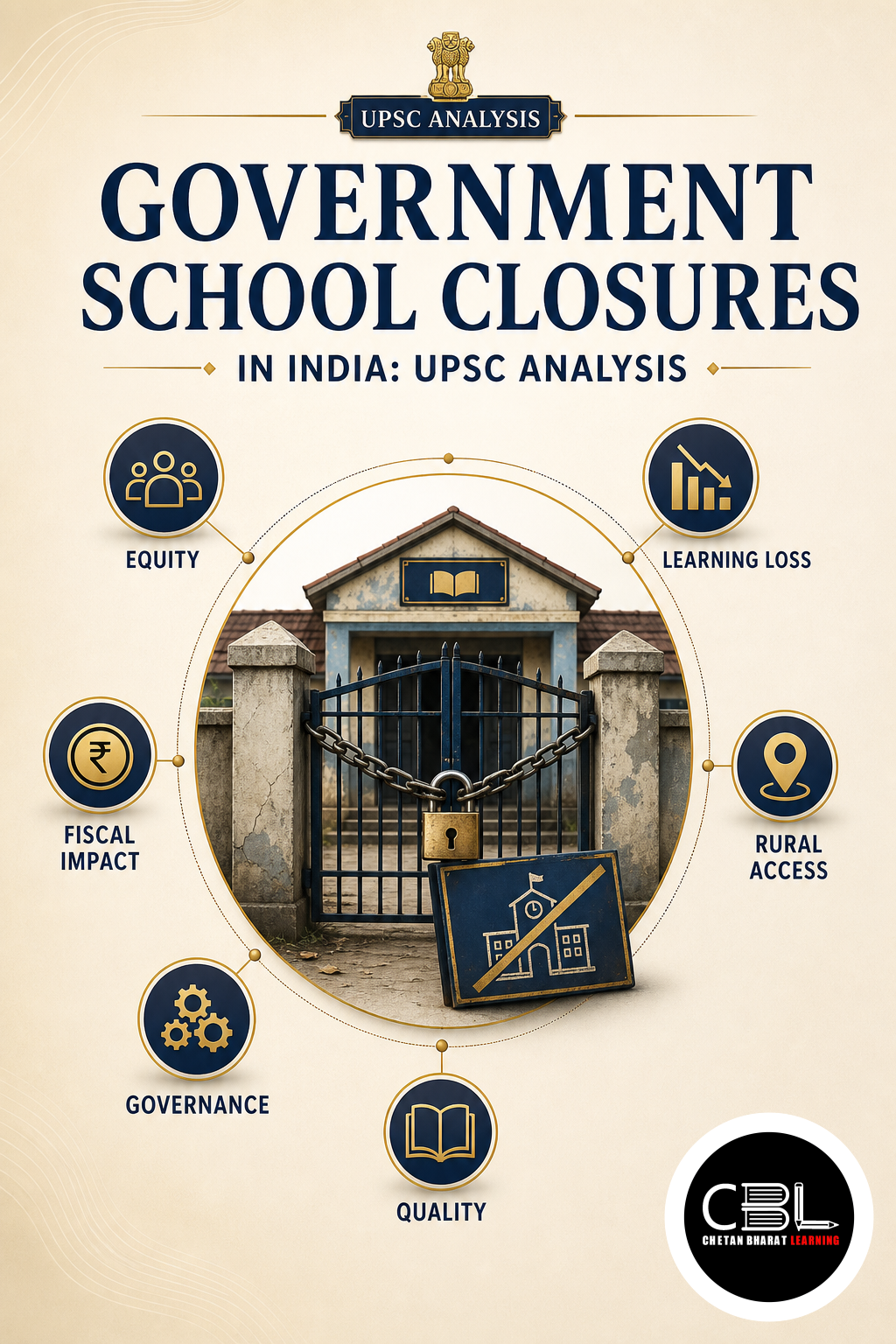
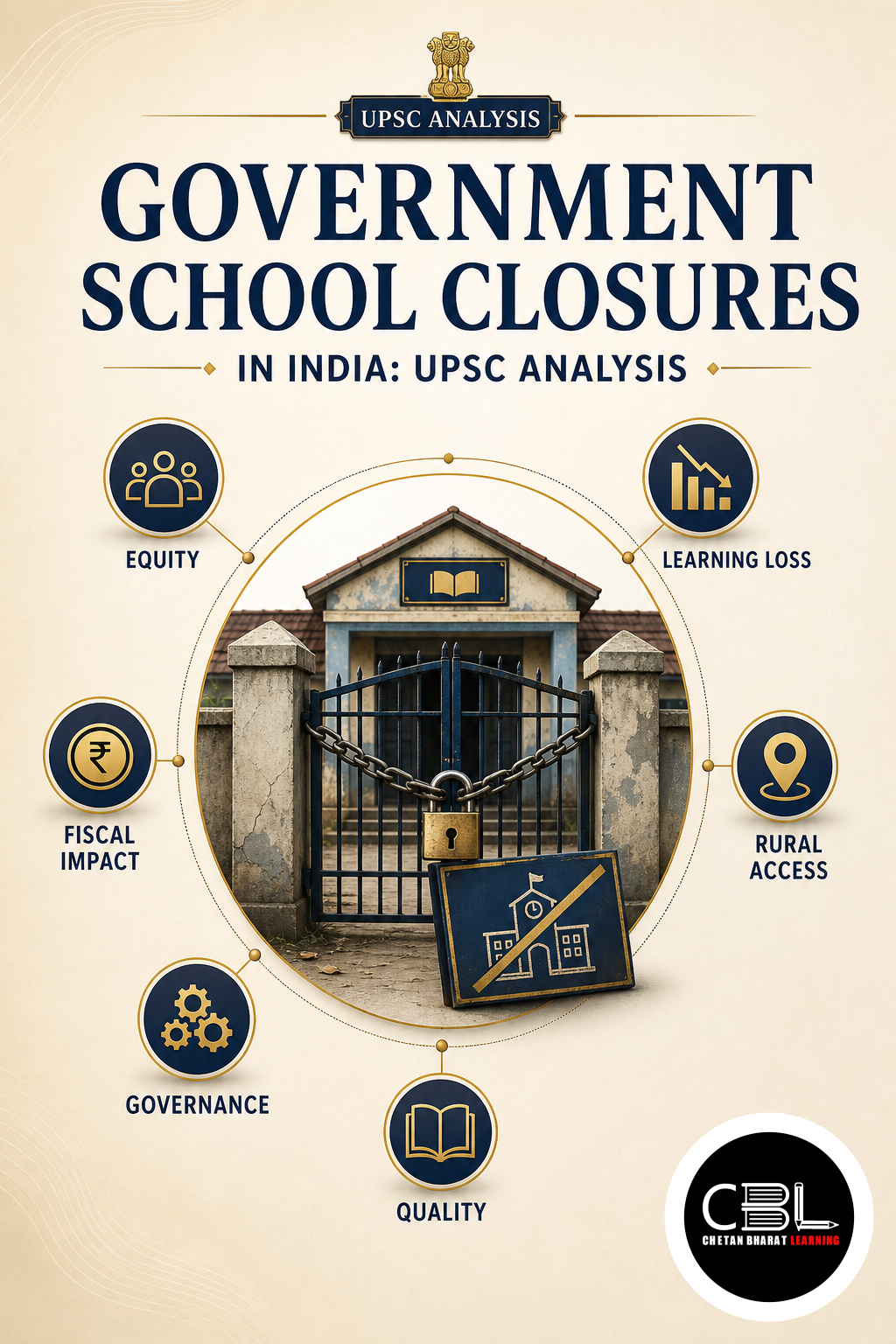
Government School Closures refer to the closure or merger of government-run schools, largely under school rationalisation policies adopted by states. According to the source, around 94,000 government schools have been closed over the last decade, while government school enrolment declined by 2.26 crore students and its share in total enrolment fell from 71% in 2005 to 49.24% in 2024-25.
States have generally justified these closures as part of rationalisation under National Education Policy (NEP) 2020. However, the source notes that NEP 2020 also emphasises that the principle of neighbourhood schools should not be compromised.
Why are Government School Closures in News?
A recent NITI Aayog report has highlighted the scale of government school closures and the associated decline in enrolment. The findings have triggered concerns regarding educational access, social equity and compliance with the Right to Education (RTE) Act, 2009.
The source also highlights that states such as Madhya Pradesh, Uttar Pradesh and Jammu & Kashmir have witnessed significant school closures or mergers, raising concerns about neighbourhood schooling and learning continuity. Aspirants should regularly refer to the Ministry of Education for official education policy updates.
Key Features
- School rationalisation: States have consolidated low-enrolment schools under NEP 2020 while citing administrative efficiency.
- Declining government enrolment: UDISE+ data cited in the source shows a decline in government schools alongside growth in private schools.
- Neighbourhood school principle: NEP 2020 supports rationalisation but also emphasises maintaining accessible neighbourhood schools.
- Shared responsibility: Education is in the Concurrent List, requiring coordination between the Union and States for implementation.
- Existing policy framework: The issue relates to Article 21A, the RTE Act, 2009, NEP 2020 and UDISE+, which monitors educational indicators.
Challenges
- Educational inequality: Government schools primarily serve economically weaker sections, including SC, ST, OBC and other disadvantaged communities.
- Higher dropout risk: Longer travel distances, migration and poverty increase the likelihood of children leaving school.
- Gender concerns: Girls may discontinue education because of safety and mobility constraints when nearby schools are closed.
- Teacher shortages: Consolidated schools often face vacant posts and multi-grade teaching, affecting learning quality and pupil-teacher norms.
- Weak accountability: The source notes that School Management Committees remain weak, limiting effective implementation of the RTE framework.
Way Forward
According to the source, school rationalisation should prioritise educational access, equity and learning outcomes rather than administrative efficiency alone. Strengthening neighbourhood schools, filling teacher vacancies, revitalising School Management Committees and improving monitoring of out-of-school children are essential.
Greater cooperation between the Union and States, stronger implementation of the Right to Education Act and evidence-based planning using UDISE+ data can help realise the constitutional vision of universal, inclusive and quality education. Aspirants may also consult the NCERT for educational resources and policy initiatives.
Prelims Practice Corner
Q1. Article 21A of the Constitution guarantees:
(a) Right to Information (b) Right to Education (c) Right to Property (d) Right to Work
Answer: (b). Article 21A provides for free and compulsory education for children aged 6–14 years.
Q2. UDISE+ is primarily used for:
(a) Tax administration (b) School education data management (c) Health records (d) Census operations
Answer: (b). It is an online management information system for school education.
Q3. Which policy introduced the 5+3+3+4 curricular structure?
(a) National Policy on Education, 1986 (b) NEP 2020 (c) RTE Act, 2009 (d) Samagra Shiksha
Answer: (b).
Q4. Education is placed in which list of the Constitution?
(a) Union List (b) State List (c) Concurrent List (d) Residuary List
Answer: (c).
Q5. The Right to Education Act, 2009 provides free and compulsory education for children aged:
(a) 3–6 years (b) 6–14 years (c) 14–18 years (d) 5–15 years
Answer: (b).
Mains Practice Questions
Q1. Examine the implications of government school closures on educational equity and the Right to Education in India. (10 Marks)
Answer Structure:
- Intro: Briefly explain the trend of school rationalisation.
- Body: Educational access, vulnerable groups, gender issues, RTE obligations, governance challenges.
- Conclusion: Emphasise inclusive and equitable school education.
Q2. Discuss the role of NEP 2020 and the Right to Education Act in ensuring universal access to quality school education. (15 Marks)
Answer Structure:
- Intro: Outline India’s constitutional commitment to education.
- Body: NEP reforms, RTE provisions, implementation gaps, Centre-State coordination, community participation.
- Conclusion: Highlight the need for accessible, quality and inclusive education.
FAQs on Government School Closures
Why are government schools being closed?
According to the source, most closures are justified by states as school rationalisation to consolidate institutions with low enrolment, although NEP 2020 states that neighbourhood schools should not be compromised.
How do school closures affect vulnerable children?
The source indicates that closures disproportionately affect economically weaker sections, girls, SCs, STs, OBCs and children in rural or tribal areas by increasing travel distances and dropout risks.
Why is this topic important for UPSC?
It connects constitutional rights, education policy, social justice, governance, cooperative federalism and welfare administration, making it relevant for both Prelims and GS Paper II in the Mains examination.
Related Current Affairs
Preparing for UPSC, PCS or HCS?
Talk to a mentor at Chetan Bharat Learning, Chandigarh. Free guidance on choosing the right exam and building a study plan.
Chat on WhatsAppCall 97793 53345UPSC / IAS / PCS coaching in Chandigarh · Trusted by aspirants across Punjab & Haryana
Leave a Reply
You must be logged in to post a comment.