

UPSC Mapping
| Prelims | MMDR Act, Coal Controller Organisation, Coal Sector |
|---|---|
| Mains | GS Paper III – Energy Security, Mining Reforms & Infrastructure |
| Notified Under | Section 18B, MMDR Act, 1957 |
|---|---|
| Regulator | Coal Controller Organisation (CCO) |
| Trading | Delivery-based Spot Contracts |
What are Coal Exchange Rules 2026?
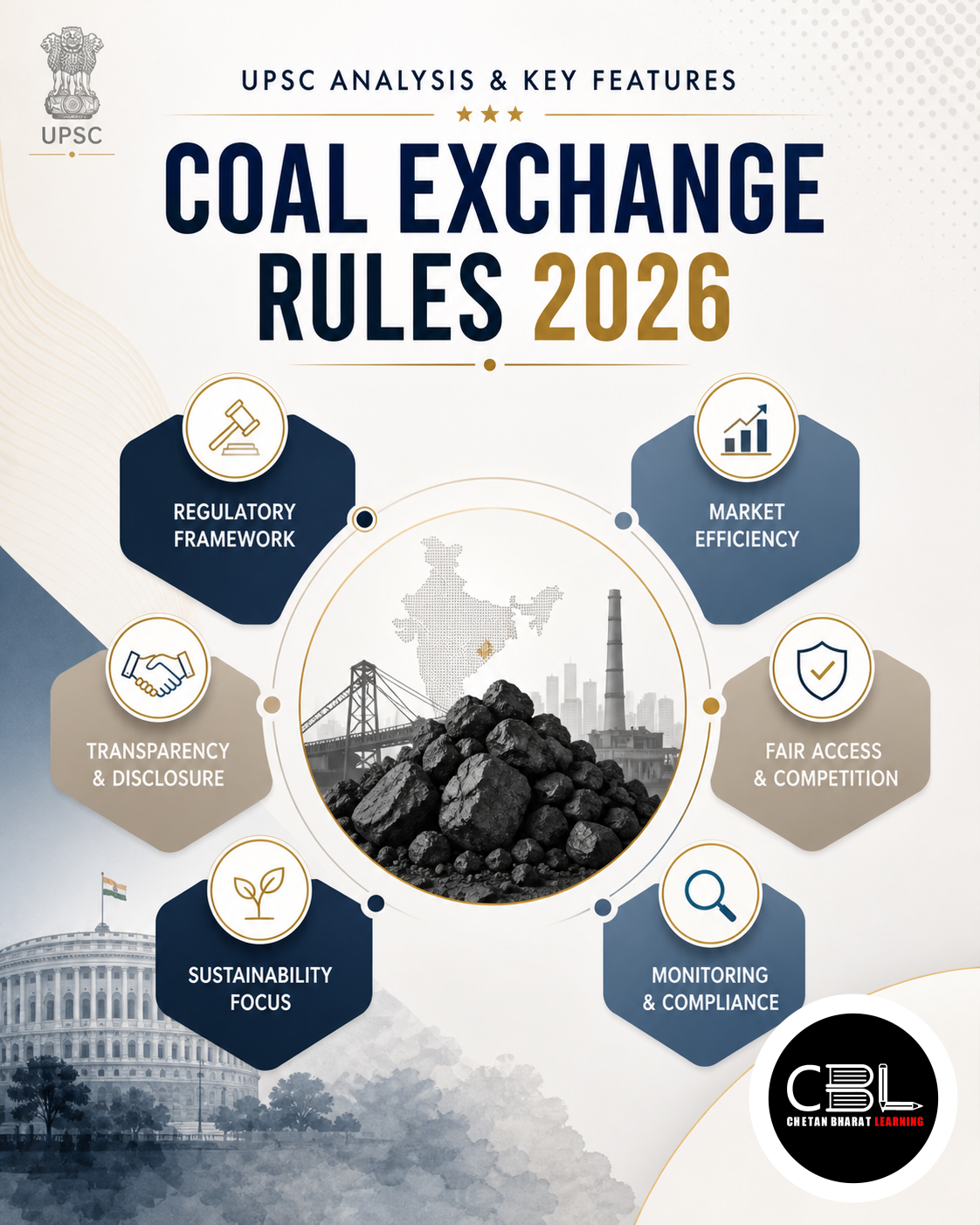
Coal Exchange Rules 2026 provide the statutory framework for establishing and operating electronic coal exchanges where buyers and sellers can trade coal, lignite and their processed products through transparent delivery-based spot contracts. The Rules aim to replace legacy allocation mechanisms with a market-driven and technology-enabled trading ecosystem.
Notified under Section 18B of the Mines and Minerals (Development and Regulation) Act, 1957, the Rules promote competitive price discovery, better market access and efficient coal distribution across the country.
Why are Coal Exchange Rules 2026 in News?
The Union Minister of State for Coal and Mines informed the Lok Sabha about the operational framework of the Coal Exchange Rules, 2026. The Rules are part of the government’s broader strategy to modernise India’s coal market through transparent digital trading and enhanced regulatory oversight.
Official details are available through the Ministry of Coal.
Key Features of Coal Exchange Rules 2026
The Rules establish a comprehensive institutional and regulatory framework for electronic coal trading.
- Coal Controller Organisation oversight: The CCO approves, renews and supervises coal exchanges, including their bye-laws and transaction mechanisms.
- Open market participation: Commercial miners, captive mine owners, public sector undertakings and eligible consumers can participate in delivery-based spot trading.
- Market-based price discovery: Coal prices are determined through competitive electronic bidding supported by approved algorithms and adjusted for certified quality.
- Settlement Guarantee Fund: Every exchange must maintain a dedicated fund to minimise settlement and counterparty risks.
- Market surveillance: Mandatory surveillance committees, audit trails, cybersecurity audits and grievance redressal mechanisms help maintain market integrity.
Challenges
- Digital readiness: Smaller participants may require technological support to participate effectively.
- Quality certification: Uniform and credible sampling remains essential for transparent settlements.
- Market concentration: Effective surveillance is necessary to prevent cartelisation and market manipulation.
- Infrastructure gaps: Efficient logistics and transport networks remain critical for timely delivery.
- Institutional coordination: Coordination between regulators, producers and consumers will determine long-term success.
Way Forward
India’s transition towards competitive coal markets should be supported by robust digital infrastructure, transparent regulation and strong dispute-resolution mechanisms. Expanding participation while ensuring fair competition will improve efficiency across the coal value chain.
Effective implementation of the Coal Exchange Rules 2026 can strengthen energy security, improve price transparency and support India’s broader mining sector reforms. Official notifications can be accessed through the Coal Controller Organisation.
Prelims Practice Corner
-
Q1. The Coal Exchange Rules, 2026 have been notified under which legislation?
- (a) Coal Mines Act
- (b) MMDR Act, 1957
- (c) Mines Act, 1952
- (d) Electricity Act, 2003
Show answer
Answer: (b) They are notified under Section 18B of the MMDR Act, 1957.
-
Q2. Which organisation regulates Coal Exchanges under the Rules?
- (a) CERC
- (b) Coal Controller Organisation
- (c) NITI Aayog
- (d) SEBI
Show answer
Answer: (b) The Coal Controller Organisation is the designated regulator.
-
Q3. The Settlement Guarantee Fund is primarily intended to:
- (a) Subsidise coal production
- (b) Manage settlement risk
- (c) Fund exploration
- (d) Finance exports
Show answer
Answer: (b) It mitigates counterparty and settlement risks.
-
Q4. Coal Exchanges facilitate:
- (a) Futures trading only
- (b) Delivery-based spot contracts
- (c) Carbon credit trading
- (d) Oil imports
Show answer
Answer: (b) The Rules provide for delivery-based spot contracts.
-
Q5. One major objective of the Rules is:
- (a) Nationalise coal trade
- (b) Promote transparent price discovery
- (c) Ban private mining
- (d) Increase coal imports
Show answer
Answer: (b) Competitive electronic bidding promotes transparent market-based pricing.
Mains Practice Questions
-
Q1. Discuss the significance of the Coal Exchange Rules, 2026 in promoting transparency and efficiency in India’s coal sector. (10 marks)
Answer Structure
- Intro: Introduce the reform.
- Body: Explain electronic trading, price discovery, regulation and energy security.
- Conclusion: Highlight market-led reforms with strong oversight.
-
Q2. Evaluate the role of market-based reforms in improving resource allocation in India’s mining sector. (15 marks)
Answer Structure
- Intro: Mention reforms in mining governance.
- Body: Discuss transparency, competition, institutional safeguards and implementation challenges.
- Conclusion: Stress balanced regulation for efficient mineral markets.
FAQs on Coal Exchange Rules 2026
What are the Coal Exchange Rules, 2026?
They establish the legal framework for regulated electronic trading of coal through registered coal exchanges.
Who regulates Coal Exchanges?
The Coal Controller Organisation (CCO) is responsible for registration, supervision and regulatory oversight of coal exchanges.
Why are these Rules important for UPSC?
The topic is relevant for GS Paper III covering mining reforms, energy security, infrastructure and market-based economic reforms.
Related Current Affairs
Preparing for UPSC, PCS or HCS?
Talk to a mentor at Chetan Bharat Learning, Chandigarh. Free guidance on choosing the right exam and building a study plan.
Chat on WhatsAppCall 97793 53345UPSC / IAS / PCS coaching in Chandigarh · Trusted by aspirants across Punjab & Haryana
Leave a Reply
You must be logged in to post a comment.