

UPSC Mapping
Prelims
- Indo-Pacific
- QUAD
- ASEAN
- Great Nicobar Project
Mains
- GS Paper II – International Relations and India’s Foreign Policy
Quick Facts
| Region | Indian Ocean to Pacific Ocean |
|---|---|
| Core Theme | Maritime security and strategic balance |
| India’s Vision | Free, Open and Inclusive Indo-Pacific |
What is Indo-Pacific Strategy?
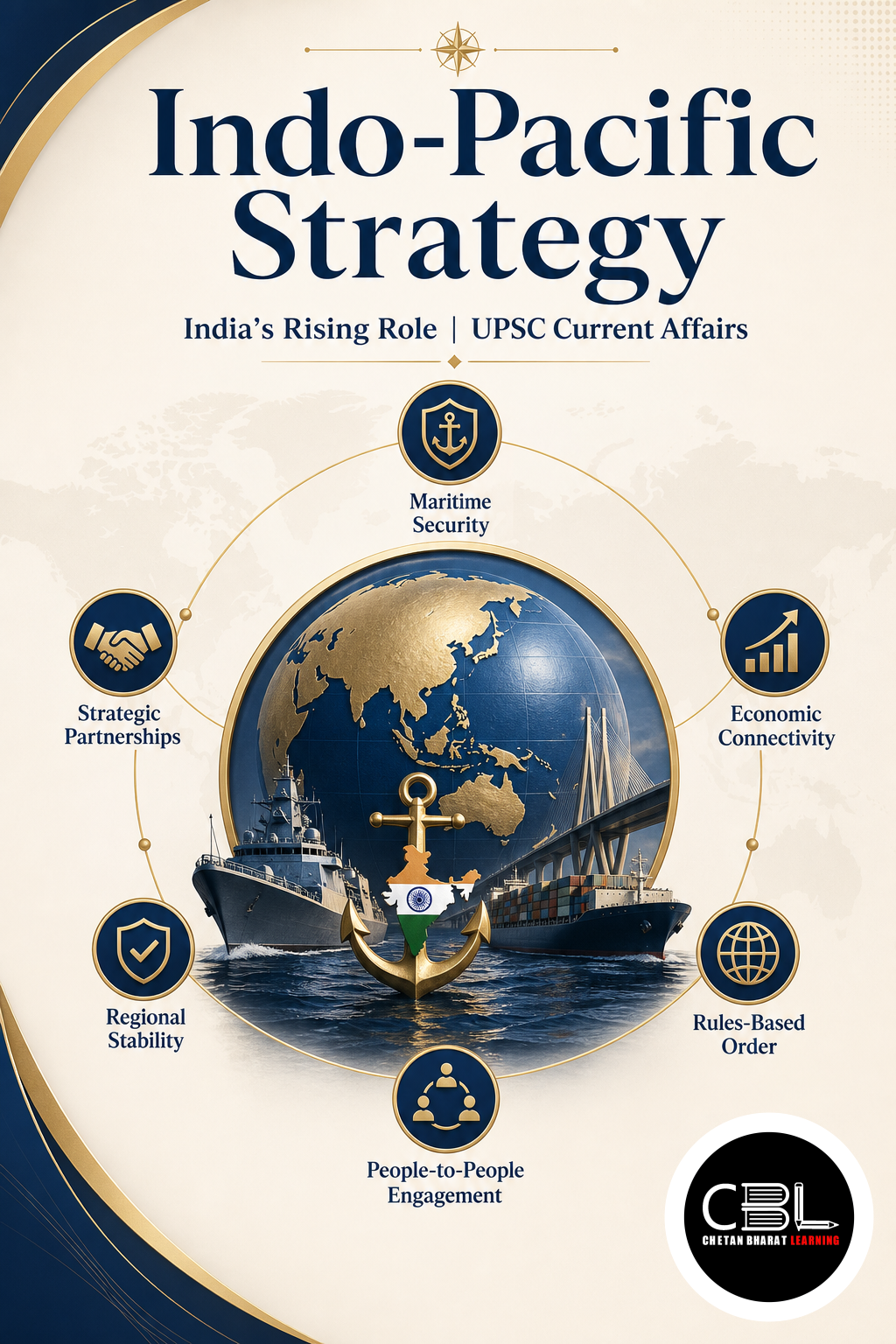
Indo-Pacific Strategy refers to India’s approach towards the strategic region linking the Indian Ocean and the Pacific Ocean. According to the uploaded infographic, the Indo-Pacific is not merely a geographical expression but a strategic and geopolitical concept extending from East Africa to the western Pacific.
The uploaded material explains that India seeks to promote a Free, Open and Inclusive Indo-Pacific based on cooperation, freedom of navigation and regional development rather than military blocs.
Why is Indo-Pacific Strategy in News?
India is emerging as a major strategic power in the Indo-Pacific through deeper engagement with ASEAN, stronger partnerships with Japan, Australia and Indonesia, expanded maritime presence and initiatives such as the Great Nicobar Island Development Project.
The source also raises the question of whether India could emerge as the third major balancing power in the Indo-Pacific. No additional conclusions beyond the uploaded material are provided. Official policy developments may be followed through the Ministry of External Affairs.
Key Features
- Strategic importance: Around 60% of global GDP, 60% of the world’s population and a large share of maritime trade are associated with the Indo-Pacific region.
- ASEAN Centrality: India believes ASEAN should remain the central institution of regional cooperation and dialogue.
- Strategic Autonomy: India’s foreign policy is described as independent and guided by national interest rather than permanent alignment with any military bloc.
- QUAD: The QUAD comprises India, the United States, Japan and Australia, focusing on maritime security, supply chains, disaster relief, critical technologies and cyber security. It is not a military alliance like NATO.
- Great Nicobar Project: The project strengthens India’s strategic presence near important sea lanes, especially around the Strait of Malacca, through planned port, airport and logistics infrastructure.
Challenges
- Great power competition: The region is emerging as the principal arena of global strategic competition.
- Maritime security: Securing vital sea lanes remains essential for trade and energy flows.
- Regional stability: Balancing cooperation with strategic competition requires sustained diplomacy.
- Economic connectivity: Maintaining resilient supply chains remains an important regional objective.
- Strategic balancing: Recognising the evolving regional power balance is key to India’s expanding role.
Way Forward
The uploaded infographic suggests that India’s Indo-Pacific vision rests on promoting freedom of navigation, ASEAN centrality, inclusive regional development and strategic autonomy. Continued maritime engagement and regional partnerships are presented as important elements of this approach. Future official statements and policy initiatives may be monitored through the Ministry of External Affairs.
Prelims Practice Corner
Q1. According to the uploaded infographic, the Indo-Pacific stretches from:
- (a) Arctic to Antarctica
- (b) East Africa to the Western Pacific
- (c) Atlantic to Mediterranean
- (d) Europe to Central Asia
Answer: (b)
Q2. Which countries are identified as members of the QUAD in the uploaded source?
- (a) India, China, Japan, Australia
- (b) India, USA, Japan, Australia
- (c) India, Indonesia, Japan, Australia
- (d) India, France, Japan, Australia
Answer: (b)
Q3. According to the uploaded infographic, ASEAN centrality means:
- (a) ASEAN should remain the central institution of regional cooperation
- (b) ASEAN should become a military alliance
- (c) ASEAN controls the Indian Ocean
- (d) ASEAN manages global trade
Answer: (a)
Q4. The Great Nicobar Project is highlighted in the uploaded source mainly for its:
- (a) Space research
- (b) Strategic location near major sea lanes
- (c) Coal mining
- (d) Textile industry
Answer: (b)
Q5. India’s Indo-Pacific vision is described as:
- (a) Exclusive military alliance
- (b) Free, Open and Inclusive
- (c) Closed regional grouping
- (d) Trade bloc only
Answer: (b)
Mains Practice Questions
Q1. Discuss the strategic significance of the Indo-Pacific for India’s foreign policy and maritime interests. (15 Marks)
Answer Structure:
- Intro: Define the Indo-Pacific concept.
- Body: Maritime trade, ASEAN, QUAD, strategic autonomy, Great Nicobar Project and regional stability.
- Conclusion: Emphasise balanced engagement and inclusive regional cooperation.
Q2. Explain the importance of ASEAN centrality in India’s Indo-Pacific vision. (10 Marks)
Answer Structure:
- Intro: Define ASEAN centrality.
- Body: Regional dialogue, cooperation, stability and India’s diplomatic approach.
- Conclusion: Highlight ASEAN’s continuing relevance in the Indo-Pacific.
FAQs
What is the Indo-Pacific?
According to the uploaded infographic, it is a strategic region linking the Indian Ocean and the Pacific Ocean, extending from East Africa to the western Pacific.
Is the QUAD a military alliance?
The uploaded source explicitly states that the QUAD is not a military alliance like NATO.
What is meant by India’s strategic autonomy?
The uploaded infographic explains that India’s foreign policy is independent, based on national interest and does not permanently align with any power bloc.
Related Current Affairs
Preparing for UPSC, PCS or HCS?
Talk to a mentor at Chetan Bharat Learning, Chandigarh. Free guidance on choosing the right exam and building a study plan.
Chat on WhatsAppCall 97793 53345UPSC / IAS / PCS coaching in Chandigarh · Trusted by aspirants across Punjab & Haryana
Leave a Reply
You must be logged in to post a comment.