

UPSC Mapping
| Exam Stage | Topics |
|---|---|
| Prelims | Communicable Diseases, Vaccination and Public Health Programmes |
| Mains | GS Paper II – Health, Government Policies and Human Development |
| Observed On | 28 July |
|---|---|
| National Programme | NVHCP |
| Target | Elimination by 2030 |
| SDG | SDG 3.3 |
What is Viral Hepatitis?
Viral Hepatitis refers to inflammation of the liver caused primarily by hepatitis viruses. Besides viral infections, liver inflammation may also result from excessive alcohol consumption, certain medicines and autoimmune diseases.
Acute hepatitis may remain asymptomatic or present with jaundice, dark urine, fatigue, nausea, vomiting and abdominal pain. Chronic infection, particularly with Hepatitis B and Hepatitis C, can progress to cirrhosis and liver cancer if untreated.
Why is Viral Hepatitis in News?
Viral Hepatitis is in the news because the Ministry of Health and Family Welfare highlighted India’s progress towards eliminating viral hepatitis as a public health threat by 2030 on the occasion of World Hepatitis Day.
India has the world’s second-highest viral hepatitis burden, with approximately 29.8 million chronic Hepatitis B cases and 5.5 million Hepatitis C cases, accounting for around 11.6% of the global burden.
Types of Viral Hepatitis
Five major hepatitis viruses affect humans, each with distinct modes of transmission and prevention strategies.
- Hepatitis A (HAV): Spread through contaminated food, water and poor sanitation. Prevented through safe drinking water, hygiene and vaccination.
- Hepatitis B (HBV): Transmitted during childbirth, through infected blood, unsafe injections and unprotected sexual contact. Prevented by vaccination, including a birth dose within 24 hours, and treated with antiviral medicines such as tenofovir.
- Hepatitis C (HCV): Spread through infected blood, unsafe injections, unscreened blood transfusions and shared drug-use equipment. Prevented by safe injection practices and blood screening. Pan-genotypic direct-acting antivirals (DAAs) can cure infection within 12–24 weeks.
- Hepatitis D (HDV): Occurs only in people already infected with Hepatitis B and spreads through infected blood or body fluids. Hepatitis B vaccination prevents HDV infection.
- Hepatitis E (HEV): Spread through contaminated food and water. Safe water, sanitation and proper sewage management are the primary preventive measures. Infection poses a particularly high risk for pregnant women.
India’s Viral Hepatitis Burden
India carries one of the largest burdens of viral hepatitis globally, making early detection and treatment a major public health priority.
- High disease burden: India accounts for nearly 11.6% of global chronic Hepatitis B and C cases.
- Public health challenge: Chronic infections significantly increase the risk of liver cirrhosis and liver cancer.
- Need for early diagnosis: Many infected individuals remain asymptomatic for years, delaying treatment.
- Economic impact: Untreated hepatitis increases healthcare expenditure and productivity losses.
India’s Hepatitis Elimination Efforts
India has adopted a comprehensive public health strategy to eliminate viral hepatitis under SDG Target 3.3.
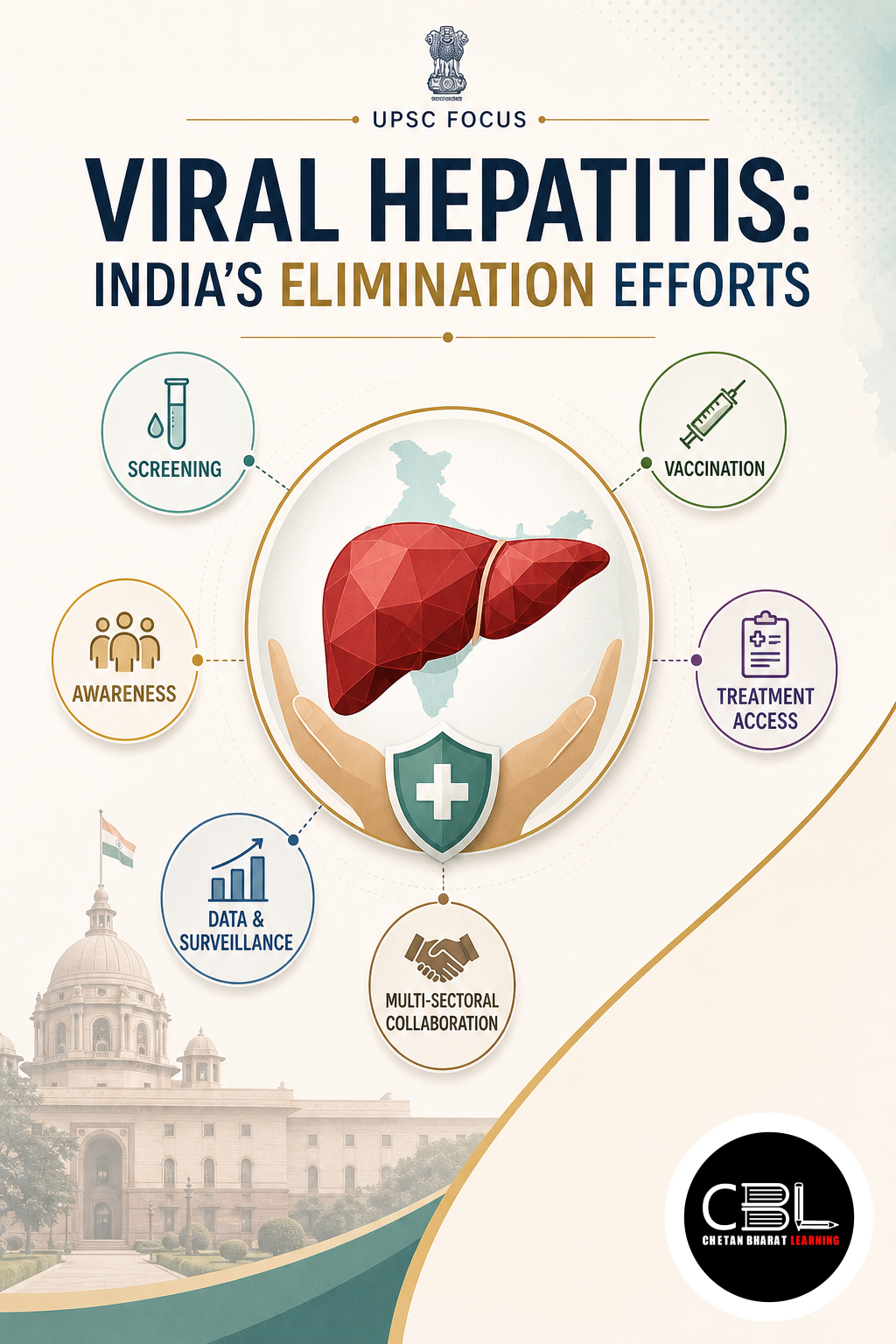
- National Viral Hepatitis Control Program (NVHCP): Launched in 2018 to provide awareness, free screening, diagnosis and treatment through decentralised healthcare facilities.
- NVHCP Portal: Tracks patient registration, diagnostic services and treatment progress. More than 21 crore people have been screened, while over 6.12 lakh patients have received treatment through 1,153 decentralised treatment sites.
- Universal Immunisation Programme (UIP): Provides Hepatitis B vaccination at birth followed by doses at 6, 10 and 14 weeks.
- RMNCAH+N Programme: Mandates universal screening of pregnant women for Hepatitis B to reduce mother-to-child transmission.
Integrated Health System Approach
India integrates hepatitis elimination with other national health programmes.
- National Tuberculosis Elimination Programme (NTEP): Existing molecular diagnostic machines are repurposed for hepatitis viral-load testing and both programmes provide toll-free guidance.
- National AIDS Control Programme (NACP): Screens high-risk populations for Hepatitis B and C while vaccinating eligible health workers and susceptible individuals.
- Integrated surveillance: Improves early diagnosis and treatment across multiple disease-control programmes.
- Health system strengthening: Expands access to diagnostics and treatment beyond tertiary hospitals.
Challenges
Several barriers continue to affect hepatitis elimination.
- Low awareness: Many infected individuals remain undiagnosed because early disease is often asymptomatic.
- Healthcare access: Remote areas continue to face diagnostic and treatment gaps.
- Social stigma: Fear and misinformation discourage timely testing.
- Safe injection practices: Continued efforts are needed to reduce healthcare-associated infections.
- Long-term follow-up: Chronic Hepatitis B patients require sustained monitoring and treatment.
Way Forward
Achieving the 2030 elimination target requires sustained investment in vaccination, early diagnosis, treatment accessibility and public awareness. Strengthening surveillance, laboratory capacity and community outreach will improve disease control.
Integrated implementation across programmes such as NVHCP, NTEP, NACP and UIP can accelerate progress towards eliminating viral hepatitis as a major public health threat. Additional guidance is available through the World Health Organization.
Prelims Practice Corner
Q1. Which hepatitis virus occurs only in individuals already infected with Hepatitis B?
Options: (a) HAV (b) HCV (c) HDV (d) HEV
Answer: (c) HDV.
Q2. The National Viral Hepatitis Control Program (NVHCP) was launched in:
Options: (a) 2016 (b) 2017 (c) 2018 (d) 2020
Answer: (c) 2018.
Q3. Which hepatitis virus can be cured using pan-genotypic direct-acting antivirals (DAAs)?
Options: (a) HAV (b) HBV (c) HCV (d) HDV
Answer: (c) HCV.
Q4. Hepatitis B birth-dose vaccination should ideally be administered within:
Options: (a) 6 hours (b) 12 hours (c) 24 hours (d) 72 hours
Answer: (c) Within 24 hours of birth.
Q5. The elimination of viral hepatitis contributes directly to which Sustainable Development Goal target?
Options: (a) SDG 2.2 (b) SDG 3.3 (c) SDG 6.1 (d) SDG 10.2
Answer: (b) SDG 3.3.
Mains Practice Questions
Q1. Discuss the burden of viral hepatitis in India and evaluate the role of the National Viral Hepatitis Control Program in achieving SDG Target 3.3. (10 marks)
Answer Structure
- Intro: Define viral hepatitis and its public health importance.
- Body: Disease burden, NVHCP objectives, achievements, challenges and integrated health approach.
- Conclusion: Highlight the need for sustained prevention and universal access to treatment.
Q2. Examine how convergence among national health programmes strengthens India’s communicable disease control strategy. (15 marks)
Answer Structure
- Intro: Explain integrated public health programmes.
- Body: NVHCP, NTEP, NACP, UIP, RMNCAH+N and benefits of convergence.
- Conclusion: Emphasise coordinated healthcare delivery for better outcomes.
FAQs on Viral Hepatitis
What is Viral Hepatitis?
Viral Hepatitis is inflammation of the liver caused mainly by hepatitis viruses (A, B, C, D and E), though alcohol, medicines and autoimmune diseases may also cause hepatitis.
Which hepatitis viruses have vaccines?
Effective vaccines are available for Hepatitis A and Hepatitis B. Hepatitis B vaccination also prevents Hepatitis D because HDV infection occurs only in individuals infected with HBV.
Why is Viral Hepatitis important for UPSC?
The topic is important for UPSC because it covers communicable diseases, vaccination, government health programmes, SDGs and public health policy.
Related Current Affairs
Preparing for UPSC, PCS or HCS?
Talk to a mentor at Chetan Bharat Learning, Chandigarh. Free guidance on choosing the right exam and building a study plan.
Chat on WhatsAppCall 97793 53345UPSC / IAS / PCS coaching in Chandigarh · Trusted by aspirants across Punjab & Haryana
Leave a Reply
You must be logged in to post a comment.