
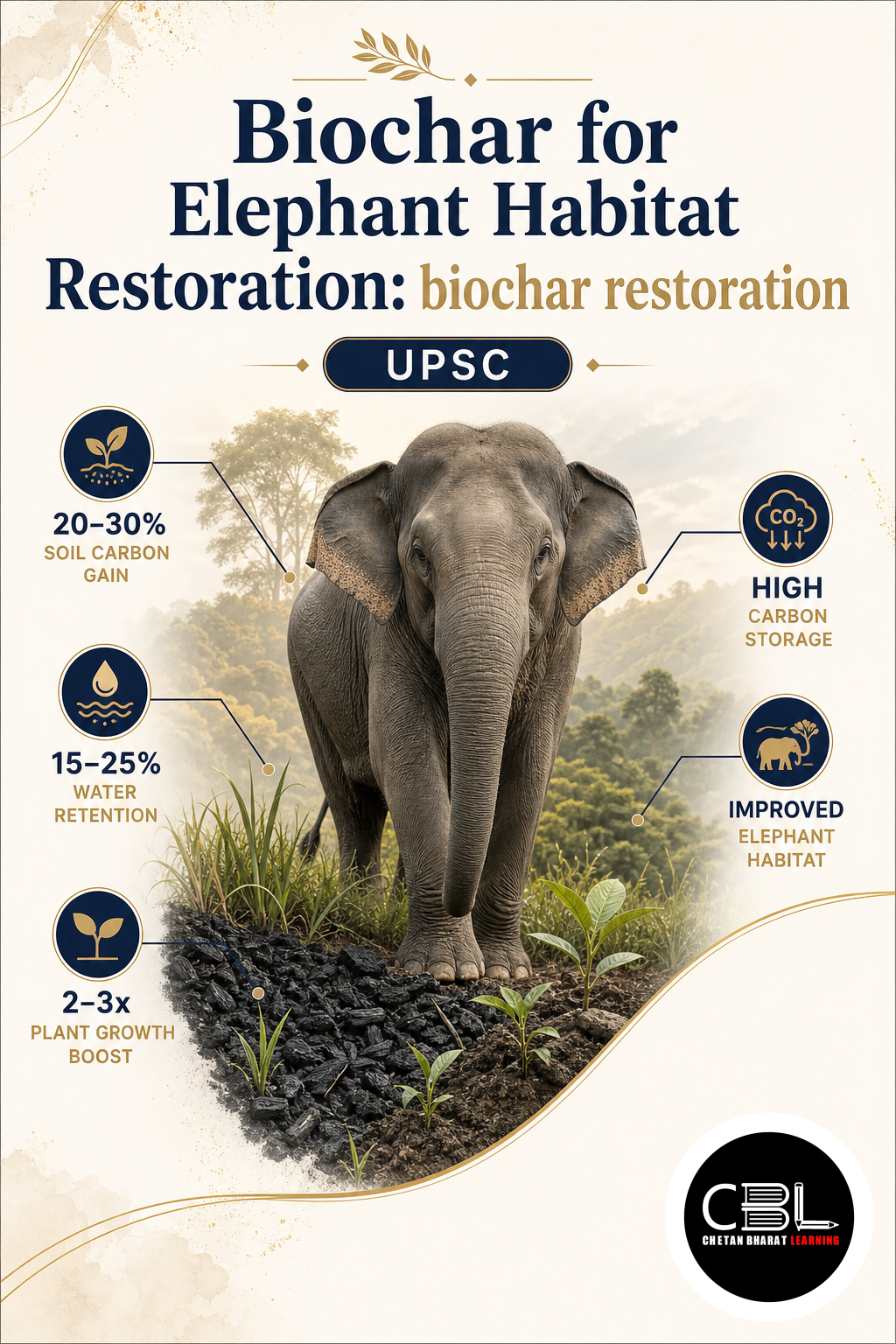

Biochar restoration is being piloted in Assam’s Khalingduar Reserve Forest to restore elephant habitats degraded by invasive weeds. The conservation group Aaranyak leads this innovative approach. For more environmental news, visit the daily current affairs archive.
| Important for | Prelims | Mains |
|---|---|---|
| Environment & Ecology | GS Paper III |
| Location | Target weeds | Biochar process |
|---|---|---|
| Khalingduar Reserve Forest, Assam | Lantana, Chromolaena, Mikania | Pyrolysis |
What is Biochar Restoration?
Biochar restoration is an ecological technique that uses biochar—a porous charcoal-like substance produced through pyrolysis—to improve soil health and remove invasive species. In Khalingduar, invasive weeds like Lantana camara, Chromolaena odorata, and Mikania micrantha are converted into biochar, which is then added to restore soil fertility.
This approach simultaneously addresses two problems: clearing invasive plants that suppress native grasses and improving soil conditions for native vegetation regrowth. Biochar restoration thus supports the recovery of elephant habitats, reducing human-elephant conflict by keeping elephants within forest areas.
Why is Biochar Restoration in News?
Biochar restoration has been highlighted as an innovative conservation tool in the Bodoland Territorial Region of Assam, which serves as an India–Bhutan corridor for endangered Asian elephants. The project by Aaranyak has shown promise in restoring degraded habitats and mitigating human-elephant conflict.
This pilot aligns with India’s commitment to nature-based solutions and sustainable land management. It also addresses the problem of invasive species, a major threat to biodiversity in the region. For official conservation updates, refer to the PIB on wildlife conservation efforts.
Key Features of Biochar Restoration
- Invasive weed control: Converts problematic species into a useful product, reducing their spread and impact.
- Soil improvement: Enhances soil water retention, nutrient availability, and microbial activity.
- Carbon sequestration: Stores carbon for centuries, contributing to climate change mitigation.
- Habitat recovery: Restores native grasslands and fodder, benefiting elephants and other wildlife.
- Community engagement: Involves local communities in collecting weeds and applying biochar, fostering stewardship.
Challenges for Biochar Restoration
- Production cost: Pyrolysis equipment and energy inputs can be expensive for community-level adoption.
- Labour intensity: Manual collection of invasive weeds is labour-intensive.
- Scalability: Scaling to large forest areas requires substantial resources.
- Monitoring: Long-term effects on soil and vegetation need systematic study.
- Fire risk: Biochar is combustible; safe handling and storage are necessary.
Way Forward for Biochar Restoration
To expand biochar restoration, the government and conservation organisations should invest in low-cost, portable pyrolysis units suitable for remote areas. Training local communities in weed collection and biochar application can create livelihood opportunities while aiding conservation.
Integrating biochar restoration into India’s national afforestation and land degradation neutrality programmes could provide funding and policy support. Research on optimal application rates and species-specific responses will enhance effectiveness. For international guidelines, refer to IUCN.
Prelims Practice Corner
Q1. Which organisation is piloting biochar restoration in Assam?
(a) WWF (b) Aaranyak (c) Greenpeace (d) WTI
Answer: (b) Aaranyak is the conservation group leading the pilot in Khalingduar.
Q2. What is the primary method used to produce biochar?
(a) Composting (b) Pyrolysis (c) Anaerobic digestion (d) Gasification
Answer: (b) Biochar is produced via pyrolysis—thermal breakdown under zero or restricted oxygen.
Q3. Which invasive weed is referred to as ‘mile-a-minute’ weed?
(a) Lantana camara (b) Chromolaena odorata (c) Mikania micrantha (d) Parthenium
Answer: (c) Mikania micrantha is commonly known as mile-a-minute weed.
Q4. Why is Khalingduar Reserve Forest important for elephants?
(a) It has a large elephant population (b) It forms an India–Bhutan elephant corridor (c) It is an elephant breeding centre (d) It has abundant water
Answer: (b) It is a critical corridor for Asian elephants between India and Bhutan.
Q5. What is one of the benefits of biochar restoration?
(a) It increases invasive weed growth (b) It stores carbon for centuries (c) It reduces soil fertility (d) It requires no labour
Answer: (b) Biochar is a stable form of carbon that can sequester carbon for hundreds to thousands of years.
Mains Practice Questions
Q1. Evaluate the role of biochar in addressing both invasive species management and habitat restoration, with reference to the Assam pilot. (15 marks)
Intro: Introduce invasive weed problem in India and the concept of biochar.
Body: Discuss the dual benefit: weed removal and soil restoration. Explain the process and its ecological impacts. Analyse its potential for reducing human-elephant conflict. Address challenges and scalability.
Conclusion: Suggest integration with government schemes like CAMPA and involve local communities.
Q2. What are the major invasive species in India and what conservation strategies are being adopted to manage them? (10 marks)
Intro: List common invasive species (Lantana, Parthenium, Mikania, etc.).
Body: Discuss mechanical, chemical, and biological control methods. Highlight innovative approaches like biochar restoration. Evaluate effectiveness and challenges.
Conclusion: Emphasise the need for integrated management and research on native alternatives.
FAQs on Biochar Restoration
What is biochar?
Biochar is a charcoal-like substance produced by heating organic matter in a low-oxygen environment (pyrolysis). It is used to improve soil fertility and sequester carbon.
How does biochar help restore elephant habitats?
By converting invasive weeds that suppress native grasses into biochar, it clears the weeds and improves soil, allowing native fodder species to regrow, thus restoring the habitat for elephants.
What are the main invasive weeds targeted in the Assam pilot?
Lantana camara, Chromolaena odorata, and Mikania micrantha (mile-a-minute weed) are the primary targets.
Related Current Affairs
Preparing for UPSC, PCS or HCS?
Talk to a mentor at Chetan Bharat Learning, Chandigarh. Free guidance on choosing the right exam and building a study plan.
Chat on WhatsAppCall 97793 53345UPSC / IAS / PCS coaching in Chandigarh · Trusted by aspirants across Punjab & Haryana
Leave a Reply
You must be logged in to post a comment.