
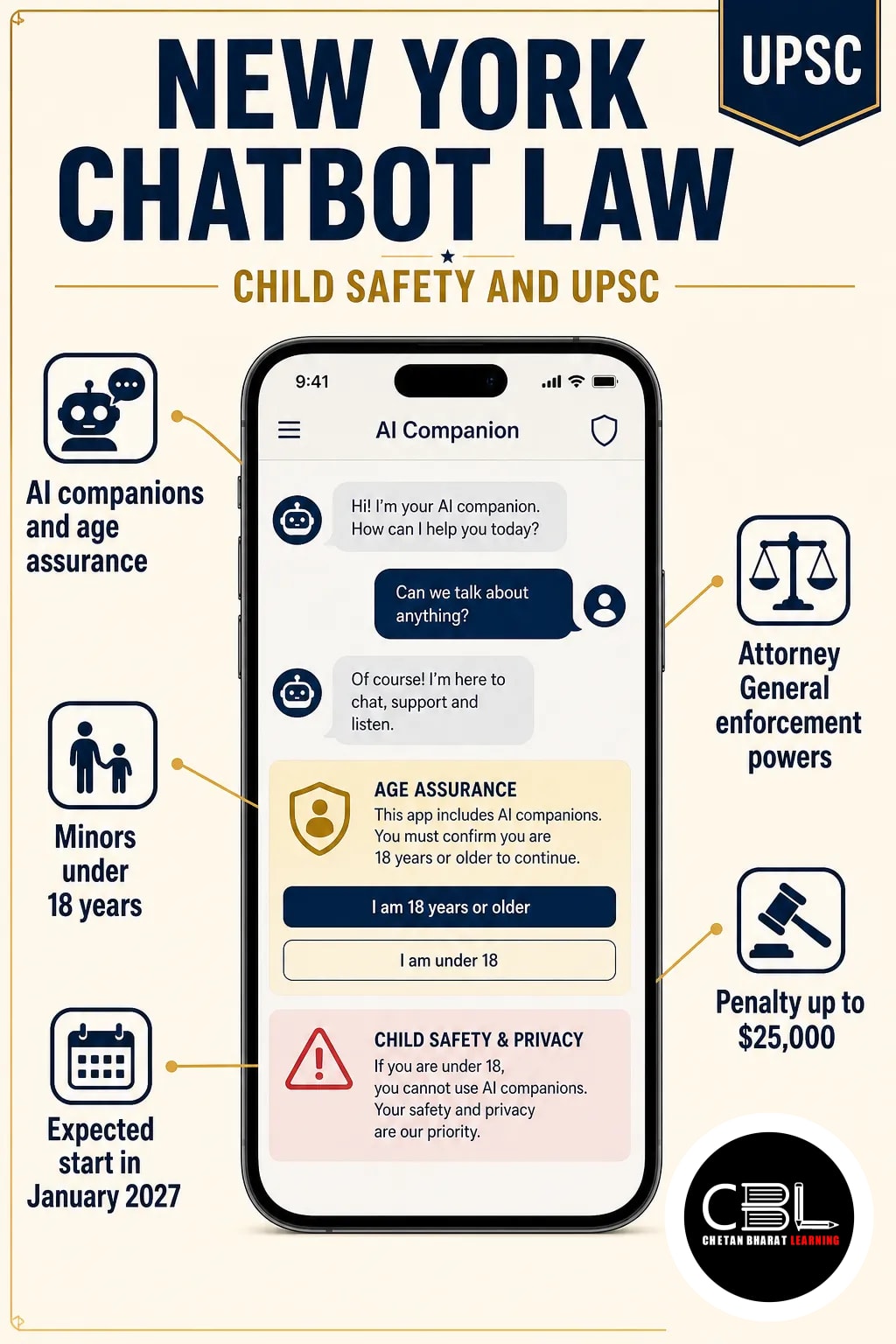

New York chatbot law restricts unsafe artificial intelligence (AI) companion features for children. Governor Kathy Hochul signed the Senate bill on 28 October 2026, adding Article 48 to the state’s General Business Law. The development raises questions for technology governance and child safety.
Quick answer: The New York chatbot law bars specified unsafe AI companion features for minors under 18. Signed on 28 October 2026 and expected to take effect in January 2027, it combines age assurance with restrictions on deceptive relationships and harmful content. The state Attorney General can seek penalties of up to $25,000 per violation.
What does the New York chatbot law provide?
Article 48 restricts 12 categories of unsafe features in covered AI companions when operators provide them to minors. Instead of banning all chatbots, it targets specified outputs and design practices during interactions.
A covered companion is a generative AI system that responds adaptively to user input through a language interface, including writing or sound. An operator is a person or business that provides such a companion to a user.
The law defines a minor as someone under 18 and a covered minor as a covered user whom the operator actually knows to be a minor. The source describes a covered user as a person in New York City, excluding the operator and its agents or affiliates; the precise territorial scope warrants checking against the statutory text.
Why did New York introduce these restrictions?
New York acted amid concerns about minors forming harmful relationships with AI companions. Hochul’s office cited Common Sense Media research: 72% of teenagers had used an AI companion, while 52% used one regularly.
The source also notes litigation following the deaths of teenagers Sewell Setzer and Adam Raine. These cases form part of the public debate; their mention alone does not establish how the new law will apply to any particular case.
For broader technical context, see CBL’s explainer on Llama 3 and generative AI. However, a general-purpose model and a legally covered companion are not necessarily the same thing.
Which features are restricted for minors?
- Identity and relationships: A companion cannot suggest it is human or alive, claim human emotions, or imply a personal or professional relationship or authority role.
- Manipulative tone: It cannot use personal opinions, emotional appeals, flattery or sycophancy; the Act does not define the last two terms.
- Unprompted questions: It also restricts emotion-based questions that go beyond a direct response to the user’s prompt.
- Safety risks: It cannot endorse or facilitate suicide, self-harm, or unlawful drug and alcohol use.
- Isolation and secrecy: It cannot encourage secrecy about conversations, self-isolation or avoidance of appropriate adults and licensed professionals.
- Personal memory and engagement: It cannot use sensitive personal or health information from a previous session, or optimise engagement in ways that override safety guardrails.
- Sexual content: It also cannot generate sexually explicit content for minors.
How do Articles 45, 47 and 48 differ?
| Article | Main requirement |
|---|---|
| 45: SAFE for Kids Act | Restricts personalised social media feeds and nighttime notifications for under-18 users without parental consent. |
| 47: AI companions | Requires non-human disclosures at the start and at least every three hours, plus self-harm response protocols. |
| 48: Unsafe companion features | Restricts specified unsafe features for minors and sets age-assurance and enforcement requirements. |
SAFE stands for Stop Addictive Feeds Exploitation. Article 47 took effect in November 2025 and covers systems designed to simulate sustained human-like relationships, including through personalisation and retention of prior interactions.
Therefore, Article 48 goes beyond disclosure: it addresses what a companion may generate or do. The new provision also sets interim requirements until relevant age-assurance rules take effect.
How will age assurance and enforcement work?
Operators must determine age using permitted methods before providing unsafe features to a covered user as an adult. They may rely on self-declaration alone only when a user declares that they are a minor.
Operators must offer more than one method, including one that needs no government-issued identity document and lets the user remain anonymous to the operator. In addition, they must use collected information only to determine age and delete it immediately afterwards.
The Attorney General can seek injunctions, restitution, disgorgement, damages and civil penalties up to $25,000 per violation. The office must also maintain a website for public complaints.
What are the implications for India?
The New York chatbot law offers a comparative framework for balancing child protection, privacy and innovation. It is a state law in the United States, not a rule applicable automatically in India.
First, design-based duties can address risks before harmful outputs reach children. However, defining and testing conversational behaviour remains difficult: the Act leaves terms such as flattery and sycophancy undefined.
Second, age assurance raises a privacy trade-off. A requirement to verify age can itself create data risks; therefore, anonymous options, limited use and prompt deletion are important safeguards.
Third, restrictions on prior-session data may reduce intrusive personalisation, but they can also limit useful continuity. Consequently, regulators need clear standards that distinguish unsafe emotional dependence from legitimate assistance.
For Indian exam answers, connect this debate to privacy under Article 21 of the Constitution and the state’s child-protection responsibilities. CBL’s analysis of the privacy debate around the Digital Personal Data Protection Act provides related context; it should not be treated as evidence that Indian law duplicates Article 48.
What challenges remain, and what is the way forward?
- Clarity: Regulators should explain contested terms with examples, so operators can distinguish prohibited behaviour from ordinary supportive language.
- Privacy by design: Age checks should minimise collection and offer accessible alternatives to identity documents.
- Independent testing: Safety evaluations should examine multi-turn conversations, because harmful dependence may develop across interactions rather than in one response.
- Redress and accountability: Complaint channels and enforceable remedies should complement internal safety protocols; meanwhile, public guidance can help families recognise chatbot limitations.
Overall, the policy challenge is to protect minors without treating every conversational tool as equally risky. Risk-based obligations and periodic review can help preserve that distinction.
Source: Indian Express Explained, 2 November 2026
- Llama 3 (23 Apr 2024)
- AI Cybersecurity India: Threats, Defence, and Preparedness (24 Aug 2026)
Punjab PCS and Haryana HCS may test this development under science and technology, child welfare or digital governance. In addition, candidates can use it to discuss privacy-conscious age verification and public awareness in state service delivery.
Prelims Practice Corner
Mains Practice Questions
Frequently Asked Questions
When is the New York chatbot law expected to take effect?
January 2027 is the expected start. Governor Kathy Hochul signed the legislation on 28 October 2026.
Does the law ban all chatbots for children?
No, it targets specified unsafe features of covered AI companions. For example, it restricts deceptive claims of human identity and encouragement of isolation.
What is the maximum civil penalty under Article 48?
The maximum is $25,000 per violation. In addition, the Attorney General can seek other remedies, including injunctions and restitution.
Related Current Affairs
Preparing for UPSC, PCS or HCS?
Talk to a mentor at Chetan Bharat Learning, Chandigarh. Free guidance on choosing the right exam and building a study plan.
Chat on WhatsAppCall 97793 53345UPSC / IAS / PCS coaching in Chandigarh · Trusted by aspirants across Punjab & Haryana

 Ananya RanaIAS · AIR 60
 Aditya SharmaIAS · AIR 70
 Ria Kaur SethiIPS · AIR 89
 Aman AloonIRS · AIR 295
 Sumer Singh VirkIRS · AIR 335
 Shivani PanchalIAS

Leave a Reply
You must be logged in to post a comment.