
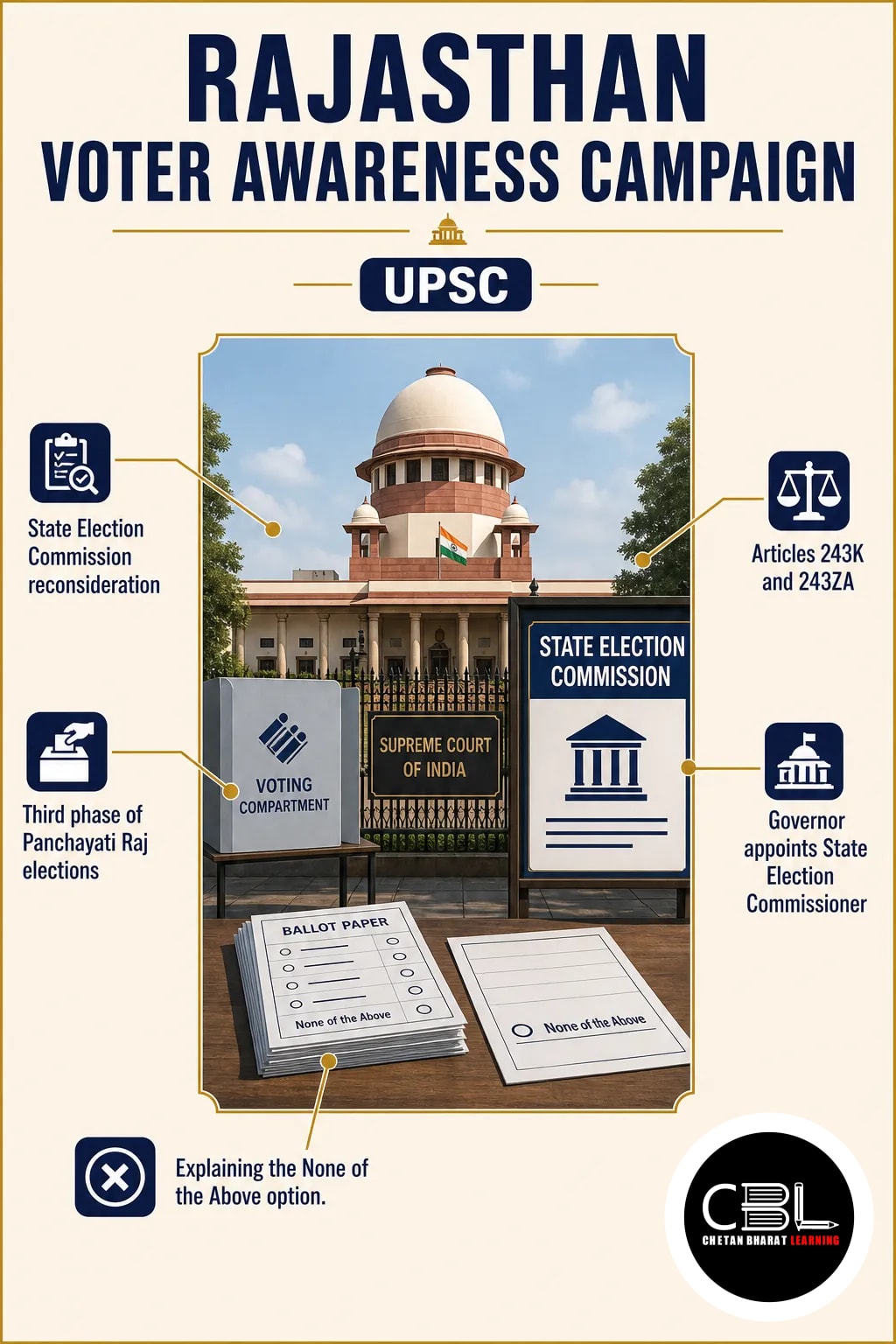
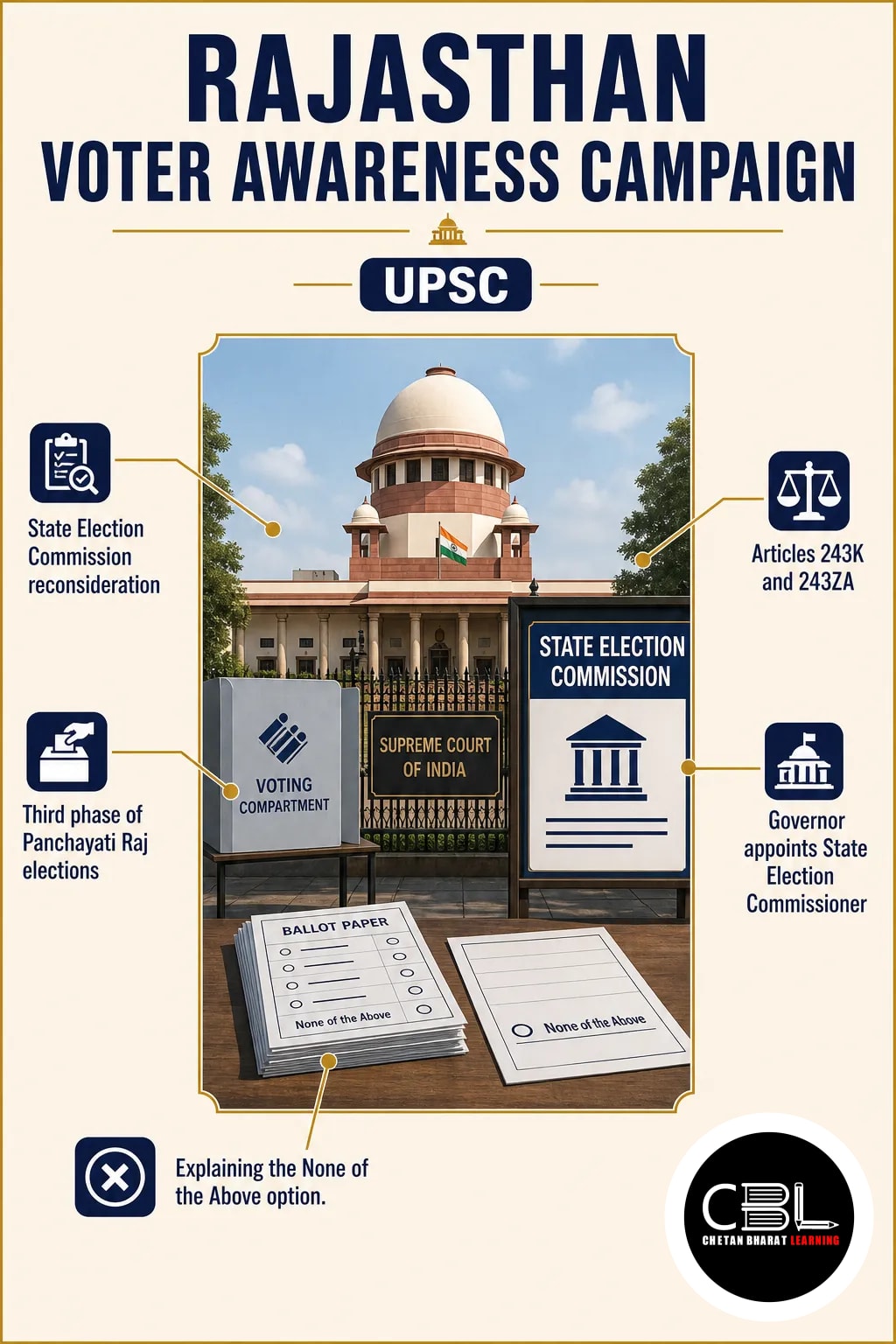
Rajasthan voter awareness campaign restrictions have prompted Supreme Court scrutiny ahead of panchayat polling. The case connects electoral regulation with citizen participation, a theme in polity current affairs.
Quick answer: On 2 November 2026, the Supreme Court set aside the Rajasthan State Election Commission’s rejection of a Rajasthan voter awareness campaign request. It directed the Commission to reconsider permission for the third phase of Panchayati Raj elections and pass an order within two days. The Court did not itself grant permission.
What did the Supreme Court hold?
The Court set aside the rejection and asked the Rajasthan State Election Commission (SEC) to reconsider the request. The bench, led by Chief Justice of India Surya Kant, included Justices Joymala Bagchi and V Mohana.
Justice Bagchi rejected the reasoning that the Commission’s own awareness programmes justified excluding other organisations. However, the operative direction required a fresh decision; it did not automatically authorise the campaign. The distinction matters because the SEC must still pass an order on the request.
The decision concerns the third phase of the Panchayati Raj election. For polling context, see CBL’s coverage of Rajasthan panchayat election facts.
Why did the dispute arise?
Aruna Roy and other applicants sought permission for non-partisan voter education, but the SEC refused their request. Advocate Prashant Bhushan challenged that refusal before the Court.
The applicants said small groups would hold interactive village sessions without supporting or opposing candidates. They also proposed explaining democratic rights and electoral choices, including None of the Above (NOTA), and discouraging voters from accepting money or other inducements.
According to the applicants, the campaign has operated since 2004. Meanwhile, Rajasthan Election Watch, Mazdoor Kisan Shakti Sangathan (MKSS) and partners said they had conducted awareness yatras during parliamentary, assembly and local elections for 20 years.
| Date | Event |
|---|---|
| 7 September | Organisations sought permission for yatras across 11 districts. |
| 10 September | The SEC declined permission under existing rules, according to the organisations. |
| 6 October | Aruna Roy and others applied for permission to conduct campaigns. |
| 9 October | The SEC again denied permission, according to the organisations. |
| 2 November | The Supreme Court ordered reconsideration within two days. |
The initial proposal covered Ajmer, Beawar, Bhilwara, Bikaner, Dungarpur, Jaipur, Rajsamand, Salumbar, Sirohi, Tonk and Udaipur. The SEC, however, expressed concern that the campaign could be conducted at another person’s behest. It also cited its own voter awareness work.
Which constitutional provisions govern local elections?
Articles 243K and 243ZA place panchayat and municipal elections under State Election Commissions, respectively. They are distinct from the Election Commission of India (ECI), which has responsibilities under Article 324.
| Provision | Relevance |
|---|---|
| Article 243K | Vests superintendence, direction and control of panchayat electoral rolls and elections in the SEC. |
| Article 243ZA | Assigns municipal electoral roll and election supervision to the SEC. |
| Article 324 | Entrusts the ECI with supervision of parliamentary, state legislative, presidential and vice-presidential elections. |
| Article 19(1)(a) | Protects freedom of speech and expression, subject to Article 19(2). |
Under Article 243K, the Governor appoints the State Election Commissioner. Moreover, removal follows the same manner and grounds as removal of a High Court judge. These safeguards support institutional independence, although the Commission must still act within the law.
Article 19 provides a broader framework for examining restrictions on expression. However, the reported order should not be read as a ruling that every proposed campaign must receive permission.
Why does the order matter for electoral governance?
The order highlights the need to balance independent election management with space for non-partisan citizen education.
- Informed choice: Village-level discussions can explain voting choices and identify inducements. Therefore, they can complement official outreach.
- Administrative accountability: Reconsideration requires the SEC to address the actual request. Thus, its own programme cannot by itself settle whether another organisation may participate.
- Electoral neutrality: The Commission’s concern about acting at another person’s behest raises a legitimate question for scrutiny. However, organisers’ assertions of neutrality and the regulator’s concerns require careful assessment.
- Local democracy: Panchayat elections determine representatives in rural self-government. Consequently, awareness efforts can help citizens understand both the voting process and their choices.
These issues also arise in urban local elections. For comparison, see the coverage of civic elections in Andhra Pradesh.
What challenges and safeguards deserve attention?
The central challenge is distinguishing genuine voter education from activity that may favour a candidate or conceal political sponsorship.
- Clear criteria: The SEC could state applicable rules and explain how each request meets or fails them. This would make decisions easier to understand and review.
- Proportionate conditions: Where lawful, conditions on campaign conduct could address specific concerns without excluding neutral education altogether.
- Transparency: Organisers could disclose partners, materials and planned locations. Likewise, election authorities could communicate reasons promptly during a short election schedule.
- Accessible information: Interactive local-language sessions can make electoral procedures easier to understand. However, accuracy and non-partisanship must remain central.
Overall, the Rajasthan voter awareness campaign case illustrates that electoral independence and public participation need not be opposing goals. A reasoned decision can protect both impartial administration and meaningful voter information.
Source: The Indian Express, 2 November 2026
- Rajasthan Panchayat Elections: Polling Facts for UPSC (31 Oct 2026)
Punjab PCS and Haryana HCS candidates should revise the constitutional role of State Election Commissions in local elections. In addition, compare voter education, administrative neutrality and citizen participation as state governance themes.
Prelims Practice Corner
Mains Practice Questions
Frequently Asked Questions
What did the Supreme Court decide on the Rajasthan campaign?
It ordered the SEC to reconsider the request within two days. However, the Court did not itself grant campaign permission.
Who conducts panchayat elections under the Constitution?
The State Election Commission supervises panchayat elections under Article 243K. In addition, Article 243ZA gives it responsibility for municipal elections.
What did the proposed voter awareness campaign cover?
It covered democratic rights, electoral choices and resistance to inducements. For example, the applicants intended to explain the NOTA option through interactive village sessions.
Why did the Rajasthan SEC oppose the request?
It feared the campaign could be undertaken at another person’s behest. It also cited its own voter awareness programmes.
Related Current Affairs
Preparing for UPSC, PCS or HCS?
Talk to a mentor at Chetan Bharat Learning, Chandigarh. Free guidance on choosing the right exam and building a study plan.
Chat on WhatsAppCall 97793 53345UPSC / IAS / PCS coaching in Chandigarh · Trusted by aspirants across Punjab & Haryana

 Ananya RanaIAS · AIR 60
 Aditya SharmaIAS · AIR 70
 Ria Kaur SethiIPS · AIR 89
 Aman AloonIRS · AIR 295
 Sumer Singh VirkIRS · AIR 335
 Shivani PanchalIAS

Leave a Reply
You must be logged in to post a comment.