
UPSC Mapping
| Prelims | Science & Technology |
|---|---|
| Mains | GS Paper 3 (Science & Technology & International Relations) |
What is the Chang’e-7 Mission?
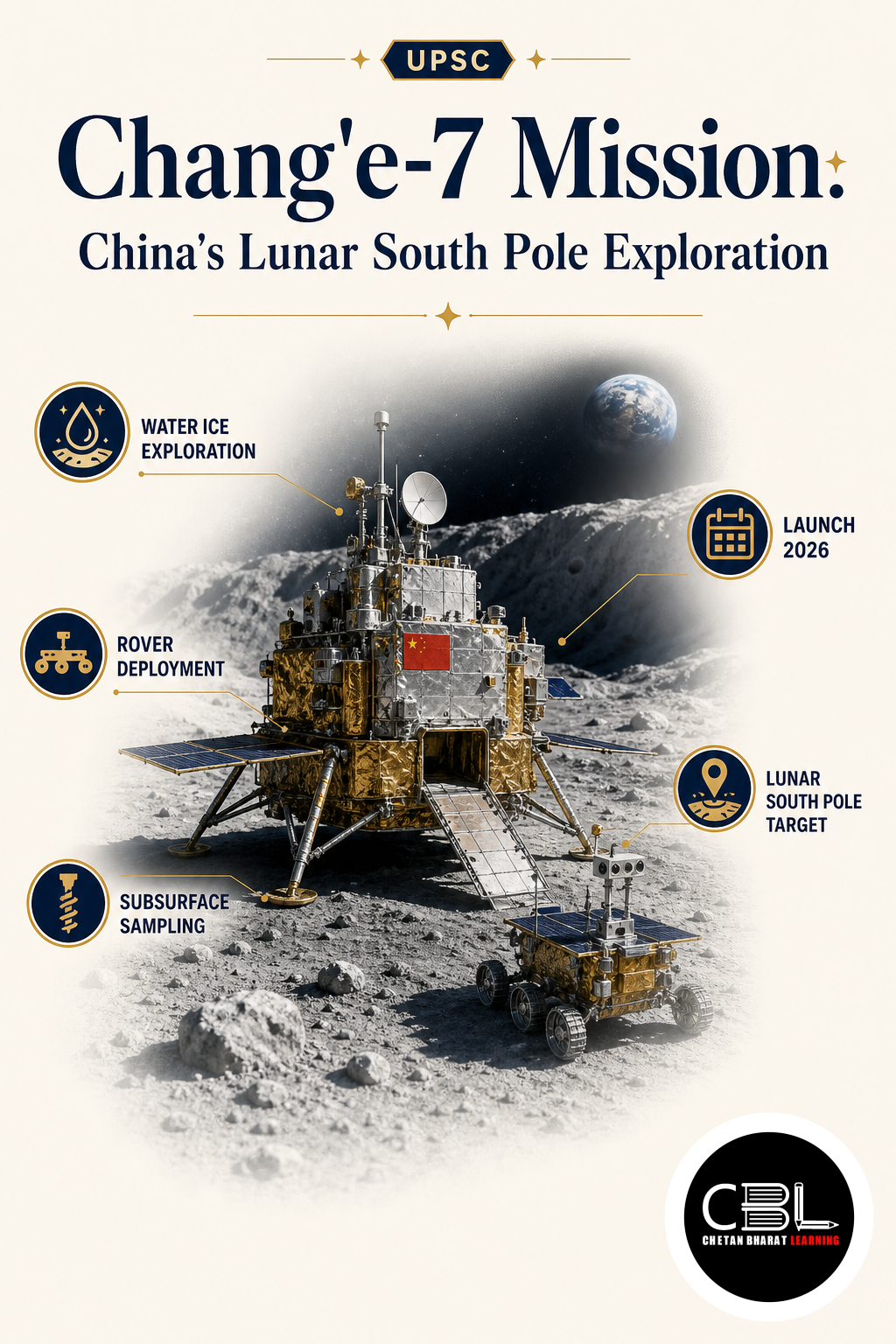
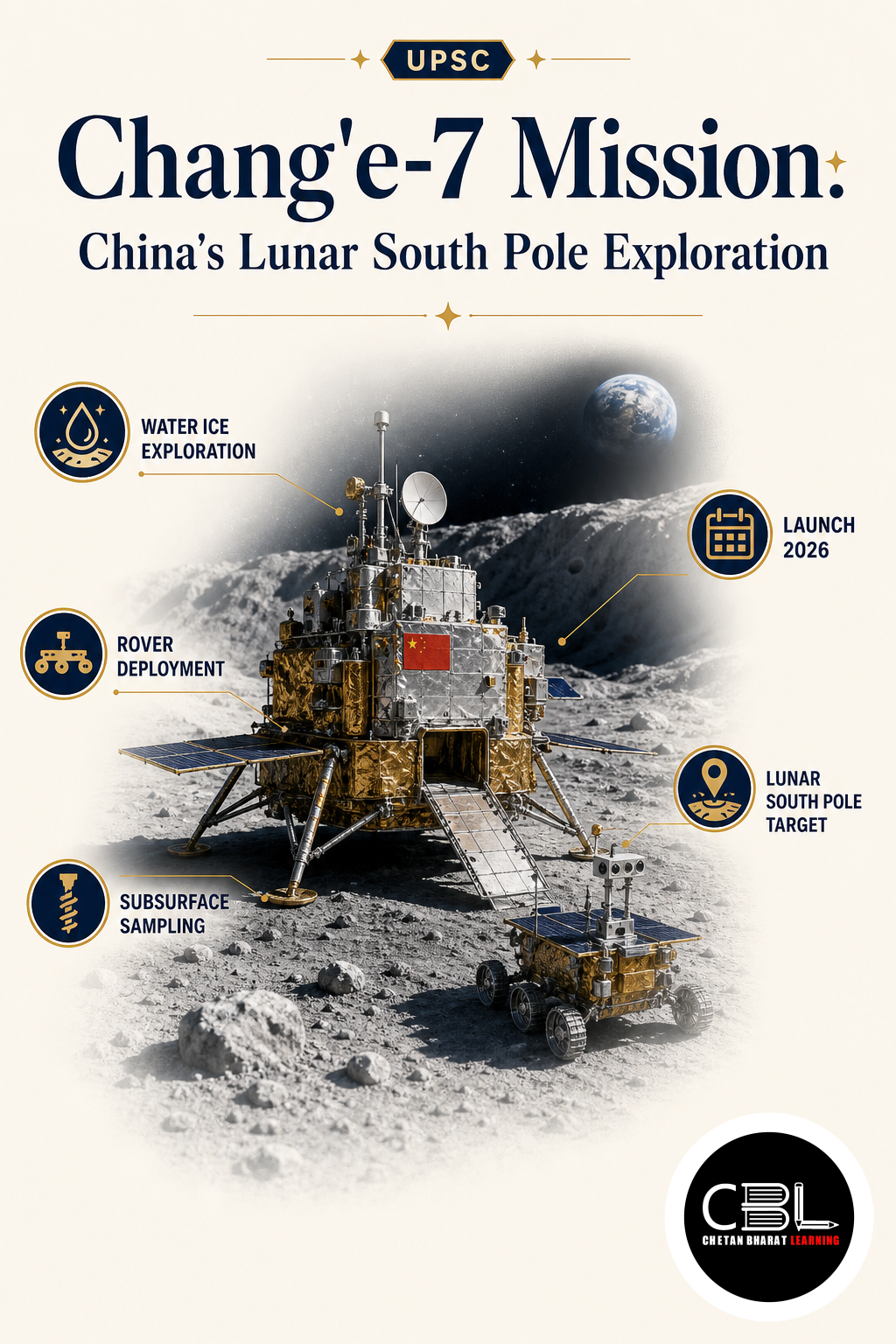
Chang’e-7 Mission is China’s robotic lunar exploration mission, part of the Chang’e program named after the Chinese lunar goddess. The mission focuses on the Moon’s south polar region, a target of high scientific and strategic interest due to the presence of water ice in permanently shadowed craters. The mission was set to carry out explorations including searching for water ice, studying surface composition, and investigating the environment.
China has made significant progress in lunar exploration, with Chang’e-6 returning samples from the far side of the Moon in 2024. Chang’e-7 is the seventh mission in the series, following a progression from orbiters to landers, rovers, and sample return missions.
Why is Chang’e-7 Mission in News?
Chang’e-7 Mission is in the news because China has postponed the launch, citing that the mission does not meet the launch conditions. The decision was based on ‘prudence, reliability and absolute mission success,’ though the specific reasons were not elaborated. The postponement highlights the complexities of deep-space missions and China’s cautious approach.
The mission is significant in the context of the new lunar race, involving China, the USA, India, Japan, and Europe, with a focus on sustained lunar presence and resource utilisation. For more details, refer to the PIB release.
Key Features of Chang’e-7 Mission
Chang’e-7 Mission has several distinctive features:
- South Pole Target: Focuses on the lunar south polar region with permanently shadowed craters containing water ice.
- Resource Search: Aims to search for water ice and other volatiles.
- Multi-Spacecraft Mission: Includes a lander, rover, and possibly an orbiter.
- International Cooperation: Part of China’s broader lunar exploration program with potential international partners.
- Postponement: Delayed due to launch conditions not being met.
Challenges in Chang’e-7 Mission
Chang’e-7 Mission faces several challenges:
- Technical Complexity: Landing on the lunar south pole is technically challenging due to rugged terrain and communication constraints.
- Resource Utilisation: Extracting and utilising water ice is still an unproven technology.
- International Competition: The global lunar race is intensifying, with multiple nations and private companies aiming for the Moon.
- Geopolitical Tensions: Lunar exploration is increasingly seen as a domain of strategic competition.
- Postponement Risks: Delays can affect mission planning and international collaboration.
Way Forward for Chang’e-7 Mission
To ensure the success of Chang’e-7 Mission, China will need to address the technical issues that led to the postponement. The mission’s focus on the lunar south pole aligns with the broader interest in lunar resources, which could support future human exploration and a sustained lunar presence. International collaboration, particularly on scientific data sharing and resource utilisation, can reduce costs and increase scientific returns.
As the global lunar race intensifies, the Chang’e-7 mission will be closely watched as a benchmark of China’s deep-space capabilities. For international best practices, refer to the NASA.
Prelims Practice Corner
Q1. Which lunar region is the target of Chang’e-7?
Answer: (c) The mission targets the lunar South Pole.
Q2. Why is the lunar South Pole important?
Answer: (b) The South Pole has water ice in permanently shadowed craters.
Q3. Which country’s mission is Chang’e-7?
Answer: (c) Chang’e-7 is China’s lunar mission.
Q4. Which Chang’e mission returned samples from the far side of the Moon?
Answer: (c) Chang’e-6 returned far-side samples in 2024.
Q5. Why was Chang’e-7 postponed?
Answer: (b) The mission was postponed due to launch conditions not being met.
Mains Practice Questions
Q1. Discuss the strategic and scientific significance of lunar south pole exploration, with reference to China’s Chang’e-7 mission. (250 words, 15 marks)
Answer Structure:
- Intro: Introduce the Chang’e-7 mission and its postponement.
- Body: Discuss the importance of lunar water ice for life support and propellant, the strategic significance of the south pole, and the global lunar race. Analyse China’s lunar achievements and the implications of the postponement.
- Conclusion: Emphasise the shift from exploration to resource utilisation and sustained presence.
Q2. What is the Outer Space Treaty, 1967, and how does it apply to lunar resources? (150 words, 10 marks)
Answer Structure:
- Intro: Define the Outer Space Treaty.
- Body: Explain its principles: peaceful use, no national appropriation, and freedom of exploration. Discuss the Moon Agreement’s more restrictive approach, which major space powers have not joined.
- Conclusion: Conclude that lunar resource governance remains legally ambiguous.
FAQs on Chang’e-7 Mission
What is Chang’e-7?
China’s lunar mission to explore the Moon’s south polar region, searching for water ice.
Why is the lunar South Pole important?
It contains water ice in permanently shadowed craters, valuable for life support and rocket propellant.
Why was Chang’e-7 postponed?
The mission did not meet launch conditions; specific technical reasons were not detailed.
Related Current Affairs
Preparing for UPSC, PCS or HCS?
Talk to a mentor at Chetan Bharat Learning, Chandigarh. Free guidance on choosing the right exam and building a study plan.
Chat on WhatsAppCall 97793 53345UPSC / IAS / PCS coaching in Chandigarh · Trusted by aspirants across Punjab & Haryana
Leave a Reply
You must be logged in to post a comment.