
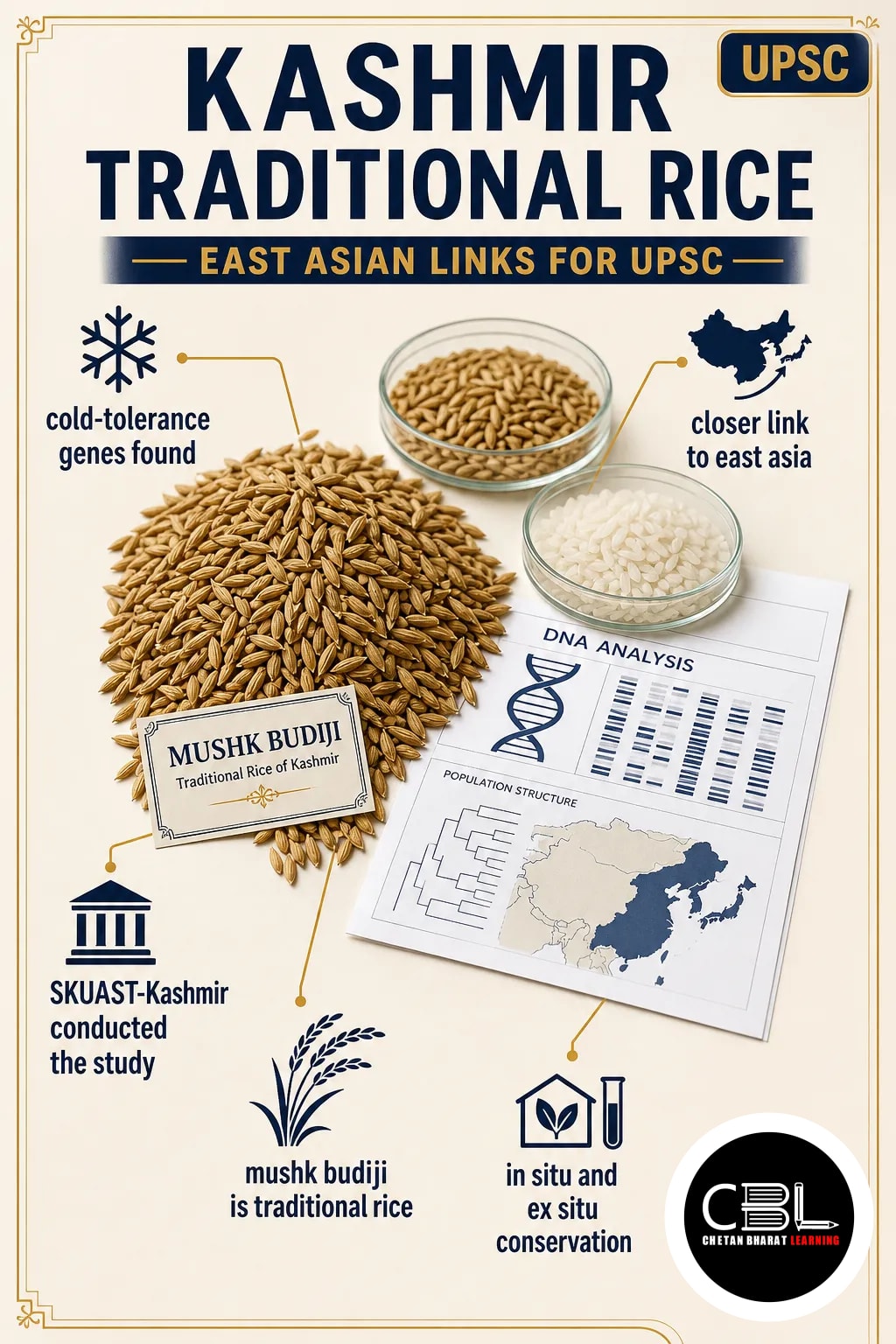
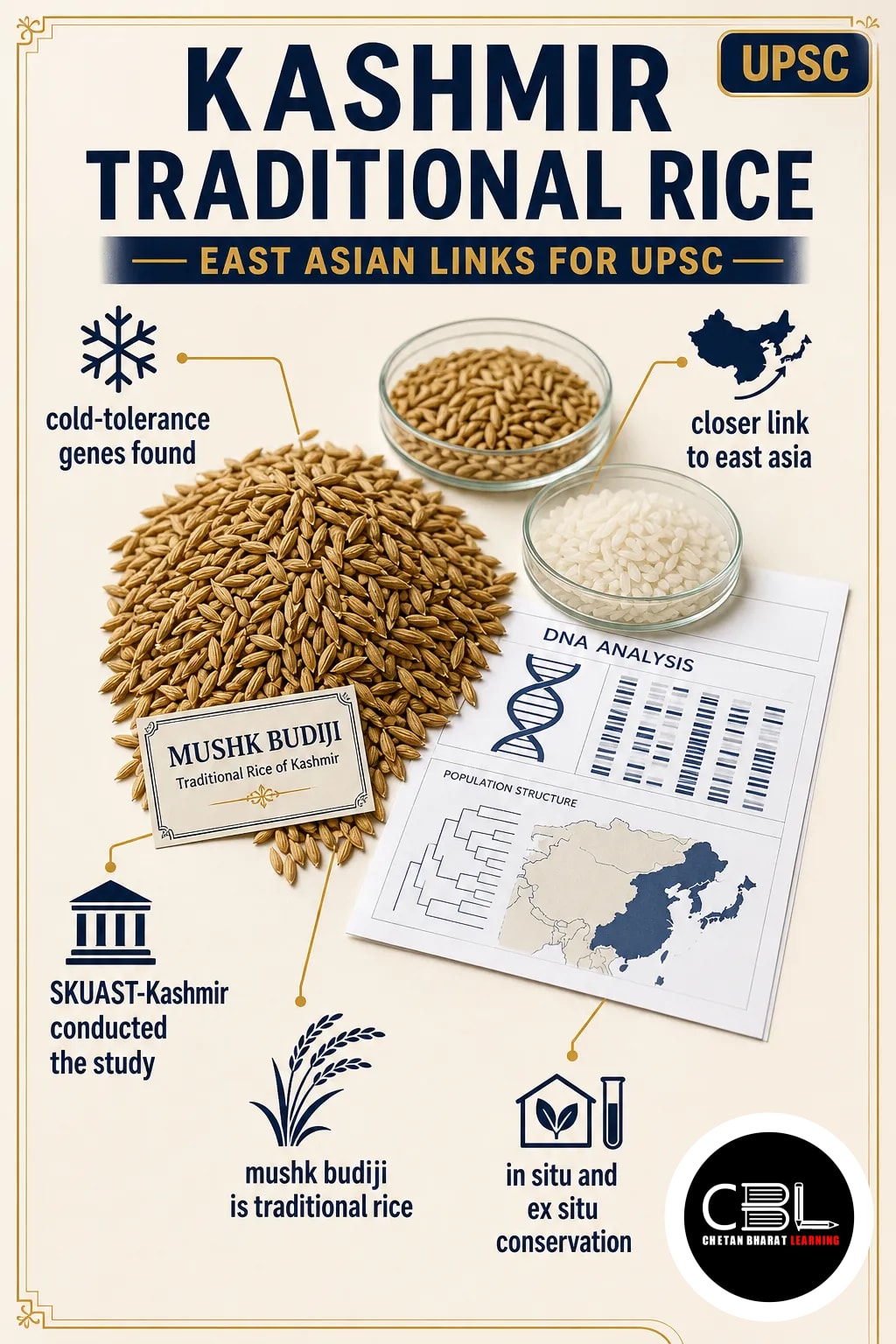
Kashmir traditional rice varieties carry genetic clues linking them to East Asia, according to a new study. The finding adds to the study of agricultural science and genetics.
Quick answer: Researchers at a Srinagar agricultural university studied Kashmir traditional rice and found genes associated with cold tolerance and local adaptation. Their analysis linked these varieties more closely to rice from the Korean Peninsula and Northeast China. Published in The Plant Genome, the study highlights their potential value under climate stress.
What did the rice study find?
The study found cold-tolerance genes and other locally adapted genes in traditional varieties cultivated by Kashmir’s farmers. Modern varieties have partly lost such genes; therefore, the older varieties may offer useful genetic material for crops facing climate stress.
Researchers at the Sher-e-Kashmir University of Agricultural Sciences and Technology, Kashmir (SKUAST-Kashmir), Srinagar, conducted the study. It appeared in The Plant Genome.
Kashmir traditional rice: quick facts
Kashmir’s farmers have cultivated traditional rice varieties for many generations. The study connects their genetic traits with both local adaptation and a wider Asian relationship.
| Feature | Fact |
|---|---|
| Research institution | SKUAST-Kashmir, Srinagar |
| Genetic traits | Cold tolerance and other local adaptations |
| Closer genetic relationship | Rice from the Korean Peninsula and Northeast China |
| Publication | The Plant Genome |
Mushk budiji is a traditional rice variety associated with Kashmir. The source article illustrates its report with a photograph of undehusked mushk budiji.
What does the East Asian link mean?
The genetic analysis indicates a closer relationship with varieties from the Korean Peninsula and Northeast China. This relationship offers a clue to the history of the rice varieties.
However, genetic similarity alone does not establish a precise route or date for their movement. The reported finding identifies a relationship; it does not specify a migration timeline.
Why does crop genetic diversity matter?
Genetic diversity provides a range of inherited traits that can help crop breeding address different stresses. For example, cold-tolerance genes may be useful when researchers seek varieties suited to low temperatures.
A landrace is a locally adapted traditional crop population. Farmers can conserve such diversity through continued cultivation; alternatively, gene banks can store seeds outside their cultivation area.
On-farm conservation is a form of in situ conservation, while seed storage in a gene bank is ex situ conservation. In addition, preserving traditional varieties keeps genetic material available for future research.
Source: The Hindu, 31 October 2026
State PCS General Studies can test traditional crop varieties, genetic diversity and conservation methods. In addition, revise the distinction between on-farm conservation and gene-bank storage.
Prelims Practice Corner
Mains Practice Questions
Frequently Asked Questions
What did researchers find in Kashmir’s traditional rice?
They found cold-tolerance and other locally adapted genes. Moreover, modern varieties have partly lost such genes.
Which regions are genetically linked to Kashmir’s traditional rice?
The Korean Peninsula and Northeast China showed closer genetic relationships. However, the finding does not establish an exact migration route or date.
Why are traditional rice varieties important for crop research?
They retain genetic traits that may be useful for crop breeding. For example, cold tolerance could help researchers address low-temperature stress.
Related Current Affairs
Preparing for UPSC, PCS or HCS?
Talk to a mentor at Chetan Bharat Learning, Chandigarh. Free guidance on choosing the right exam and building a study plan.
Chat on WhatsAppCall 97793 53345UPSC / IAS / PCS coaching in Chandigarh · Trusted by aspirants across Punjab & Haryana

 Ananya RanaIAS · AIR 60
 Aditya SharmaIAS · AIR 70
 Ria Kaur SethiIPS · AIR 89
 Aman AloonIRS · AIR 295
 Sumer Singh VirkIRS · AIR 335
 Shivani PanchalIAS

Leave a Reply
You must be logged in to post a comment.