
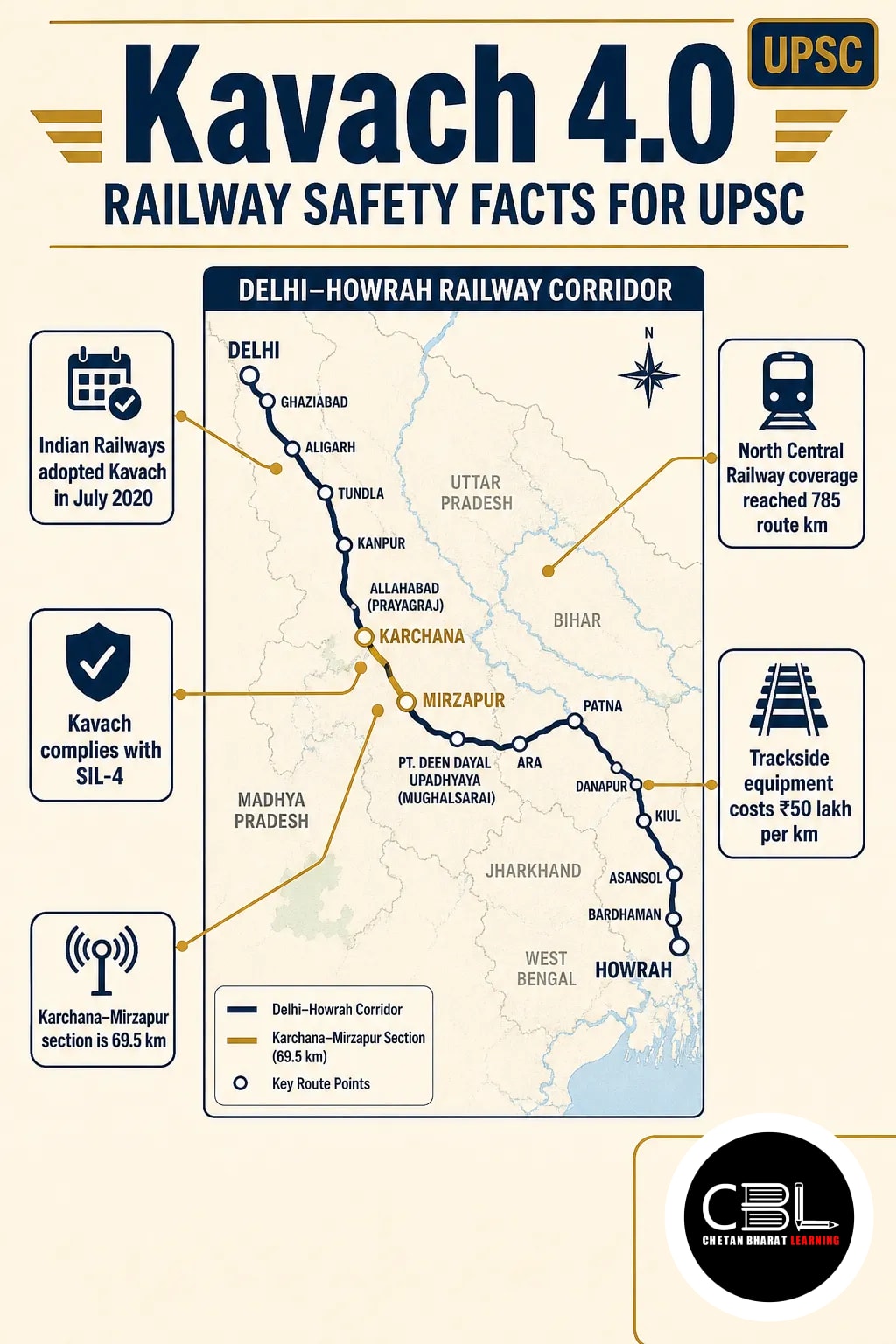
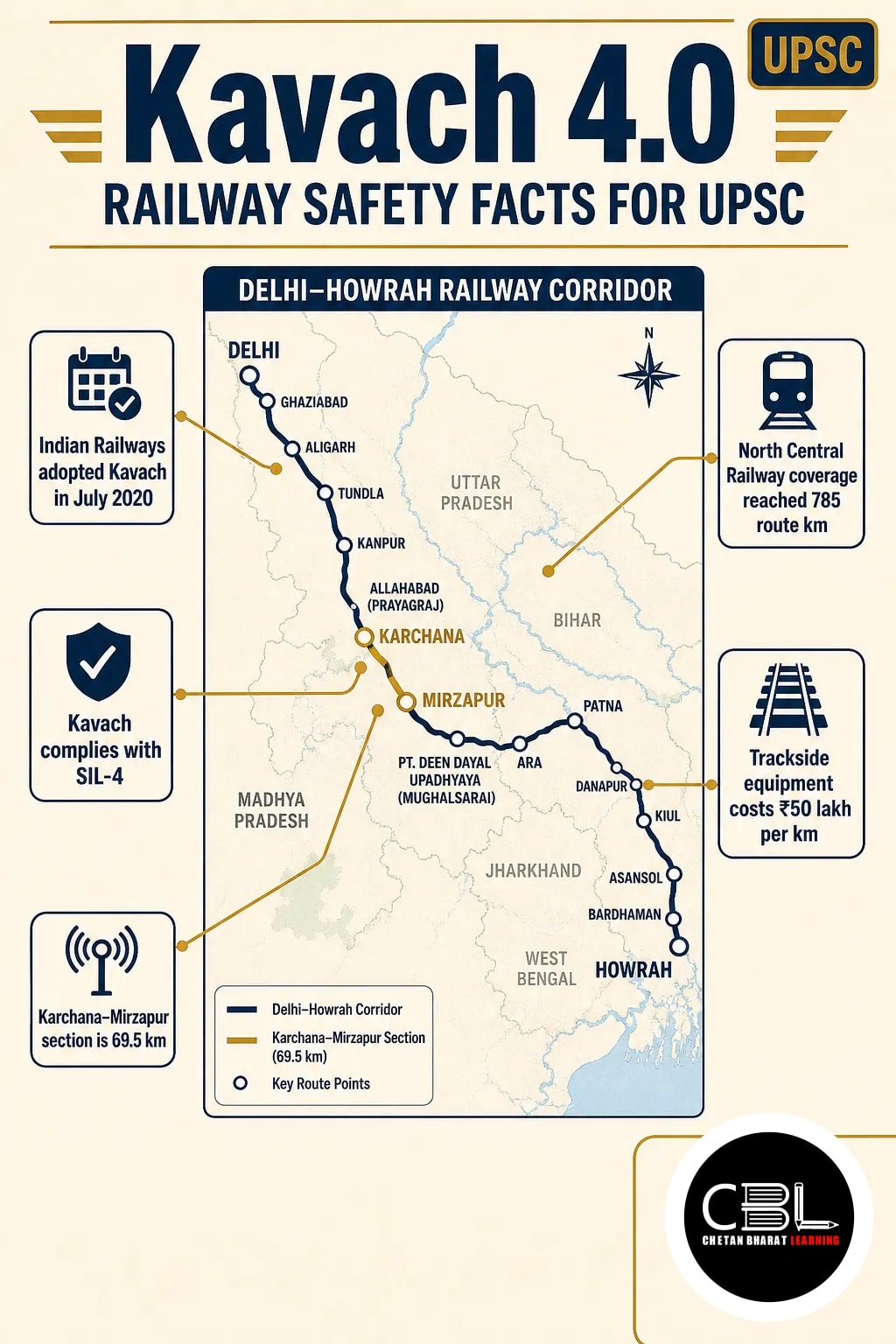
Kavach 4.0 has reached the Karchana–Mirzapur section of the Delhi–Howrah railway corridor. The commissioning adds to India’s railway safety technology coverage.
Quick answer: North Central Railway has commissioned Kavach 4.0 on the 69.5-km Karchana–Mirzapur section of the Delhi–Howrah route. Consequently, its Kavach network has reached 785 route kilometres. The indigenous Automatic Train Protection system applies brakes in critical situations and helps address overspeeding and collision risks.
What is Kavach 4.0?
Kavach 4.0 is the latest version discussed here of India’s indigenous Automatic Train Protection (ATP) system. Indian Railways adopted Kavach as its national ATP system in July 2020. It applies brakes in critical situations and continuously monitors and controls overspeeding.
Additionally, Kavach protects against Signal Passing at Danger (SPAD) and head-on and rear-end collision risks. SPAD occurs when a train passes a signal displaying danger. The system also supports safety in low visibility and adverse weather.
Where was the system commissioned?
North Central Railway commissioned the system between Karchana and Mirzapur on the Delhi–Howrah corridor. The 69.5-km section brings its Kavach coverage to 785 route kilometres, not 785 km of newly commissioned track.
| Fact | Detail |
|---|---|
| Railway zone | North Central Railway |
| New section | Karchana–Mirzapur, 69.5 km |
| Corridor | Delhi–Howrah |
| Total zonal coverage | 785 route km after commissioning |
For wider context, see CBL’s discussion of infrastructure and connectivity.
What changed in version 4.0?
Version 4.0 improves location accuracy and interfaces with railway signalling infrastructure. Its main improvements include:
- Location accuracy: The version improves the accuracy of train location information.
- Large yards: It provides better information on signal aspects in bigger yards.
- Station interface: It provides a station-to-station Kavach interface using optical fibre cable.
- Electronic interlocking: It interfaces directly with the existing Electronic Interlocking System.
Moreover, the system complies with Safety Integrity Level 4 (SIL-4), the highest safety integrity level. Electronic interlocking controls signalling arrangements to prevent conflicting train movements.
What does installation cost and why does it matter?
The Ministry of Railways estimates trackside and station equipment costs at approximately ₹50 lakh per km. Locomotive equipment costs approximately ₹80 lakh per locomotive. These are separate cost measures, so they should not be added as a single per-kilometre figure.
Indigenous design reduces dependence on imported technology. Additionally, automatic intervention can support safer operations when drivers face overspeeding or danger-signal risks.
Source: The Indian Express, 2 November 2026
Asked in UPSC: Previous Year Questions
- UPSC CSE Prelims 2025 (GS Paper I): Which statements are incorrect: the National Rail Plan targets a future-ready system by 2028; Kavach was developed with Germany; Kavach uses radio-frequency identification tags on station-section tracks?
UPSC tests Kavach alongside railway planning and its technical components.
Punjab PCS and Haryana HCS can test Kavach under science and technology or transport infrastructure. Candidates should distinguish the railway zone’s total coverage from the newly commissioned section.
Prelims Practice Corner
Mains Practice Questions
Frequently Asked Questions
What is Kavach 4.0 used for?
It is used for automatic train protection. For example, it can apply brakes in critical situations and control overspeeding.
How much of North Central Railway’s network has Kavach?
Coverage has reached 785 route kilometres. This total includes the newly commissioned 69.5-km Karchana–Mirzapur section.
When did India adopt Kavach as its national ATP system?
India adopted it in July 2020. The system is indigenous and, moreover, complies with the SIL-4 safety standard.
Related Current Affairs
Preparing for UPSC, PCS or HCS?
Talk to a mentor at Chetan Bharat Learning, Chandigarh. Free guidance on choosing the right exam and building a study plan.
Chat on WhatsAppCall 97793 53345UPSC / IAS / PCS coaching in Chandigarh · Trusted by aspirants across Punjab & Haryana

 Ananya RanaIAS · AIR 60
 Aditya SharmaIAS · AIR 70
 Ria Kaur SethiIPS · AIR 89
 Aman AloonIRS · AIR 295
 Sumer Singh VirkIRS · AIR 335
 Shivani PanchalIAS

Leave a Reply
You must be logged in to post a comment.