
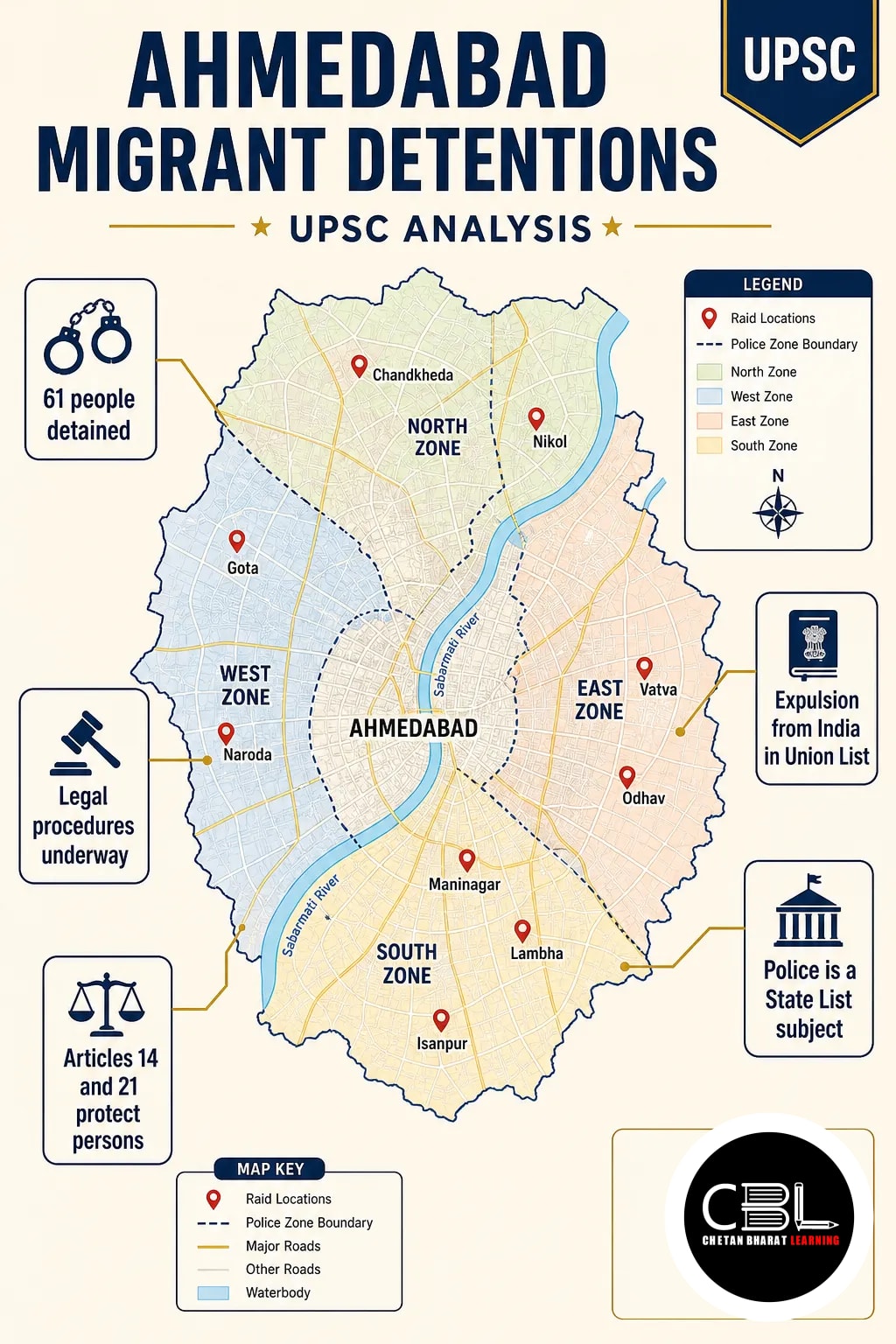
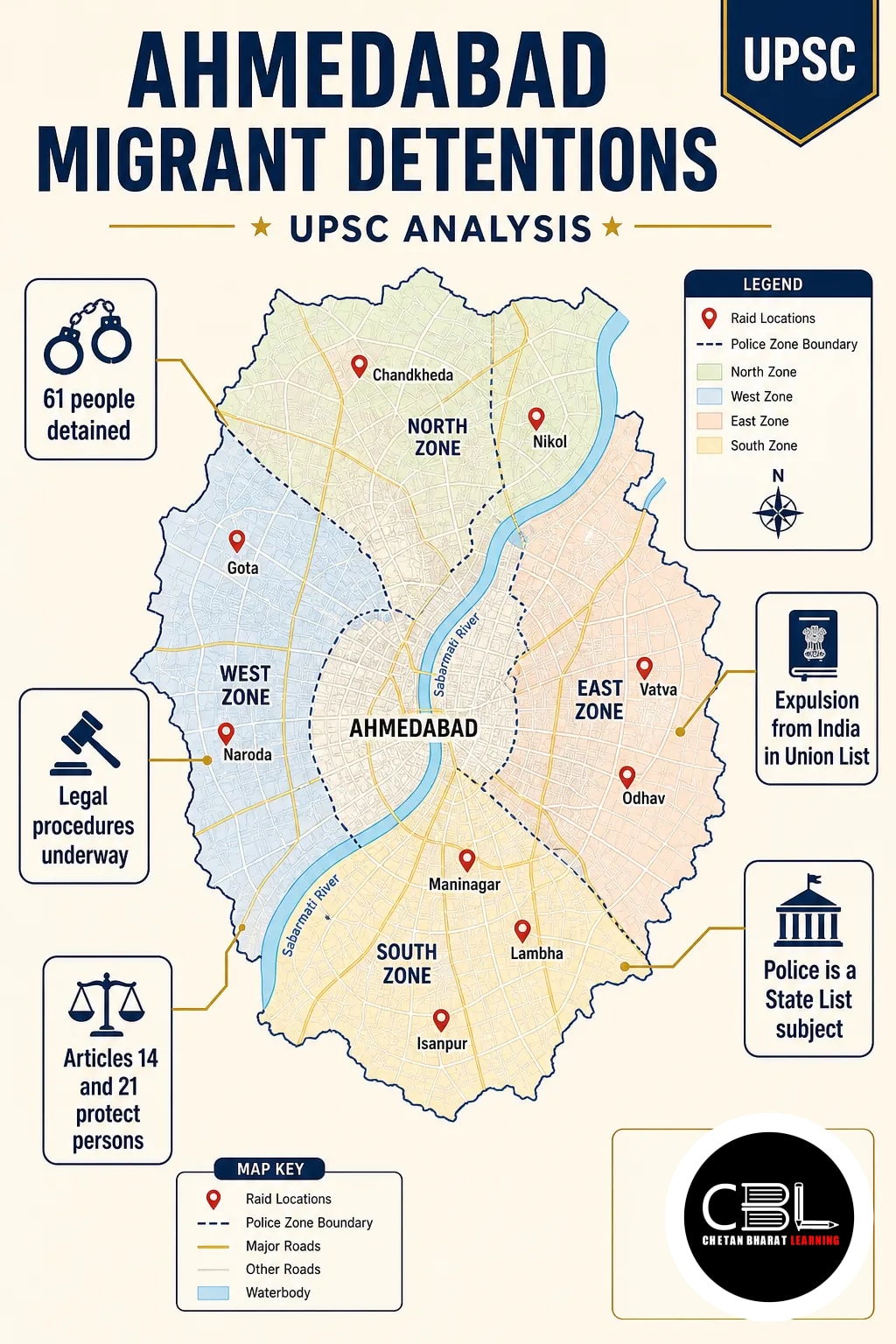
Ahmedabad migrant detentions have brought immigration enforcement and constitutional safeguards into focus. The Crime Branch detained 61 people ahead of Diwali, according to police. Explore related developments in polity and governance.
Quick answer: Ahmedabad migrant detentions involved 61 people, mostly Bangladeshi nationals, according to the Crime Branch on 2 November 2026. Police said city-wide raids followed intelligence gathering and aimed to strengthen security ahead of Diwali. Legal procedures for deportation were underway; police also said verification and legal action would continue.
What happened in Ahmedabad?
The Crime Branch detained 61 people in coordinated raids across Ahmedabad ahead of Diwali. Police said most were from Bangladesh and described the operation as a public-safety measure. The drive followed intelligence gathering across multiple city zones.
Legal procedures for deportation were underway, according to the police press note. However, the source does not provide the number deported or the final outcome of individual cases. Detention and completed deportation are therefore distinct stages.
What is the background to the operation?
Ahmedabad police conducted earlier operations against allegedly unauthorised residence in 2025. The following events provide context, but their figures should not be added to the 2026 total.
| Date or period | Event reported by police |
|---|---|
| April 2025 | After the Pahalgam terror attack, police raided the Chandola Lake area and detained over 200 Bangladeshi nationals. |
| October 2025 | Police detained 17 Bangladeshi women in an operation in Sola localities. |
| 2 November 2026 | The Crime Branch announced the detention of 61 people in a city-wide drive. |
The earlier operations are police accounts of alleged unauthorised residence. They do not establish individual outcomes in the present cases. Moreover, the source does not specify how many of the 61 were Bangladeshi nationals.
Which constitutional provisions are relevant?
The Constitution gives important protections to persons as well as specific rights to citizens. It also divides legislative subjects between the Union and the states.
| Provision | Relevance |
|---|---|
| Article 14 | Guarantees equality before the law and equal protection of laws to any person. |
| Article 21 | Protects life and personal liberty except according to procedure established by law. |
| Article 22 | Provides safeguards concerning arrest and detention, subject to constitutional exceptions. |
| Article 19 | Protects specified freedoms of citizens; it does not confer those freedoms on all persons. |
| Seventh Schedule | Places citizenship and aliens, and admission into and expulsion from India, in the Union List; police is a State List subject. |
For ordinary arrests, Article 22 includes safeguards such as being informed of grounds and access to legal counsel. However, Article 22 itself specifies exceptions, including for enemy aliens and persons held under preventive detention laws. The applicable procedure depends on the legal basis of each case.
The distinction between citizens and foreign nationals matters here. For example, a debate about a citizenship register in Manipur raises identification questions, but it is not evidence about the Ahmedabad detainees.
What governance issues do Ahmedabad migrant detentions raise?
The operation raises questions about verification, legal process and coordination between authorities. These are analytical issues; the source does not establish that any safeguard was violated.
- Individual verification: Authorities must establish nationality and immigration status case by case, because an allegation alone does not settle either question.
- Security and rights: Police may pursue public-safety objectives; however, action affecting liberty must follow applicable law and constitutional safeguards.
- Centre-state coordination: Local police conduct enforcement, while citizenship, aliens and expulsion fall within Union legislative subjects. Therefore, effective processing requires coordination across levels of government.
- Administrative capacity: Identity verification and case records matter because errors can affect both enforcement and individual rights. The role of registration offices is explained in this guide to Foreigners Regional Registration Offices.
What should a lawful response prioritise?
A lawful response should combine reliable identification with proportionate, accountable enforcement. First, authorities should document the grounds for action and examine each person’s status individually.
Second, officials should communicate the applicable process and enable access to safeguards required by law. In addition, coordination with relevant Union authorities should support nationality verification and any lawful removal process.
Finally, public reporting should distinguish people detained, cases under verification and completed deportations. This distinction improves accountability without assuming that every person detained has the same legal status or case outcome.
Source: The Hindu, 2 November 2026
- Manipur NRC: The 1951 Base Year Debate Explained (9 Sep 2026)
State PCS General Studies questions can test the division between state policing and Union subjects concerning foreign nationals. They may also ask candidates to distinguish constitutional protections available to persons from rights reserved for citizens.
Prelims Practice Corner
Mains Practice Questions
Frequently Asked Questions
How many people did police detain in Ahmedabad?
Police detained 61 people, mostly Bangladeshi nationals. The Crime Branch announced the operation on 2 November 2026.
Were the detained people deported?
The source does not say that deportations were completed. Instead, police said legal procedures for deportation were underway.
Do foreign nationals have constitutional protections in India?
Yes, because Articles 14 and 21 protect persons, not only citizens. However, Article 19 grants its specified freedoms to citizens.
Which government level has legislative authority over expulsion from India?
The Union has legislative authority because expulsion from India is a Union List subject. Police, however, is a State List subject.
Related Current Affairs
Preparing for UPSC, PCS or HCS?
Talk to a mentor at Chetan Bharat Learning, Chandigarh. Free guidance on choosing the right exam and building a study plan.
Chat on WhatsAppCall 97793 53345UPSC / IAS / PCS coaching in Chandigarh · Trusted by aspirants across Punjab & Haryana

 Ananya RanaIAS · AIR 60
 Aditya SharmaIAS · AIR 70
 Ria Kaur SethiIPS · AIR 89
 Aman AloonIRS · AIR 295
 Sumer Singh VirkIRS · AIR 335
 Shivani PanchalIAS

Leave a Reply
You must be logged in to post a comment.