
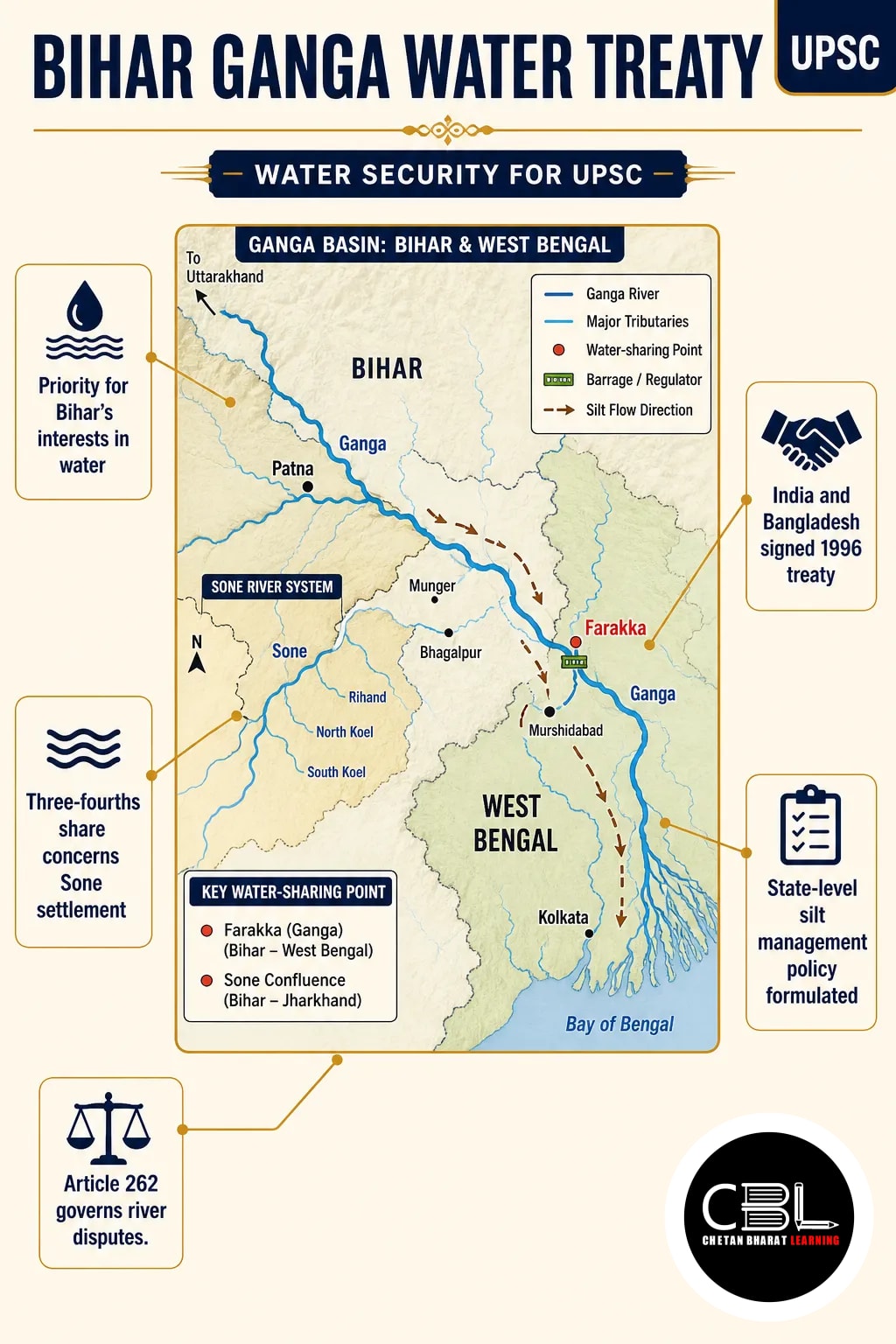
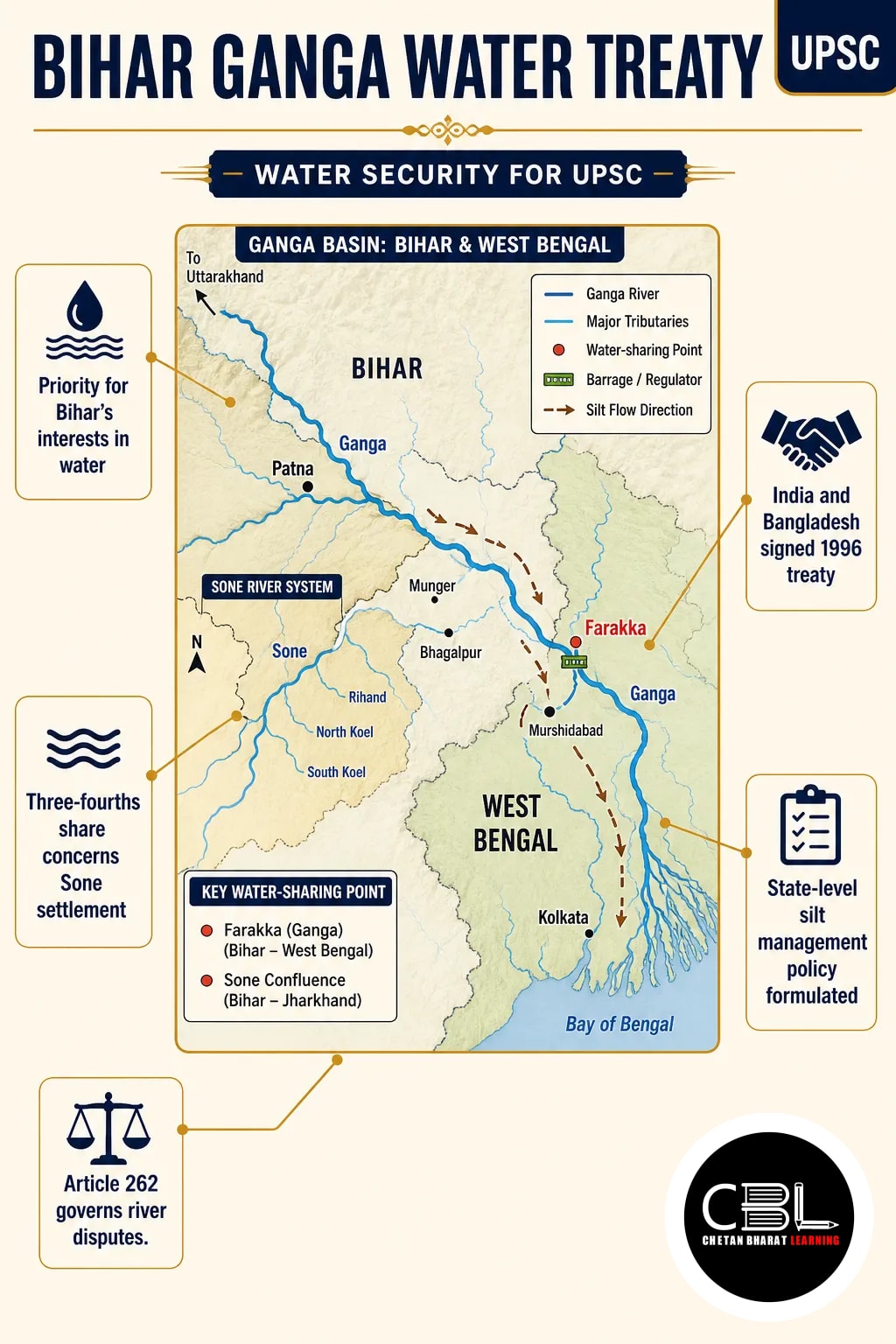
Bihar Ganga Water Treaty concerns gained attention on 30 October 2026, when Chief Minister Samrat Choudhary called for priority to the state’s interests. The debate connects river management and environmental governance with federal and international water-sharing questions.
Quick answer: The Bihar Ganga Water Treaty debate concerns the state’s demand for water security in decisions on Ganga water and the Farakka Treaty. On 30 October 2026, Chief Minister Samrat Choudhary linked adequate water and scientific silt management to drinking water, agriculture, industry, infrastructure and employment.
What is the Bihar Ganga Water Treaty debate?
The debate is Bihar’s demand that its water needs receive priority in decisions concerning the Ganga and Farakka. It is not an announcement of a separate treaty signed by Bihar.
For context, India and Bangladesh signed the Ganges Water Treaty in 1996 concerning water sharing at Farakka. Farakka lies in West Bengal, downstream of Bihar. Therefore, the issue connects a transboundary agreement with the needs of an Indian state in the river basin.
The source does not establish a new treaty, a revised Ganga allocation for Bihar or the current status of treaty negotiations. Aspirants should therefore distinguish the Chief Minister’s demand from an agreed change in treaty terms.
Why is Bihar’s water security in the news?
Choudhary raised the issue at a one-day seminar organised by Bihar’s Water Resources Department on 30 October 2026. He identified drinking water, irrigation and industry as competing requirements for sufficient water.
He also said the government had formulated a state-level silt management policy. Moreover, he proposed an aerial survey so experts could assess the Ganga’s flow and silt accumulation.
| Issue | Announcement or proposal |
|---|---|
| Ganga water | Priority for Bihar’s interests in water and Farakka-related decisions |
| Sone dispute | The Chief Minister said Bihar would receive three-fourths of the water after a settlement with Jharkhand |
| Silt use | Scientific removal and use, including for roads and other infrastructure |
| Institutional cooperation | A future agreement with the National Highways Authority of India (NHAI) was proposed |
Exam distinction: The three-fourths figure refers to the Sone settlement, not Bihar’s share under the Ganges Water Treaty. Choudhary said Union Home Minister Amit Shah assisted in resolving the 25-year-old Bihar–Jharkhand dispute.
Why does water and silt management matter?
Water and sediment management can affect Bihar’s development as well as the health of the river system.
- Water security: Reliable supplies support households, irrigation and industrial activity; therefore, allocation decisions must consider competing uses.
- Silt as a resource: The state proposes using extracted material for public purposes and infrastructure. However, its suitability and environmental effects require assessment.
- Flood management: Embankments can protect settlements, but their design and maintenance must account for river flow and sediment movement.
- Employment: Choudhary linked water-resource use to the state’s goal of creating opportunities for one crore people. This is a stated goal, not a verified employment outcome.
For a comparison of international river agreements, see CBL’s coverage of the debate on Indus Waters Treaty reform. The two river systems and their treaty arrangements are distinct.
Which constitutional provisions govern water?
The Constitution divides water-related responsibilities between states and the Union, while providing for inter-state dispute resolution.
| Provision | Relevance |
|---|---|
| State List, Entry 17 | Water supplies, irrigation and related matters fall under state legislative competence, subject to Union List Entry 56. |
| Union List, Entry 56 | Parliament may legislate on inter-state rivers and river valleys when it declares Union regulation expedient in the public interest. |
| Article 262 | Parliament may provide for adjudication of disputes over inter-state river waters and may exclude court jurisdiction over such disputes. |
| Union List, Entry 14 | Treaties and agreements with foreign countries fall within Union legislative competence. |
Thus, inter-state allocation and international treaty-making involve different legal settings. The Bihar–Jharkhand Sone settlement should not be treated as an India–Bangladesh treaty outcome.
What are the challenges and the way forward?
The central challenge is to integrate state needs, river ecology and international commitments without confusing their legal frameworks.
Key challenges
- Competing demands: Drinking water, agriculture and industry can place different demands on available flows; therefore, priorities need transparent assessment.
- Sediment uncertainty: Silt moves through a river system, so removing it at one location requires evidence about effects elsewhere.
- Federal coordination: River management crosses state boundaries, while international agreements involve the Union; consequently, consultation is essential.
- Implementation: A proposed NHAI agreement does not establish that silt reuse has begun or is viable at every site.
Policy priorities
First, authorities can assess seasonal flows, sediment and sectoral demand across the basin. The proposed aerial survey could complement field measurements rather than replace them.
Second, the Union and basin states can share evidence and consult on water security. In addition, any silt-removal plan should test material suitability, costs and ecological consequences before reuse.
Finally, embankment decisions should follow scientific assessment and community consultation. Choudhary also called for a national silt management policy; such a policy would need to accommodate differences between rivers.
For broader treaty context, CBL has also examined the Indus treaty and the Hague ruling. However, that dispute does not determine the Ganga’s allocation.
Source: The Hindu, 31 October 2026
- Indus Waters Treaty: Hague Ruling & India’s Stance (2 Sep 2026)
- Indus Waters Treaty: Need for Reform for UPSC (22 Jul 2026)
- Indus Water Treaty (2 Apr 2023)
Punjab PCS and Haryana HCS can test the constitutional division of water-related powers and inter-state river disputes. Moreover, candidates can use this case to discuss federal consultation and scientific river management in General Studies.
Prelims Practice Corner
Mains Practice Questions
Frequently Asked Questions
What did Bihar demand on the Ganga Water Treaty?
Bihar’s Chief Minister demanded priority for the state’s interests in decisions concerning Ganga water and Farakka. He also linked adequate supplies to drinking water, irrigation and industry.
Did Bihar receive three-fourths of Ganga treaty water?
No, the three-fourths figure concerns the Sone water settlement with Jharkhand. The source does not state a revised Ganga treaty share for Bihar.
What is Bihar’s proposed approach to river silt?
Bihar plans scientific removal and utilisation under a state-level silt management policy. In addition, the Chief Minister proposed using suitable material for roads and other infrastructure.
Related Current Affairs
Preparing for UPSC, PCS or HCS?
Talk to a mentor at Chetan Bharat Learning, Chandigarh. Free guidance on choosing the right exam and building a study plan.
Chat on WhatsAppCall 97793 53345UPSC / IAS / PCS coaching in Chandigarh · Trusted by aspirants across Punjab & Haryana

 Ananya RanaIAS · AIR 60
 Aditya SharmaIAS · AIR 70
 Ria Kaur SethiIPS · AIR 89
 Aman AloonIRS · AIR 295
 Sumer Singh VirkIRS · AIR 335
 Shivani PanchalIAS

Leave a Reply
You must be logged in to post a comment.