

UPSC Mapping
| Prelims | Environment & Disaster Management |
|---|---|
| Mains | GS Paper 3 (Environment & Disaster Management) |
Quick Facts
| River System | Brahmaputra |
|---|---|
| Key Natural Factor | High sediment load |
| Key Human Factor | Embankment decay |
What are Assam Flood Causes?
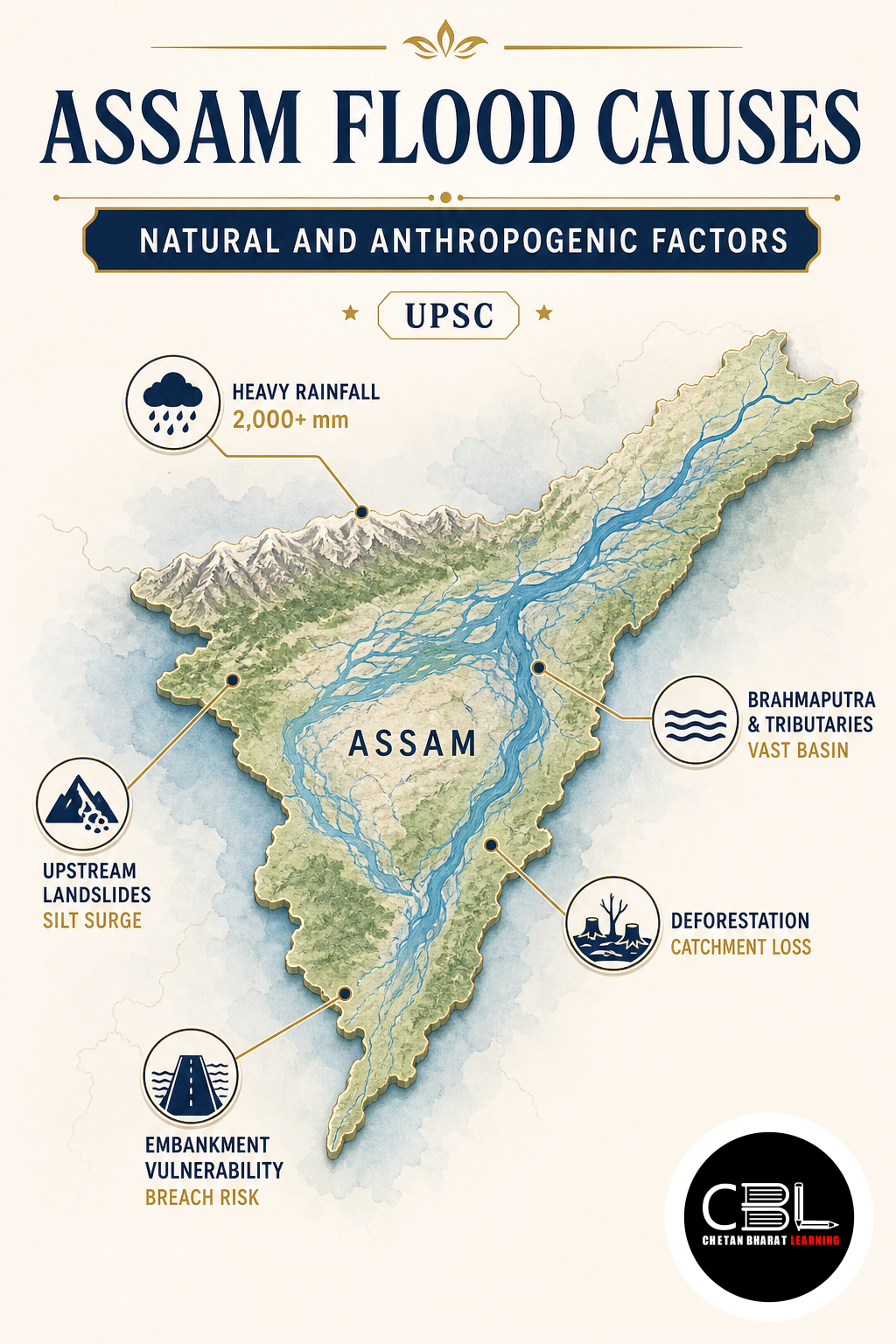
Assam Flood Causes are rooted in the Brahmaputra’s highly dynamic river system. The river carries enormous quantities of sediment from the tectonically active Himalayas, which, combined with variable monsoon discharge, leads to a braided, shifting channel. The Brahmaputra is not a fixed channel; it is a highly dynamic river system that continually changes course.
Natural factors include: topographical funneling of runoff, riverbed aggradation from annual sediment deposit (~1,000 million tonnes), and intense precipitation (cloudbursts can be 435% above normal). Human interventions—embankments, deforestation, and wetland encroachment—amplify the risk.
Why are Assam Flood Causes in News?
Assam Flood Causes are in the news as the state faces recurring annual floods, with recent years witnessing severe devastation to life, property, and agriculture. The issue has become a recurring national headline, prompting debates on whether the problem is purely natural or if human intervention is amplifying a naturally flood-prone landscape.
Experts argue that while Assam is naturally flood-prone, human activities—embankment decay (295 of 423 embankments have expired design lives), deforestation in upstream catchments, and wetland encroachment—have significantly increased vulnerability. For more details, refer to the PIB release.
Key Features of Assam Flood Causes
- High Sediment Load: The Brahmaputra carries ~1,000 million tonnes of sediment annually, elevating the riverbed.
- Braided River System: The river has multiple shifting channels, making flood prediction and management complex.
- Variable Discharge: Monsoon produces very high flows, while dry-season flows are low.
- Embankment Decay: 295 of 423 earthen embankments have expired design lives, prone to breaching.
- Wetland Loss: Encroachment has reduced flood-absorbing wetlands like Deepor Beel.
Challenges in Addressing Assam Flood Causes
- Transboundary Complexity: The Brahmaputra is an international river; upstream actions in China and Bhutan affect Assam.
- Embankment Maintenance: Repairing and upgrading 423 embankments is a massive financial and logistical task.
- Catchment Degradation: Deforestation in upstream states (e.g., 800 sq km lost in Nagaland) accelerates runoff.
- Climate Change: Changing rainfall patterns and glacial melt are altering flood dynamics.
- Development vs Environment: Balancing flood protection with development in floodplains is contentious. For more on river management, visit the environment section.
Way Forward for Assam Flood Causes
To address Assam Flood Causes, a multi-pronged approach is needed:
- Strengthening and upgrading embankments
- Restoring wetlands and floodplains to absorb excess water
- Promoting afforestation in upstream catchments
- Implementing modern flood forecasting using satellite and AI technologies
- Transboundary data sharing and joint flood management with China and Bhutan
- Community-based early warning systems and resilient livelihoods (flood-resistant crops, raised housing)
Prelims Practice Corner
Q1. Which river is the primary cause of recurrent floods in Assam?
- (a) Ganga
- (b) Brahmaputra
- (c) Mahanadi
- (d) Godavari
Answer: (b) The Brahmaputra is the primary river causing floods.
Q2. What is the annual sediment load carried by the Brahmaputra?
- (a) 100 million tonnes
- (b) 500 million tonnes
- (c) 1,000 million tonnes
- (d) 2,000 million tonnes
Answer: (c) The river carries about 1,000 million tonnes of sediment annually.
Q3. How many embankments in Assam have expired design lives?
- (a) 100
- (b) 200
- (c) 295
- (d) 423
Answer: (c) 295 of 423 embankments have expired design lives.
Q4. What is a braided river system?
- (a) A river with a single straight channel
- (b) A river with multiple shifting channels
- (c) A river that flows only in monsoon
- (d) A river with no sediment
Answer: (b) A braided river has multiple, shifting channels separated by sandbars.
Q5. Which wetland in Assam has been reduced by encroachment?
- (a) Chilika Lake
- (b) Deepor Beel
- (c) Vembanad Lake
- (d) Loktak Lake
Answer: (b) Deepor Beel has been reduced by encroachment, losing its flood-absorbing capacity.
Mains Practice Questions
Q1. Analyse the natural and human-induced factors contributing to recurrent floods in Assam, and suggest long-term mitigation strategies. (250 words, 15 marks)
Answer Structure:
- Intro: Introduce Assam as a flood-prone state.
- Body: Discuss natural factors: Brahmaputra dynamics, sediment load, high rainfall. Anthropogenic factors: embankment decay, deforestation, wetland loss. Suggest strategies: embankment upgrade, wetland restoration, afforestation, flood forecasting, transboundary cooperation.
- Conclusion: Emphasise a shift from flood control to flood management.
Q2. What is the role of embankments in flood management, and why have they become a challenge in Assam? (150 words, 10 marks)
Answer Structure:
- Intro: Define embankments as flood protection structures.
- Body: Explain their role in containing river flows. However, in Assam, 295 of 423 embankments have expired design lives, becoming vulnerable to breaching. This, combined with sediment aggradation, has made them less effective.
- Conclusion: Conclude that embankments must be complemented with other measures like wetland restoration.
FAQs on Assam Flood Causes
What are the main causes of floods in Assam?
Natural factors: high sediment load, intense monsoon, braided river system. Human factors: embankment decay, deforestation, wetland encroachment.
Why is the Brahmaputra so dynamic?
Due to high sediment load from the Himalayas, variable monsoon discharge, and erodible floodplains, the river constantly changes course.
What is the solution to Assam floods?
A combination of embankment upgrade, wetland restoration, afforestation, flood forecasting, and transboundary cooperation.
Related Current Affairs
Preparing for UPSC, PCS or HCS?
Talk to a mentor at Chetan Bharat Learning, Chandigarh. Free guidance on choosing the right exam and building a study plan.
Chat on WhatsAppCall 97793 53345UPSC / IAS / PCS coaching in Chandigarh · Trusted by aspirants across Punjab & Haryana
Leave a Reply
You must be logged in to post a comment.