
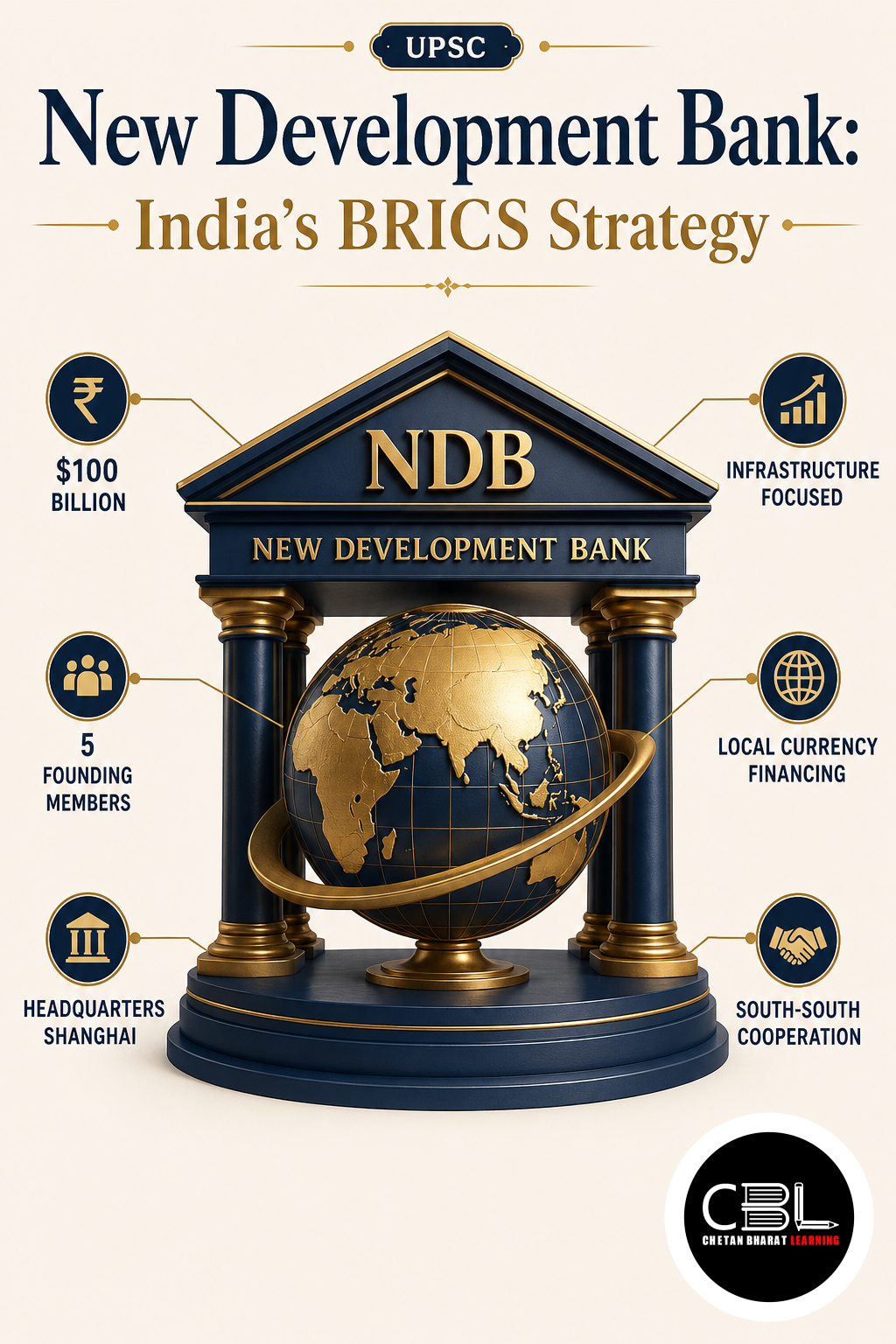

New Development Bank: India’s BRICS Strategy
UPSC Mapping
- Prelims: International Organisations and Economy
- Mains: GS Paper II and GS Paper III
Quick Facts
| Established | 2015 |
|---|---|
| Headquarters | Shanghai, China |
| Founders | Brazil, Russia, India, China and South Africa |
| Core Mandate | Infrastructure and sustainable development |
What is New Development Bank?
The New Development Bank is a multilateral development bank created by the five original BRICS members. It mobilises resources for infrastructure and sustainable development in member and other emerging economies. The institution began operations in 2015 and maintains its headquarters in Shanghai.
Its founding design gave the original members equal subscriptions and an equal institutional voice. This arrangement distinguished the bank from lenders where advanced economies retain dominant voting power. Its mandate covers clean energy, transport, water, sanitation, environmental protection, social facilities and digital infrastructure.
Why is New Development Bank in News?
The New Development Bank participated in the 18th BRICS Summit hosted by India in New Delhi. The September 2026 summit examined resilience, innovation, cooperation and sustainability across an expanded grouping. This placed development financing and institutional effectiveness within India’s chairship agenda.
The bank also joined BRICS in launching a knowledge portal during India’s chairship. The initiative can connect project experience, policy research and practical solutions across participating economies. The official bank portal reports 139 approved projects and financing approvals worth USD 42.9 billion.
Key Features
Five institutional features explain the bank’s relevance to BRICS cooperation and India’s development interests.
- Development mandate: The bank finances infrastructure and sustainable development aligned with members’ national priorities.
- Emerging-economy ownership: BRICS countries created the institution to widen their role in global financial governance.
- Sectoral range: Operations cover transport, renewable energy, water, sanitation, social infrastructure and digital systems.
- Local-currency approach: Domestic-currency borrowing and lending can reduce exchange-rate exposure for suitable projects.
- Expanding membership: New members widen geographical reach, capital sources and opportunities for development partnerships.
For India, the institution adds a financing channel for large projects with long repayment periods. Bank-backed initiatives have included urban transport, rural water systems and state-level infrastructure programmes. Such lending can complement domestic budgets and established multilateral sources without replacing either.
The institution can also test financing methods suited to emerging markets. Local-currency bonds may connect domestic savings with infrastructure needs while limiting currency mismatches. This approach requires deep bond markets, reliable benchmarks and careful management of interest-rate risk.
Its knowledge role matters alongside lending. Members face common problems involving urbanisation, climate resilience, public transport and digital access. Structured exchanges can help governments adapt successful models while respecting different administrative and social conditions.
Challenges
The bank must address delivery gaps while preserving credibility, balance and sound financial management.
- Slow project execution: Complex preparation and implementation can delay the conversion of approvals into development outcomes.
- Concentrated portfolio: Heavy exposure to large founding economies may limit geographical diversification and institutional reach.
- Geopolitical pressures: Rivalries among members can complicate consensus, borrowing choices and relationships with international markets.
- Currency risks: Wider local-currency financing needs adequate liquidity, hedging instruments and dependable domestic investors.
- Governance balance: Membership expansion must protect borrower voice while maintaining transparent and efficient decision-making.
Speed cannot come at the cost of environmental and social safeguards. Weak project preparation can create delays, cost overruns or assets that do not meet public needs. The bank needs strong appraisal, consultation, procurement oversight and independent evaluation throughout each project cycle.
India must also separate institutional cooperation from alignment with any single member’s strategic preferences. It can support equitable governance, competitive procurement and transparent project selection across the expanded grouping.
Financial strength presents another constraint. A development bank must raise funds affordably, protect asset quality and retain investor confidence across market cycles. Geopolitical sanctions, credit-rating pressures and volatile currencies can raise costs even when projects remain economically valuable.
Membership expansion creates both opportunity and institutional complexity. New participants bring capital, project demand and regional knowledge, but they also widen differences over priorities. Clear accession rules and predictable voting arrangements can prevent enlargement from weakening operational coherence.
The bank must distinguish between announcing finance and delivering durable public assets. Governments often face land, procurement, regulatory and coordination delays after loan approval. Better project-preparation facilities can identify these constraints before commitments enter the active portfolio.
Debt sustainability deserves particular attention in lower-income members. Financing terms should reflect repayment capacity, expected economic returns and exposure to climate shocks. Transparent debt analysis can protect borrowers while preserving the bank’s balance sheet.
Way Forward
India can promote a larger pipeline of well-prepared projects in clean energy, resilient cities, logistics and digital public infrastructure. It should seek time-bound appraisal, transparent procurement and measurable development outcomes. Partnerships with other multilateral lenders can combine finance, technical expertise and risk-sharing capacity.
The bank should expand local-currency operations gradually and match each loan with appropriate funding and hedging. Its general strategy framework can guide portfolio diversification and institutional learning. Strong safeguards and public disclosure will reinforce financial credibility and development legitimacy.
Membership growth should accompany clear rules that preserve meaningful participation by borrowers of different sizes. India can advocate balanced governance, rotation in leadership and balanced staffing and independent assessment of completed projects. These measures would help prevent any country from converting financial weight into disproportionate strategic influence.
Implementation quality should become the central test of institutional relevance. India can encourage publication of project milestones, procurement performance and independently assessed results. Comparable information would help legislatures, communities and investors distinguish actual outcomes from headline approval figures.
Co-financing with national development banks can strengthen local expertise and reduce project-preparation delays. The institution can also mobilise private capital through guarantees without shifting excessive risks to governments. Such partnerships need clear accountability, fair risk allocation and accessible grievance mechanisms.
A stronger New Development Bank can complement existing institutions rather than create a closed financial bloc. Cooperation on co-financing, climate standards and debt sustainability can improve global development architecture. India’s objective should remain practical: secure quality finance while advancing a more representative and rules-based multilateral order.
Prelims Practice Corner
Q1. Which countries founded the BRICS development bank in 2015?
- (a) BRICS five original members
- (b) G7 members
- (c) ASEAN members
- (d) SAARC members
Answer: Brazil, Russia, India, China and South Africa.
Q2. Where is the bank’s headquarters located?
- (a) New Delhi
- (b) Shanghai
- (c) Johannesburg
- (d) Brasília
Answer: Shanghai, China.
Q3. What is the bank’s central mandate?
- (a) Military cooperation
- (b) Infrastructure and sustainable development
- (c) Trade dispute settlement
- (d) Exchange-rate fixing
Answer: Infrastructure and sustainable development.
Q4. Local-currency lending mainly helps a borrower reduce which risk?
- (a) Exchange-rate risk
- (b) Geological risk
- (c) Electoral risk
- (d) Demographic risk
Answer: Exchange-rate risk.
Q5. Which sector falls within the bank’s stated focus areas?
- (a) Nuclear deterrence
- (b) Digital infrastructure
- (c) Customs adjudication
- (d) Electoral management
Answer: Digital infrastructure.
Mains Practice Questions
Q1. Examine how a BRICS-led development bank can make global financial governance more representative. (250 words, 15 marks)
Answer Structure:
- Intro: Define the institution and its development mandate.
- Body: Cover borrower voice, infrastructure finance, local currencies, membership expansion and governance challenges.
- Conclusion: Link effectiveness with balanced governance, safeguards and measurable outcomes.
Q2. Discuss India’s interests and policy choices in strengthening the BRICS development finance architecture. (150 words, 10 marks)
Answer Structure:
- Intro: Frame India’s infrastructure needs and commitment to multilateral reform.
- Body: Discuss project finance, local-currency markets, strategic autonomy, balanced governance and implementation quality.
- Conclusion: Emphasise credible, transparent and development-focused institutional leadership.
FAQs on New Development Bank
Why did BRICS countries create their development bank?
They sought another source of finance for infrastructure and sustainable development in emerging economies. The institution also increases borrower participation in multilateral financial governance.
Why does local-currency financing matter?
It can reduce currency mismatches when projects earn revenue in a domestic currency. Successful expansion still requires liquid bond markets and suitable risk-management instruments.
What should India prioritise within the institution?
India should promote high-quality projects, balanced governance and transparent evaluation. It should also support diversified funding without weakening debt sustainability or environmental safeguards.
Related Current Affairs
Preparing for UPSC, PCS or HCS?
Talk to a mentor at Chetan Bharat Learning, Chandigarh. Free guidance on choosing the right exam and building a study plan.
Chat on WhatsAppCall 97793 53345UPSC / IAS / PCS coaching in Chandigarh · Trusted by aspirants across Punjab & Haryana
Leave a Reply
You must be logged in to post a comment.