
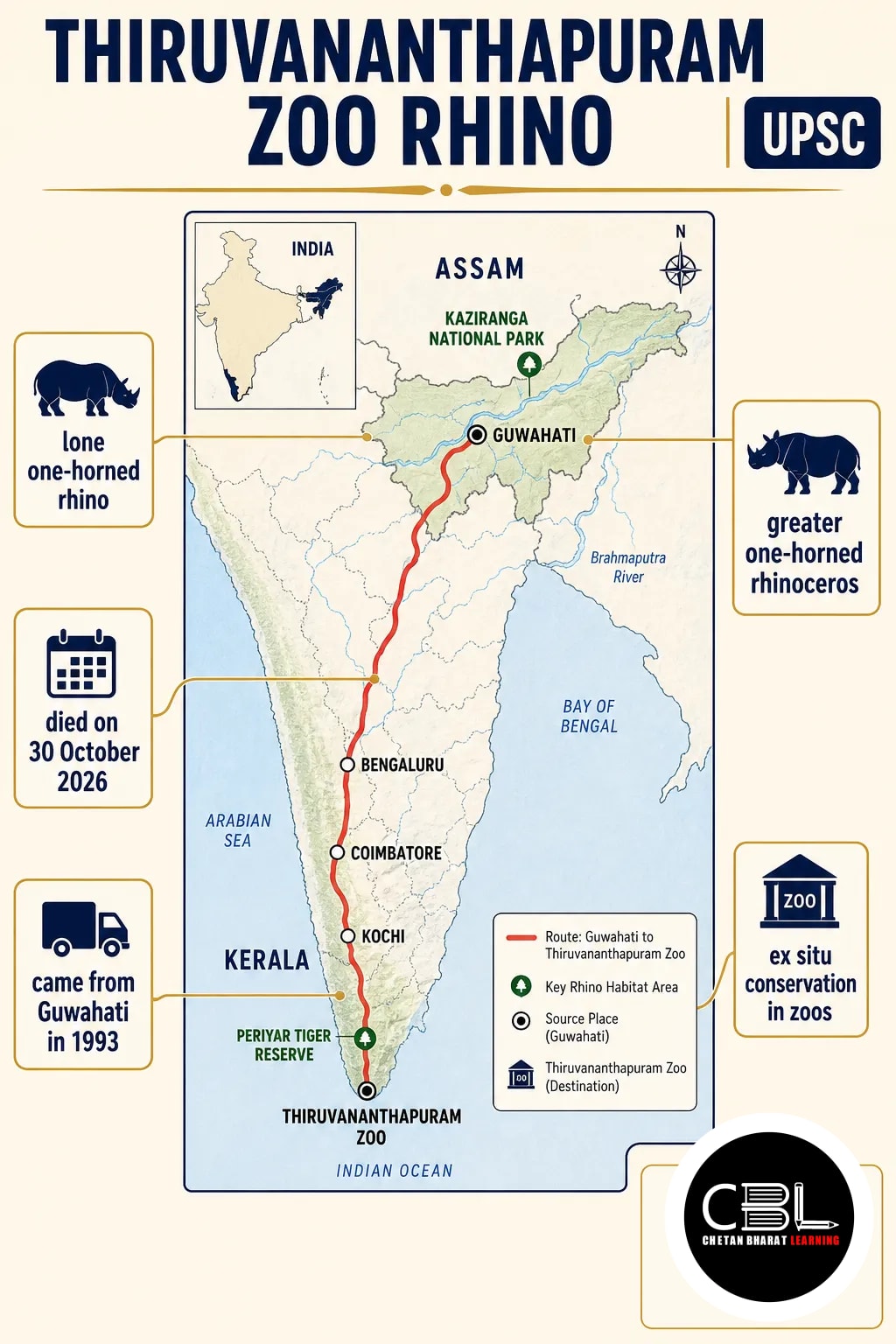
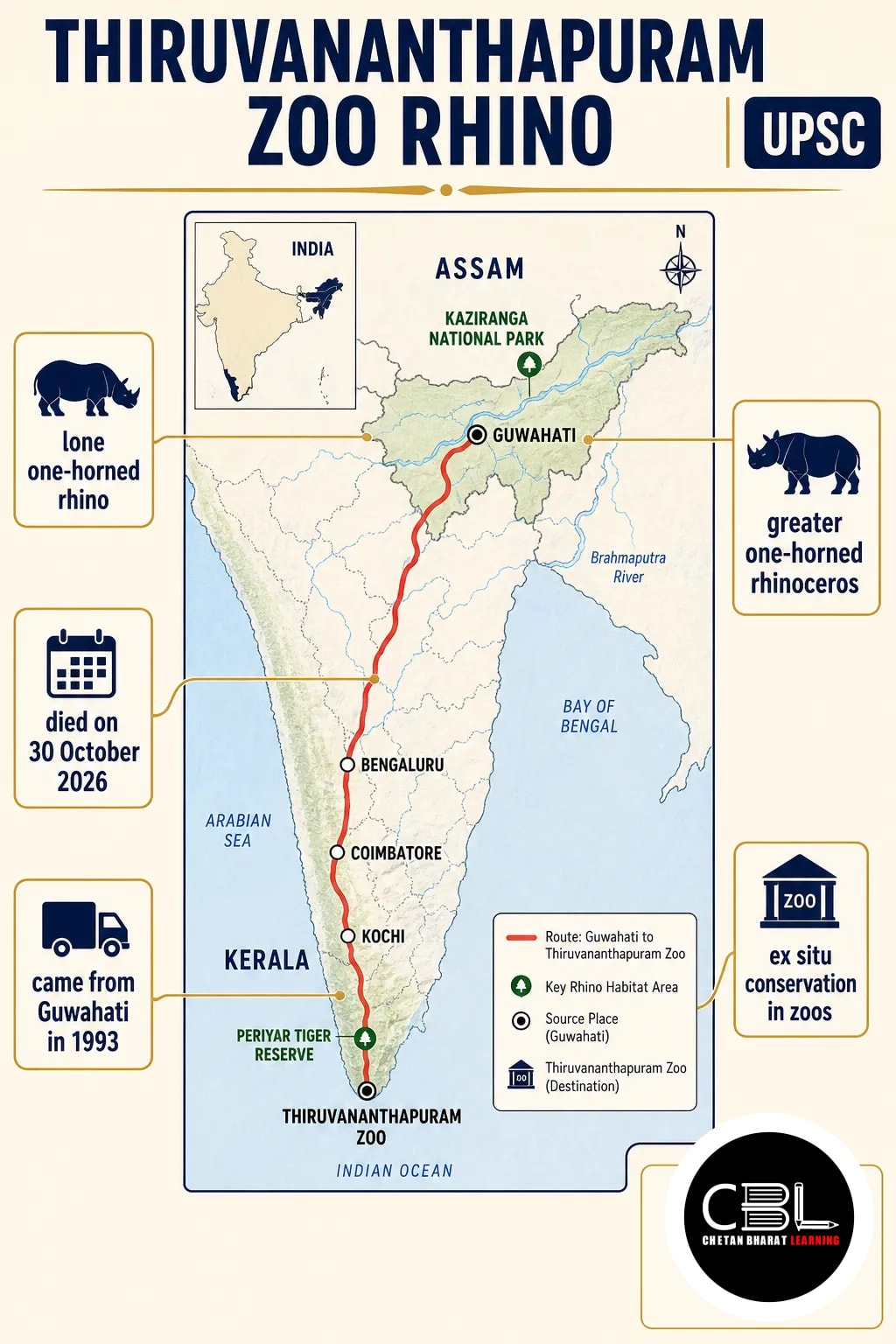
Thiruvananthapuram zoo rhino Jadu died on 30 October 2026 at the age of 39. The news offers an opportunity to revise wildlife conservation and species habitats.
Quick answer: Thiruvananthapuram zoo rhino Jadu, also called Shambhu, died on 30 October 2026 in Kerala. The zoo’s lone one-horned rhino was 39 and had been receiving treatment for age-related ailments. He arrived from Guwahati in Assam in 1993; a post-mortem examination was planned.
What happened to Jadu?
Jadu, the zoo’s lone one-horned rhinoceros, died after receiving treatment for old-age ailments. However, the report said a post-mortem examination was planned; it did not establish a cause of death.
Zoo veterinary surgeon Nikesh Kiran and pathologist Harish of the State Institute for Animal Diseases, Palode, were to lead the examination. The source also notes an average rhinoceros lifespan of around 35–40 years.
Where did the Thiruvananthapuram zoo rhino come from?
Jadu came from the State Zoological Park in Guwahati, Assam, in 1993. The following facts distinguish his journey and the zoo’s earlier rhinos.
| Fact | Details |
|---|---|
| Transfer date | 19 May 1993 |
| Age at transfer | Five years, according to the source |
| Transfer expenditure | ₹6.5 lakh |
| Earlier rhinos | Rita died after being gored by Ramu in 2004; Ramu later died of illness. |
Where does the one-horned rhinoceros live?
The greater one-horned rhinoceros, Rhinoceros unicornis, lives in grasslands and wetlands of the Indian subcontinent. For example, Assam’s Kaziranga National Park supports the species; it also occurs in Nepal’s Terai.
It is a herbivore and has a single horn. Moreover, its habitat includes floodplain grasslands, which make protected areas important for its survival.
Why does the case matter for conservation?
The case illustrates ex situ conservation: protecting wildlife outside its natural habitat. Zoos can support animal care and conservation education; however, they differ from protection in the wild.
In contrast, in situ conservation protects species within their natural habitats, including national parks. The Central Zoo Authority oversees zoo recognition under the Wild Life (Protection) Act, 1972. For Prelims, distinguish its zoo-related role from habitat protection in a national park.
Source: The Hindu, 31 October 2026
State PCS General Studies can test the rhino’s habitat, scientific name and conservation methods. In addition, revise the distinction between zoos and protected natural habitats.
Prelims Practice Corner
Mains Practice Questions
Frequently Asked Questions
What was the name of the Thiruvananthapuram zoo rhino?
Jadu was his name; zoo staff also called him Shambhu. He was the zoo’s lone one-horned rhino.
Where was Jadu brought from?
He came from the State Zoological Park in Guwahati, Assam. The transfer took place on 19 May 1993 and cost ₹6.5 lakh.
Is keeping a rhino in a zoo in situ conservation?
No, because a zoo protects an animal outside its natural habitat and is an example of ex situ conservation. In contrast, protection in a national park is in situ conservation.
Related Current Affairs
Preparing for UPSC, PCS or HCS?
Talk to a mentor at Chetan Bharat Learning, Chandigarh. Free guidance on choosing the right exam and building a study plan.
Chat on WhatsAppCall 97793 53345UPSC / IAS / PCS coaching in Chandigarh · Trusted by aspirants across Punjab & Haryana

 Ananya RanaIAS · AIR 60
 Aditya SharmaIAS · AIR 70
 Ria Kaur SethiIPS · AIR 89
 Aman AloonIRS · AIR 295
 Sumer Singh VirkIRS · AIR 335
 Shivani PanchalIAS

Leave a Reply
You must be logged in to post a comment.