
UPSC Mapping
| Prelims | Polity and IPR |
|---|---|
| Mains | GS Paper 2 (Polity) |
| Nodal Agency | Copyright Office (DPIIT) |
|---|---|
| Governing Law | Copyright Act, 1957 |
| International Treaty | Berne Convention |
Article
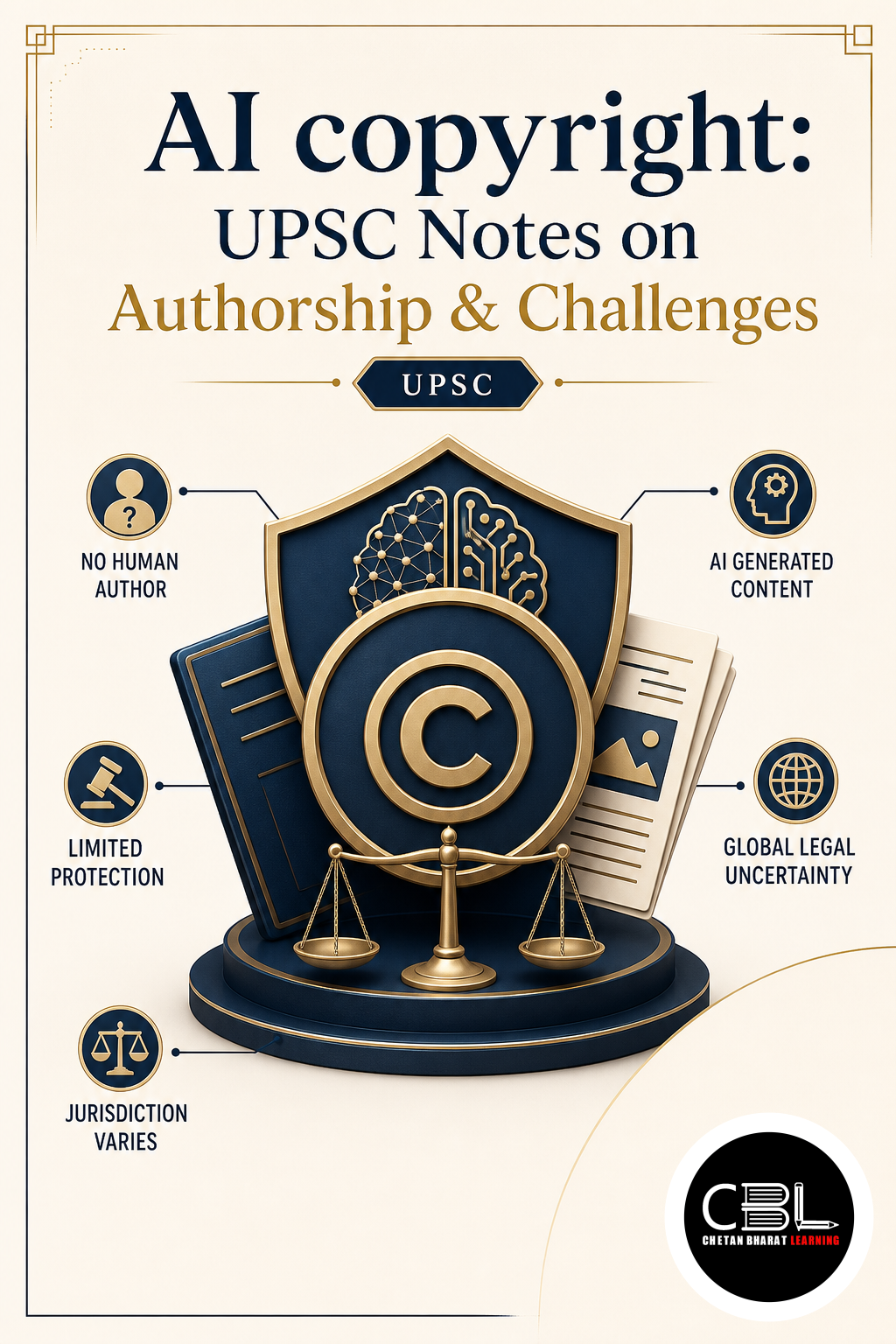
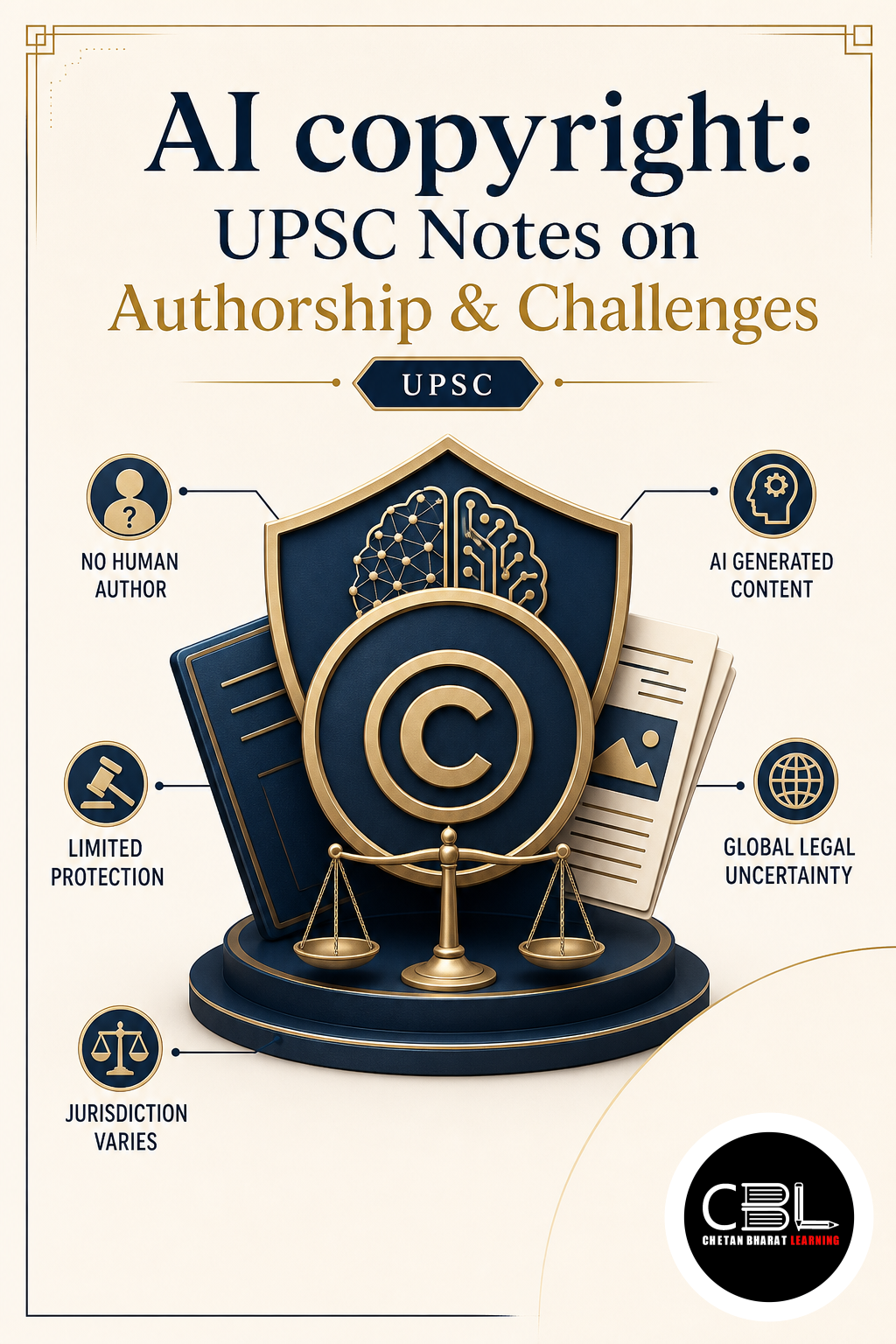
The evolving landscape of AI copyright represents a critical legal challenge for intellectual property regimes. The Indian Copyright Office recently ruled that an AI system cannot be recognized as an author. Aspirants must thoroughly understand this framework for the upcoming civil services examination. You can explore more such vital topics in our daily current affairs archive. This decision marks a definitive stance on autonomous machine authorship. It ensures that creative outputs remain eligible for protection only if attributed to a human.
What is AI copyright?
The concept of AI copyright revolves around the legal ownership of works generated by artificial intelligence. Section 2(d)(vi) of the Copyright Act, 1957, restricts authorship to legally recognized individuals with juridical will. This statutory requirement explicitly disqualifies non-human autonomous systems from holding copyright. The law views AI strictly as an advanced technical tool, legally identical to cameras or software. Therefore, the human creator utilizing the tool remains the sole legitimate author of the final output.
Copyright is established automatically once a work is fixed in a tangible medium of expression. The protection covers the specific expression of an idea, not the underlying idea itself. Literary, dramatic, musical, and artistic works receive protection for the author’s lifetime plus 60 years. Films, sound recordings, and photographs get 60 years from the date of publication. This clear duration provides certainty for creators and investors alike.
Why is AI copyright in News?
The AI copyright debate recently gained prominence following a landmark ruling by the Indian Copyright Office. The office explicitly rejected applications seeking to list an AI system as the sole author of a creative work. You can verify the latest official guidelines and policy positions on the Copyright Office portal. This ruling reinforces the principle that intellectual absence in automated outputs precludes copyright protection. It highlights the legislature’s prerogative to decide on conferring legal personhood to machine entities.
Furthermore, this decision aligns India with global trends that prioritize human creative intent. Critics argue that denying protection forces valuable digital assets into the public domain. However, supporters maintain that protecting human authorship incentivizes genuine artistic innovation. The ruling provides much-needed clarity for developers and creators navigating this emerging technological frontier.
Key Features of AI copyright framework
The current legal framework governing AI copyright incorporates several distinct jurisprudential dimensions.
- Statutory Human Requirement: Only legally recognized individuals with juridical will can claim authorship under existing laws.
- Instrumental Equivalence: The law treats AI as a mere instrument, similar to a camera or word processor.
- Human Attribution: Creative outputs remain eligible for protection if a human claims authorship and demonstrates creative intent.
- Automatic Protection: Copyright is established automatically once a work is fixed in a tangible medium of expression.
- International Alignment: As a Berne Convention signatory, India ensures reciprocal protection for Indian works across 182 member states.
This comprehensive structure ensures that various stakeholders can leverage intellectual property laws effectively. The emphasis on human attribution distinguishes it from purely machine-centric legal theories. By empowering human creators, the policy fosters genuine artistic innovation. The institutional framework relies heavily on the Copyright Office under the Ministry of Commerce and Industry. This agency coordinates complex bilateral engagements to ensure consistent messaging across all international IP forums.
Challenges in AI copyright regulation
Despite clear rulings, the AI copyright landscape faces several structural and operational hurdles requiring immediate legislative attention.
- Originality Disconnect: Complex neural networks generate highly original variations that are unmapped and unexpected by the original human programmer.
- Liability Void: An AI system lacks the legal personhood required to incur infringement liability or transfer enforceable property rights.
- Incentive Maximization: Denying protection to machine-generated outputs might discourage private investment in developing advanced creative technologies.
- Public Domain Risks: Valuable, commercially viable digital assets might fall into an unprotected, easily exploitable public domain.
- Regulatory Lag: Existing statutes drafted decades ago struggle to address the nuances of modern autonomous generative models.
Addressing these bottlenecks is crucial for the long-term credibility and growth of the innovation ecosystem. Aspirants can study related governance issues in our polity current affairs updates. Policymakers must remain vigilant against the unchecked exploitation of digital assets. The verification of human creative input requires robust, transparent auditing mechanisms. Introducing strict quality control norms will help alleviate some of these operational difficulties significantly.
Way Forward
To address the complexities of AI copyright, policymakers must consider introducing a sui-generis protection category. This separate, limited machine-authorship framework could bridge the regulatory gap between traditional human creation and modern autonomy. Strengthening the technical capabilities of the Copyright Office will also ensure efficient processing of hybrid human-AI applications. The government must actively promote indigenous AI capability while simultaneously strengthening intellectual property safeguards.
Additionally, international cooperation is vital to establish universal standards for AI-generated content. Policymakers should establish clear guidelines to mandate transparent reporting of AI involvement in creative workflows. For detailed legislative analysis on intellectual property reforms, refer to the PRS Legislative Research database. A robust, transparent, and inclusive system will ultimately drive India’s innovation ecosystem forward. Continuous academic research will further refine the operational guidelines for digital authorship.
Prelims Practice Corner
Q1. With reference to AI copyright in India, consider the following statements:
- The Copyright Act, 1957, allows AI systems to be recognized as authors.
- Copyright is established automatically once a work is fixed in a tangible medium.
- The Copyright Office operates under the Ministry of Commerce and Industry.
Which of the statements given above is/are correct? (a) 1 only (b) 2 and 3 only (c) 1 and 3 only (d) 1, 2 and 3
Answer: (b) Statement 1 is incorrect because autonomous machine authorship is explicitly rejected.
Q2. Under the Copyright Act, 1957, what is the duration of protection for literary and artistic works?
(a) 60 years from publication (b) Author’s lifetime plus 60 years (c) 50 years from creation (d) Author’s lifetime plus 70 years
Answer: (b) Literary, dramatic, musical, and artistic works are protected for the author’s lifetime plus 60 years.
Q3. Which international treaty ensures that works created in India receive automatic legal protection across member states?
(a) TRIPS Agreement (b) Madrid Protocol (c) Berne Convention (d) Paris Convention
Answer: (c) As a signatory to the Berne Convention, Indian works receive protection across 182 member states.
Q4. The Indian Copyright Office recently rejected AI authorship primarily because:
(a) AI systems are too expensive to regulate (b) Automated outputs lack human consciousness and deliberate creative intent (c) The technology is not yet advanced enough (d) International laws mandate a ban on AI copyright
Answer: (b) The ruling cited the intellectual absence and lack of deliberate creative intent in automated outputs.
Q5. Consider the following arguments in favor of AI authorship: 1. Incentive maximization 2. Unpredictable expression 3. Sui-generis protection. Which of the above are correct?
(a) 1 and 2 only (b) 2 and 3 only (c) 1 and 3 only (d) 1, 2 and 3
Answer: (d) All three are valid arguments frequently cited in favor of granting some form of protection to AI-generated works.
Mains Practice Questions
Q1. Discuss the legal challenges posed by AI-generated content to the existing copyright framework in India. (150 words, 10 marks)
Intro: Define the core conflict between autonomous AI generation and the human-centric Copyright Act, 1957.
Body: Discuss challenges (originality disconnect, liability void, incentive maximization, public domain risks, regulatory lag).
Conclusion: Suggest a way forward focusing on sui-generis protection and updated statutory frameworks.
Q2. The refusal to grant copyright to AI systems may hinder technological innovation. Critically analyze this statement and suggest a balanced way forward. (250 words, 15 marks)
Intro: Contextualize the tension between protecting human authorship and fostering rapid AI development.
Body: Analyze the innovation argument (incentive maximization, unpredictable expression) versus the traditional copyright rationale (juridical will, liability, instrumental equivalence). Discuss the need for a balanced approach.
Conclusion: Conclude that introducing a limited sui-generis category could bridge the regulatory gap without compromising human-centric IP principles.
FAQs on AI copyright
Can an AI system be listed as the author of a work in India?
No, the Indian Copyright Office has ruled that AI systems cannot be recognized as authors, as the law requires a human with juridical will.
How long does copyright protection last for films and sound recordings in India?
Films, sound recordings, and photographs receive copyright protection for 60 years from the date of publication.
What is the role of the Berne Convention in Indian copyright law?
As a signatory, India ensures that works created by Indian authors receive automatic legal protection in all 182 member states of the convention.
Related Current Affairs
Preparing for UPSC, PCS or HCS?
Talk to a mentor at Chetan Bharat Learning, Chandigarh. Free guidance on choosing the right exam and building a study plan.
Chat on WhatsAppCall 97793 53345UPSC / IAS / PCS coaching in Chandigarh · Trusted by aspirants across Punjab & Haryana
Leave a Reply
You must be logged in to post a comment.